
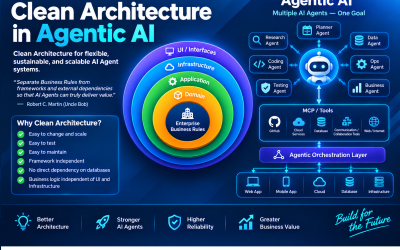
As enterprises move from traditional AI assistants to Agentic AI systems, the complexity of AI applications increases significantly.
An enterprise AI platform is no longer just an LLM connected to a chatbot interface. It involves:
- Multiple AI agents
- Complex business workflows
- Enterprise knowledge
- External tools and APIs
- Decision-making processes
- Human approval systems
- Data governance requirements
Without a strong design methodology, AI systems can quickly become difficult to scale, maintain, and align with business objectives.
This is where Domain-Driven Design (DDD) becomes essential.
DDD provides a strategic approach to designing Agentic AI systems around business capabilities and domain knowledge, ensuring that AI agents solve real business problems instead of becoming isolated technical components.
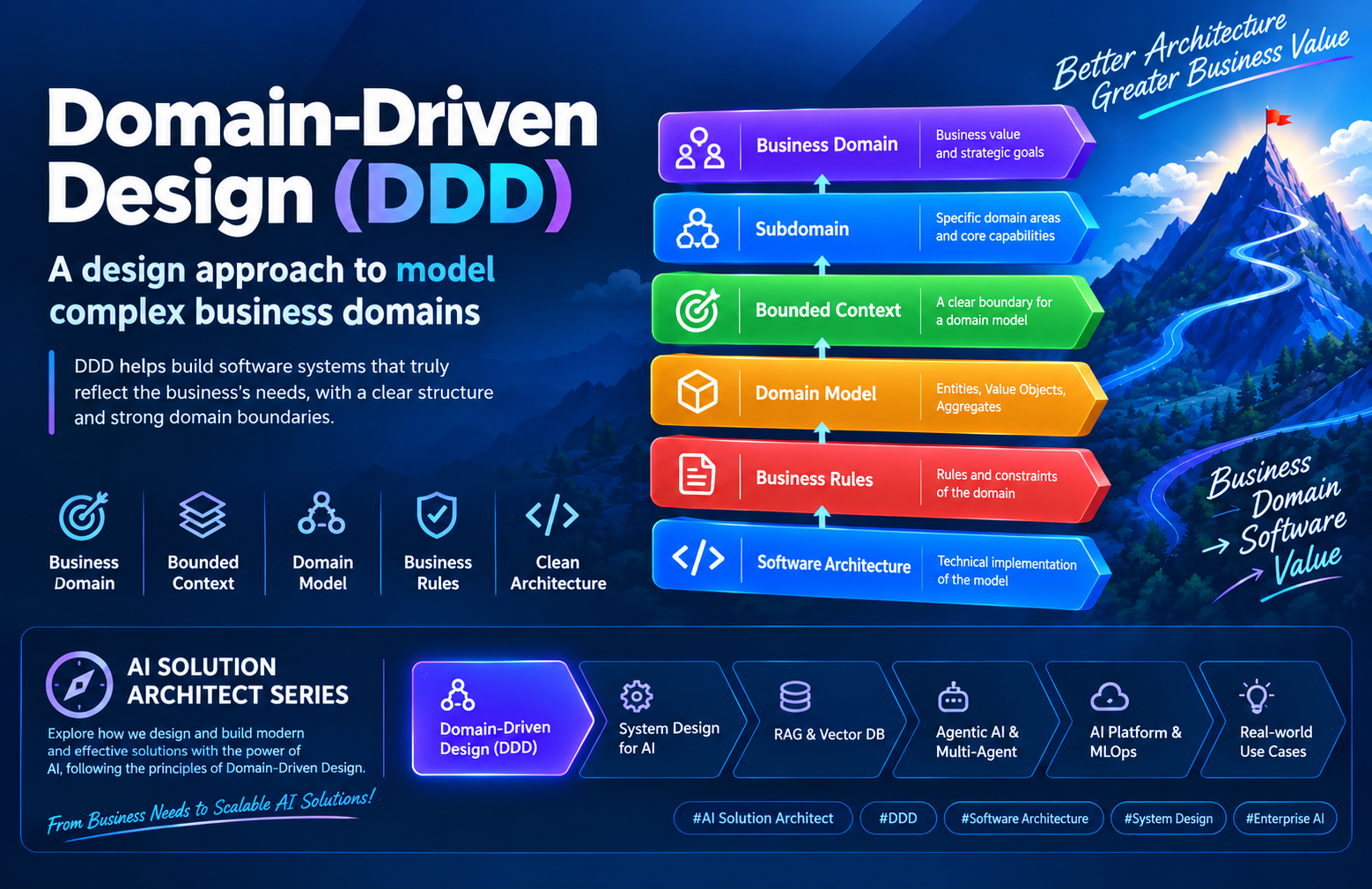
What Is Domain-Driven Design (DDD)?
Domain-Driven Design is a software design methodology introduced by Eric Evans that focuses on creating software around the core business domain.
The fundamental principle of DDD is:
“The architecture should reflect the business, not the technology.”
Instead of organizing systems around technical layers:
Controller
Database
API
Service
DDD organizes systems around business capabilities:
Sales Domain
Finance Domain
Customer Service Domain
Supply Chain Domain
Human Resources Domain
This approach creates software that closely matches how the organization operates.
Why DDD Matters for Agentic AI
Traditional AI applications are often technology-driven:
User
 │
Chatbot
 │
LLM
 │
Database
Agentic AI requires a different mindset.
AI agents need to understand:
- Business objectives
- Domain rules
- Roles and responsibilities
- Decision boundaries
- Data ownership
For example:
A customer support AI system should not simply be:
Customer Support Agent
A better DDD approach defines specialized domains:
Customer Service Domain

├── Customer Inquiry Agent
├── Complaint Resolution Agent
├── Refund Agent
├── Knowledge Agent
└── Escalation Agent
Each agent represents a specific business capability.
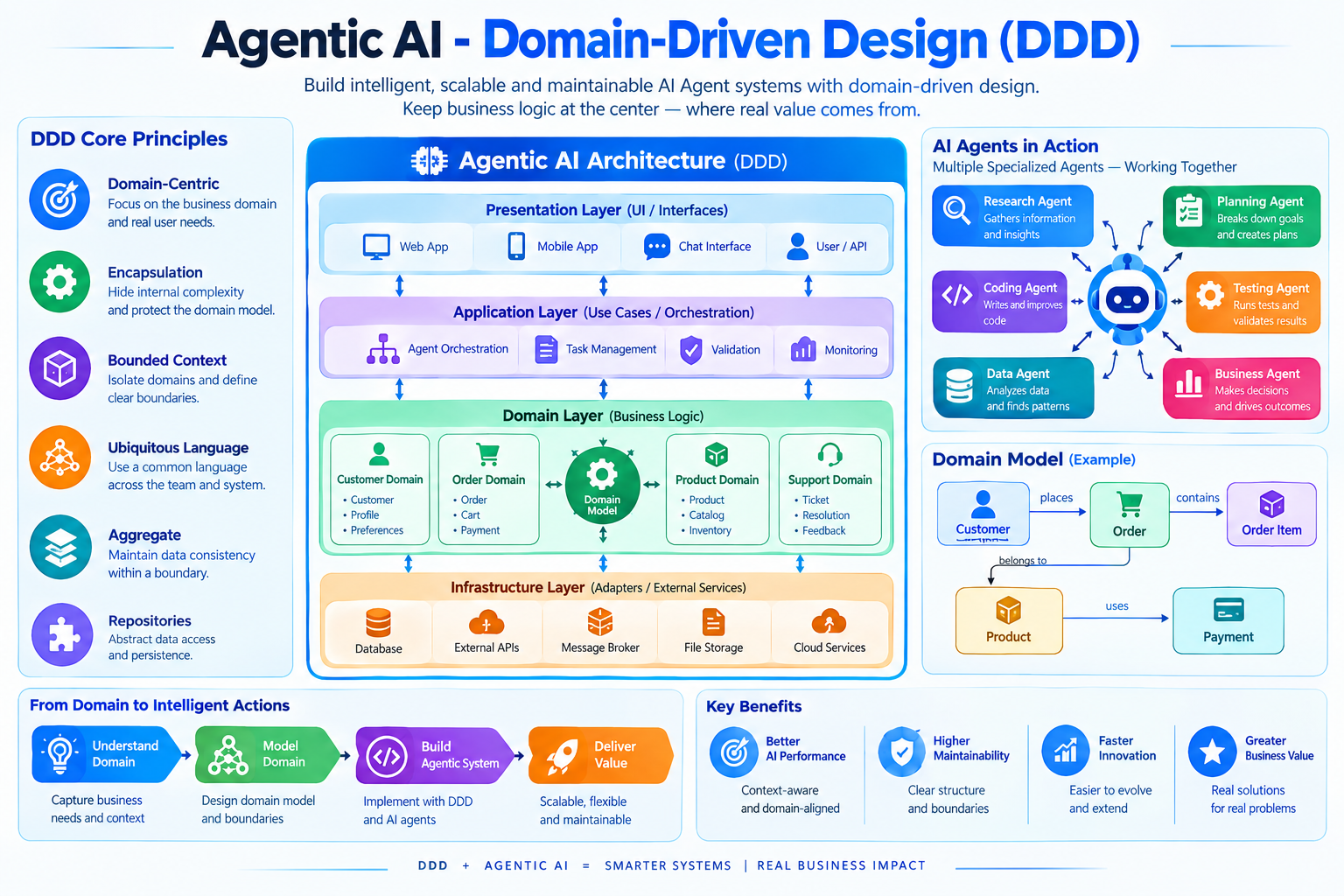
Core DDD Concepts Applied to Agentic AI
1. Bounded Contexts
The most important DDD concept is the Bounded Context.
A bounded context defines a clear boundary where:
- Business rules are consistent.
- Data ownership is defined.
- Agents have specific responsibilities.
In Agentic AI:
Enterprise AI Platform

 ┌───────────────────────┐
 │ Sales Context         │
 │                       │
 │ Sales Agent           │
 │ Forecast Agent        │
 │ Pricing Agent         │
 └───────────────────────┘


 ┌───────────────────────┐
 │ Finance Context       │
 │                       │
 │ Audit Agent           │
 │ Payment Agent         │
 │ Risk Agent            │
 └───────────────────────┘


 ┌───────────────────────┐
 │ HR Context            │
 │                       │
 │ Recruitment Agent     │
 │ Policy Agent          │
 │ Training Agent        │
 └───────────────────────┘
Each AI agent operates within its business boundary instead of trying to understand the entire enterprise.
2. Domain Agents
In Agentic AI, a domain agent is an AI capability specialized in a specific business area.
Example:
Finance Agent
Responsibilities:
- Analyze financial transactions
- Detect anomalies
- Apply accounting rules
- Generate financial reports
It should not:
- Manage customer complaints
- Create marketing campaigns
- Modify HR policies
DDD prevents AI agents from becoming overly broad “general assistants” with unclear responsibilities.
3. Domain Models
A domain model represents important business concepts.
For example:
A banking AI system may have:
Customer

Account

Transaction

Loan

Risk Score

Approval Policy
The AI agent uses these concepts to reason about business decisions.
Instead of asking:
“Analyze this data.”
The agent understands:
“Evaluate whether this loan application satisfies the organization's lending policy.”
4. Ubiquitous Language
DDD introduces the concept of Ubiquitous Language:
A shared vocabulary between:
- Business experts
- Developers
- AI systems
- Users
For Agentic AI, this becomes extremely important because AI agents need accurate business terminology.
Example:
A company defines:
“Qualified Lead”
as:
- Company size > 100 employees
- Budget confirmed
- Decision maker identified
- Purchase timeline within 90 days
The Sales Agent should use this exact definition.
DDD reduces ambiguity in AI reasoning.
5. Domain Events
Domain Events describe important business occurrences.
Examples:
CustomerRegistered

OrderApproved

PaymentCompleted

ContractSigned

EmployeePromoted
These events can trigger AI agent actions.
Example:
Contract Signed

       ↓

Legal Agent reviews compliance

       ↓

Finance Agent creates invoice

       ↓

Customer Success Agent prepares onboarding
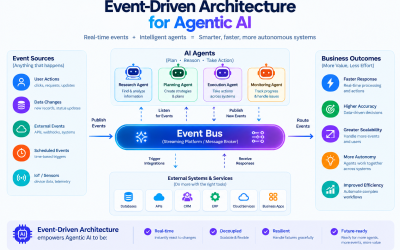
DDD combined with Event-Driven Architecture creates highly autonomous enterprise workflows.
DDD Architecture for Agentic AI
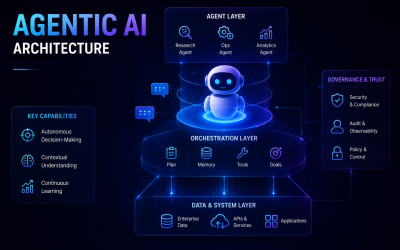
A typical architecture:
                 User

                  │

          AI Experience Layer

                  │

          Agent Orchestration

                  │

 ┌────────────────────────────────┐
 │        Domain Layer            │
 │                                │
 │ Sales Agent                    │
 │ Finance Agent                  │
 │ Customer Agent                 │
 │ HR Agent                       │
 └────────────────────────────────┘

                  │

          Domain Events

                  │

 ┌────────────────────────────────┐
 │ Infrastructure Layer            │
 │                                │
 │ LLM APIs                       │
 │ Vector Database                │
 │ External Systems               │
 │ Enterprise Applications        │
 └────────────────────────────────┘
The business domain controls AI behavior, while infrastructure supports execution.
Benefits of DDD for Agentic AI
1. Better AI Accuracy
Agents understand specific business contexts instead of receiving generic instructions.
Result:
- Better reasoning
- More relevant responses
- Fewer hallucinations
2. Clear Agent Responsibilities
DDD prevents creating massive AI agents that handle everything.
Instead:
Bad design:
Enterprise Super Agent
Better design:
Sales Agent
Finance Agent
HR Agent
Support Agent
Each agent has a clear mission.
3. Easier Scaling
When business requirements grow, new domains can be added independently.
Example:
Adding a Procurement AI system:
Procurement Context

├── Vendor Agent
├── Purchase Agent
├── Contract Agent
└── Compliance Agent
No need to redesign the entire platform.
4. Improved Governance
DDD creates natural boundaries for:
- Data access
- Security policies
- AI permissions
- Compliance controls
A Finance Agent cannot automatically access HR confidential data unless explicitly authorized.
5. Better Human-AI Collaboration
Because agents are aligned with business functions, employees understand:
- What each agent does.
- When to trust it.
- When human approval is required.
DDD vs Traditional AI Design
| Aspect | Traditional AI Design | DDD for Agentic AI |
|---|---|---|
| Organization | Technology-based | Business-based |
| Agent Design | Generic assistant | Domain specialist |
| Knowledge | General data | Domain knowledge |
| Responsibility | Broad | Clearly bounded |
| Scaling | Technical scaling | Business capability scaling |
| Governance | Difficult | Built into boundaries |
Combining DDD with Other Agentic AI Architectures
A mature enterprise Agentic AI platform often combines:
              Domain-Driven Design

                      │

        ┌─────────────┴─────────────┐

 Clean Architecture          Event-Driven Architecture

                      │

              Multi-Agent System

                      │

              Microservices
DDD defines what agents should do.
Clean Architecture defines how the system is structured.
Event-Driven Architecture defines how agents communicate.
Microservices define how the system scales.
When Should Organizations Apply DDD?
DDD is especially valuable when:
- Building enterprise Agentic AI platforms.
- Multiple business departments use AI.
- Business rules are complex.
- Compliance requirements are high.
- Many AI agents collaborate.
- Long-term scalability is required.
For simple AI assistants, DDD may be unnecessary. But for enterprise-scale Agentic AI, it becomes a strategic foundation.
Conclusion
Domain-Driven Design provides a powerful framework for building enterprise Agentic AI systems that are aligned with real business operations.
Instead of creating generic AI assistants, organizations can build specialized AI agents that understand specific domains, follow business rules, and collaborate through well-defined boundaries.
DDD transforms Agentic AI from a collection of AI tools into a structured intelligent ecosystem where technology serves business objectives.
As enterprises move toward autonomous workflows, Domain-Driven Design will become a critical architecture principle for creating scalable, trustworthy, and business-aligned AI systems.
Write Your Review
No reviews yet. Be the first to share your experience!