
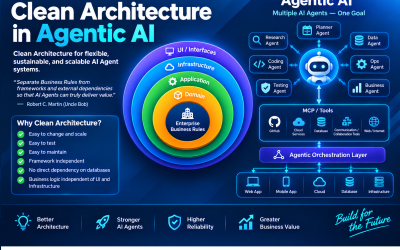
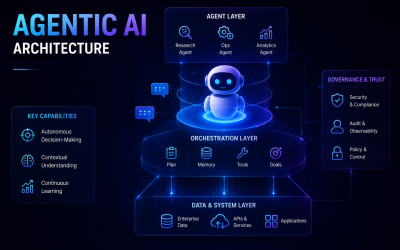
As Agentic AI evolves from simple chatbots into autonomous systems capable of planning, reasoning, and executing complex workflows, software architecture becomes just as important as the AI models themselves.
Traditional request-response architectures work well for straightforward applications, but they quickly become a bottleneck when multiple AI agents need to collaborate asynchronously.
This is where Event-Driven Architecture (EDA) becomes a powerful design pattern.
Instead of directly calling one another through APIs, AI agents communicate by publishing and subscribing to events. The result is a system that is more scalable, resilient, and adaptable to complex business processes.
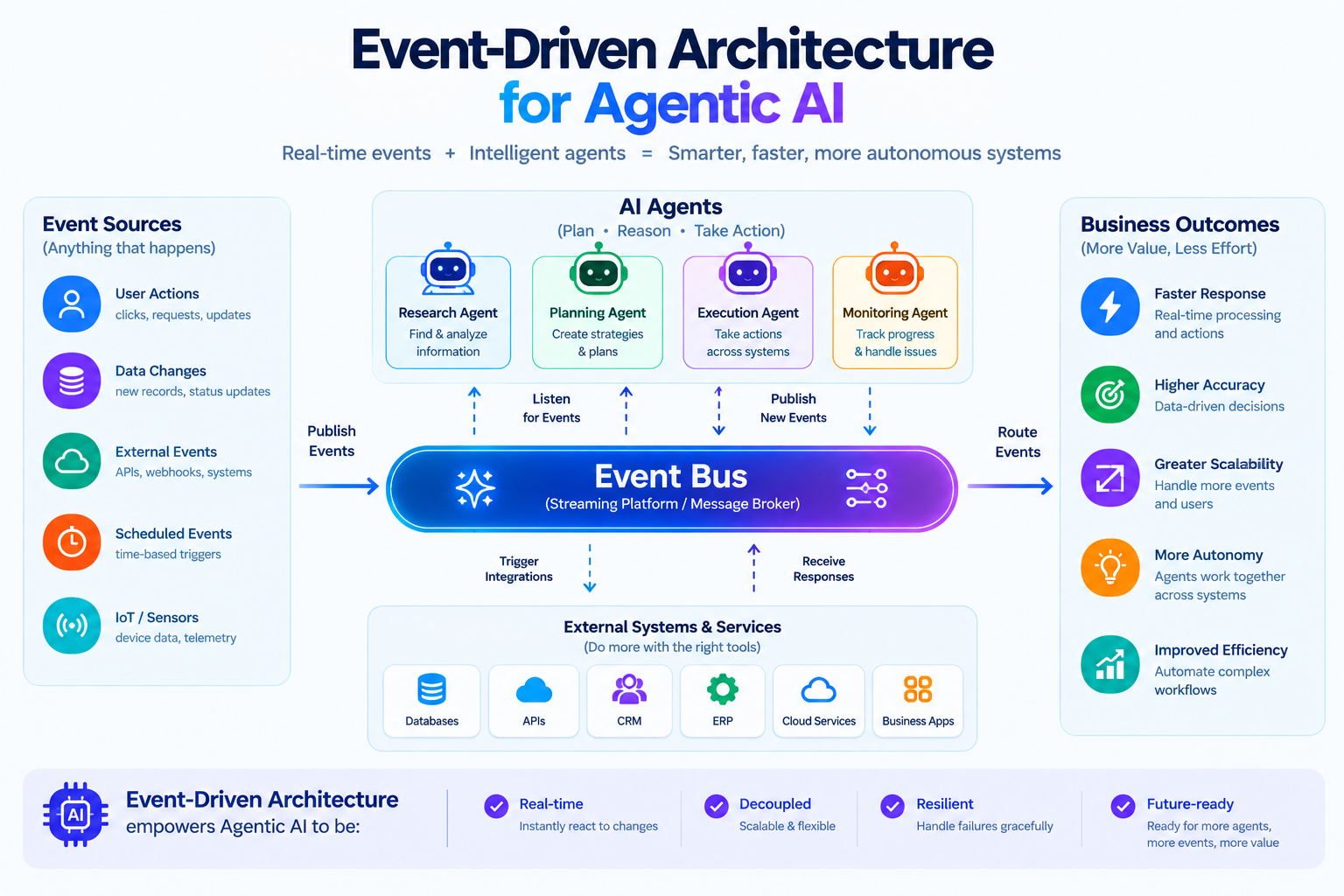
What Is Event-Driven Architecture?
Event-Driven Architecture is a software design approach where components communicate by exchanging events.
An event represents something that has happened within the system, such as:
- Customer Created
- Payment Approved
- Document Uploaded
- Report Generated
- AI Task Completed
- Human Approval Received
Rather than waiting for synchronous API responses, services simply react whenever relevant events occur.
A central Event Broker (such as Apache Kafka, RabbitMQ, Amazon EventBridge, or Azure Event Grid) distributes these events to interested consumers.
Why Agentic AI Needs Event-Driven Architecture
Unlike traditional applications, Agentic AI systems rarely execute a single linear process.
Instead, they involve multiple specialized agents collaborating on long-running tasks.
For example:
A user requests:
“Analyze our quarterly sales, identify key risks, prepare a PowerPoint presentation, and email it to the executive team.”
Instead of one agent doing everything, the workflow could involve:
- Planner Agent
- Data Retrieval Agent
- Analytics Agent
- Report Generation Agent
- Presentation Agent
- Email Agent
Each agent completes its task independently and publishes an event when finished.
The next agent automatically starts after receiving the corresponding event.
This creates a flexible, loosely coupled workflow without requiring every agent to know about the others.
Typical Event Flow
User Request
      │
      ▼
Planner Agent
      │
Publish: AnalysisRequested
      ▼
Event Broker
      │
      ├────────► Data Agent
      │             │
      │             ▼
      │     Publish: DataReady
      │
      ├────────► Analytics Agent
      │             │
      │             ▼
      │     Publish: AnalysisCompleted
      │
      ├────────► Report Agent
      │             │
      │             ▼
      │     Publish: ReportGenerated
      │
      └────────► Email Agent
                    │
                    ▼
            Publish: EmailSent
Each agent focuses solely on its own responsibility and remains unaware of how other agents are implemented.
Benefits of Event-Driven Architecture
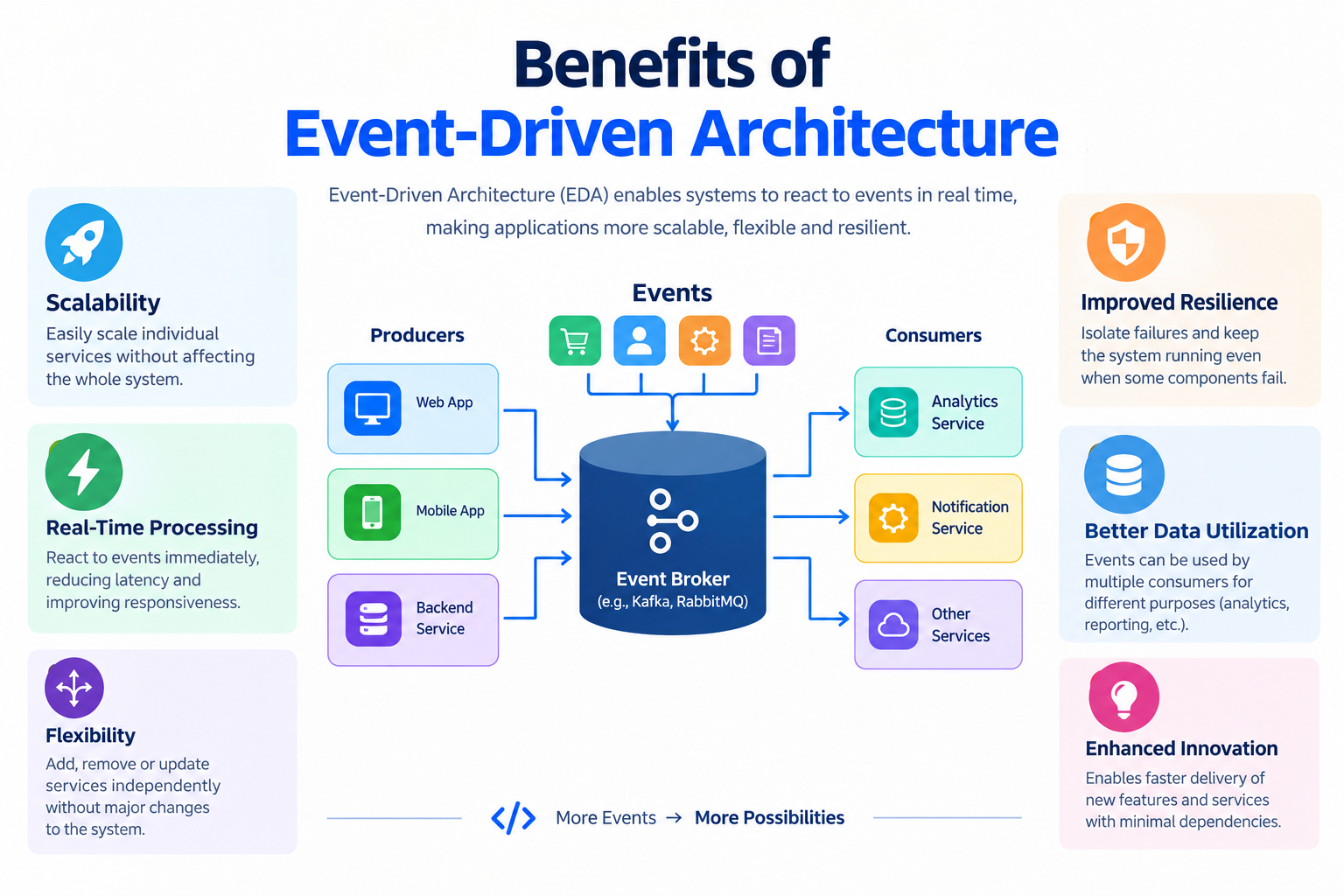
1. Loose Coupling
Agents communicate through events rather than direct API calls.
This means:
- Agents can evolve independently.
- Services can be replaced without impacting others.
- New agents can be introduced with minimal changes.
2. Better Scalability
If one agent becomes a bottleneck—for example, a document processing agent—it can be scaled independently.
The rest of the system continues operating normally.
This makes Event-Driven Architecture ideal for enterprise AI workloads.
3. Improved Reliability
Events can be stored in durable message brokers.
If an agent becomes temporarily unavailable, the event remains in the queue until processing resumes.
Unlike synchronous APIs, failures do not necessarily interrupt the entire workflow.
4. Parallel Execution
Multiple agents can consume the same event simultaneously.
For example:
After a report is generated:
- A Translation Agent creates multilingual versions.
- A Compliance Agent validates regulatory requirements.
- A Notification Agent alerts stakeholders.
- A Knowledge Base Agent archives the report.
All of these tasks can execute concurrently.
5. Easier Integration
Many enterprise platforms already generate business events.
Examples include:
- CRM systems
- ERP platforms
- E-commerce applications
- HR systems
- IoT devices
- Cloud services
Agentic AI can simply subscribe to these existing events rather than relying on tightly integrated APIs.
Challenges of Event-Driven AI Systems
While powerful, Event-Driven Architecture introduces additional complexity.
Common challenges include:
- Event ordering
- Duplicate event handling
- Idempotent processing
- Event versioning
- Distributed tracing
- Dead-letter queues
- Monitoring asynchronous workflows
These concerns require robust engineering practices and operational tooling.
Best Practices
Successful enterprise Agentic AI platforms typically follow these principles:
- Keep events immutable.
- Design agents to be stateless whenever possible.
- Ensure event handlers are idempotent.
- Use correlation IDs to trace end-to-end workflows.
- Implement retry mechanisms with exponential backoff.
- Route failed events to dead-letter queues.
- Standardize event schemas across the organization.
- Monitor event latency and processing times.
These practices improve reliability and simplify troubleshooting as systems scale.
When Should You Choose Event-Driven Architecture?
Event-Driven Architecture is an excellent choice when:
- Multiple AI agents collaborate asynchronously.
- Workflows involve long-running tasks.
- High scalability is required.
- Systems integrate with numerous enterprise applications.
- Business processes span multiple domains.
- Reliability and fault tolerance are critical.
For small proofs of concept or simple AI assistants, a modular monolith with synchronous communication is often sufficient. As the platform grows, introducing an event-driven backbone provides greater flexibility and scalability.
Conclusion
Agentic AI is shifting enterprise software from request-response interactions toward autonomous, collaborative systems.
To support this evolution, Event-Driven Architecture provides a strong foundation by enabling AI agents to communicate through events rather than direct dependencies.
The result is an architecture that is more scalable, resilient, loosely coupled, and capable of supporting complex business workflows.
Rather than treating AI agents as isolated services, organizations should view them as event-driven participants within a larger intelligent ecosystem. As enterprises adopt increasingly sophisticated AI solutions, Event-Driven Architecture will become a key enabler for building robust and future-ready Agentic AI platforms.
Write Your Review
No reviews yet. Be the first to share your experience!