
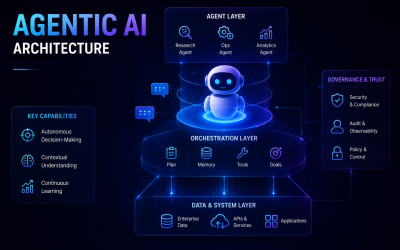
As Agentic AI systems become more sophisticated, software architecture plays a critical role in ensuring scalability, maintainability, security, and long-term evolution.
Unlike traditional AI applications that simply send prompts to Large Language Models (LLMs), Agentic AI systems involve multiple intelligent components:
- AI Agents
- Planning Engines
- LLM Providers
- Memory Systems
- Retrieval-Augmented Generation (RAG)
- External Tools
- APIs
- Business Workflows
- Human Approval Processes
Without a strong architectural foundation, Agentic AI platforms can quickly become difficult to maintain, tightly coupled, and expensive to evolve.
This is where Clean Architecture becomes a powerful design approach.
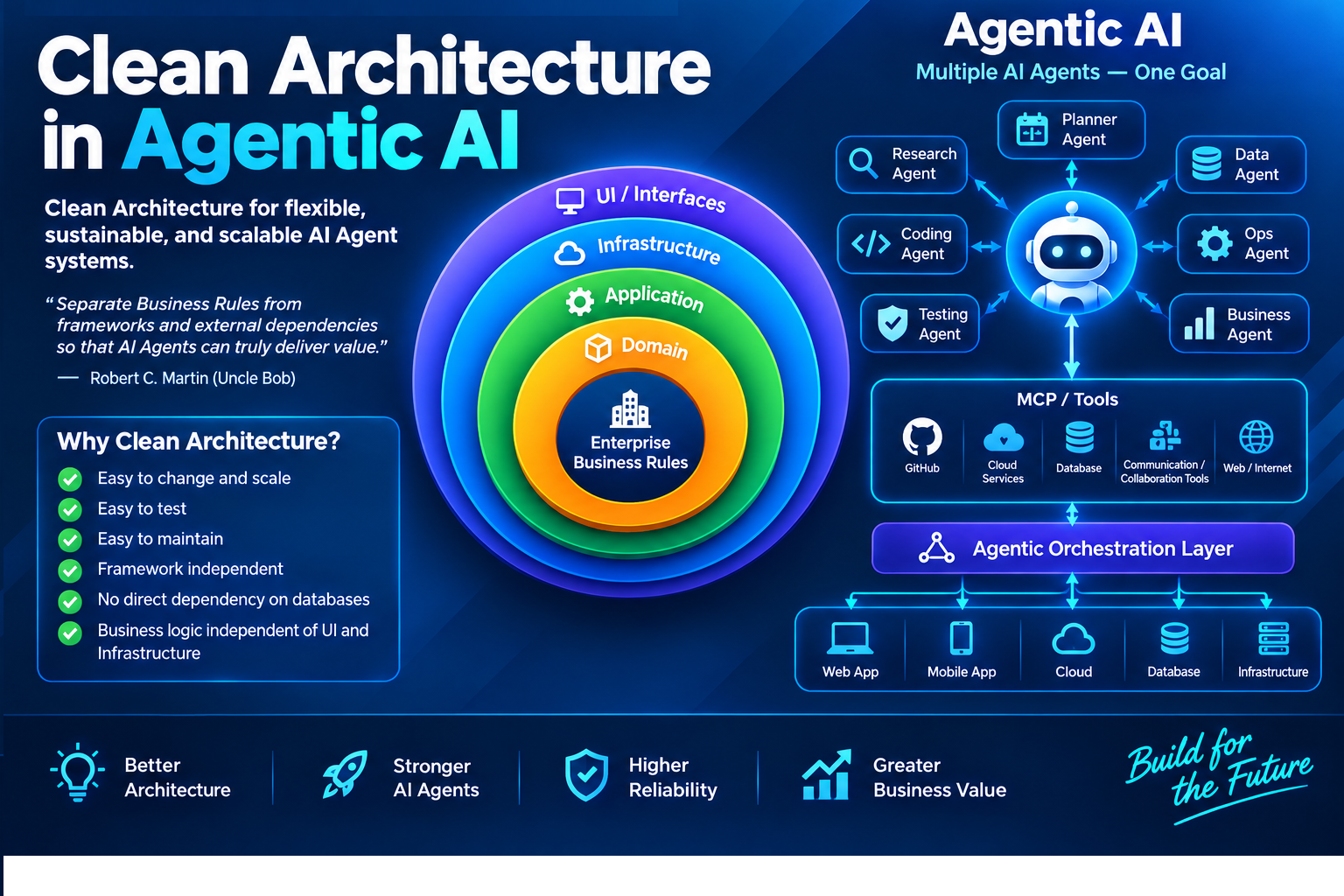
Clean Architecture helps separate business intelligence from technical implementation, allowing AI systems to change models, tools, databases, and infrastructure without rewriting core logic.
What Is Clean Architecture?
Clean Architecture is a software design principle introduced by Robert C. Martin (Uncle Bob) that focuses on:
- Separation of concerns
- Dependency independence
- Business logic isolation
- Testability
- Long-term maintainability
The central idea is:
“Business rules should not depend on external technologies.”
The architecture is organized into layers, where dependencies always point inward toward the core business logic.
A typical Clean Architecture structure:
                External Systems
                       │
                       ▼

        ┌──────────────────────────┐
        │ Frameworks & Infrastructure│
        │ APIs, Databases, LLM APIs │
        └──────────────────────────┘
                       │

        ┌──────────────────────────┐
        │ Interface Adapters       │
        │ Controllers, Gateways    │
        └──────────────────────────┘
                       │

        ┌──────────────────────────┐
        │ Application Layer        │
        │ Use Cases & Workflows    │
        └──────────────────────────┘
                       │

        ┌──────────────────────────┐
        │ Enterprise Core           │
        │ Business Rules            │
        └──────────────────────────┘
The inner layers do not know that the outer layers exist.
Why Clean Architecture Matters for Agentic AI
Agentic AI systems continuously evolve:
- New LLM models appear.
- New AI tools are introduced.
- New memory systems emerge.
- Business workflows change.
- Different AI providers are adopted.
A poorly designed system may become locked into a specific technology.
For example:
Business Logic
       │
       ▼
OpenAI API
       │
       ▼
Application
If the business logic directly depends on a specific LLM provider, changing models becomes expensive.
Clean Architecture creates abstraction layers:
Business Logic

      │

AI Agent Interface

      │

LLM Provider Adapter

      │

OpenAI / Claude / Gemini / Local Model
The AI system can change technology without changing its core intelligence.
Clean Architecture Applied to Agentic AI
A typical Agentic AI implementation can be divided into four major layers.
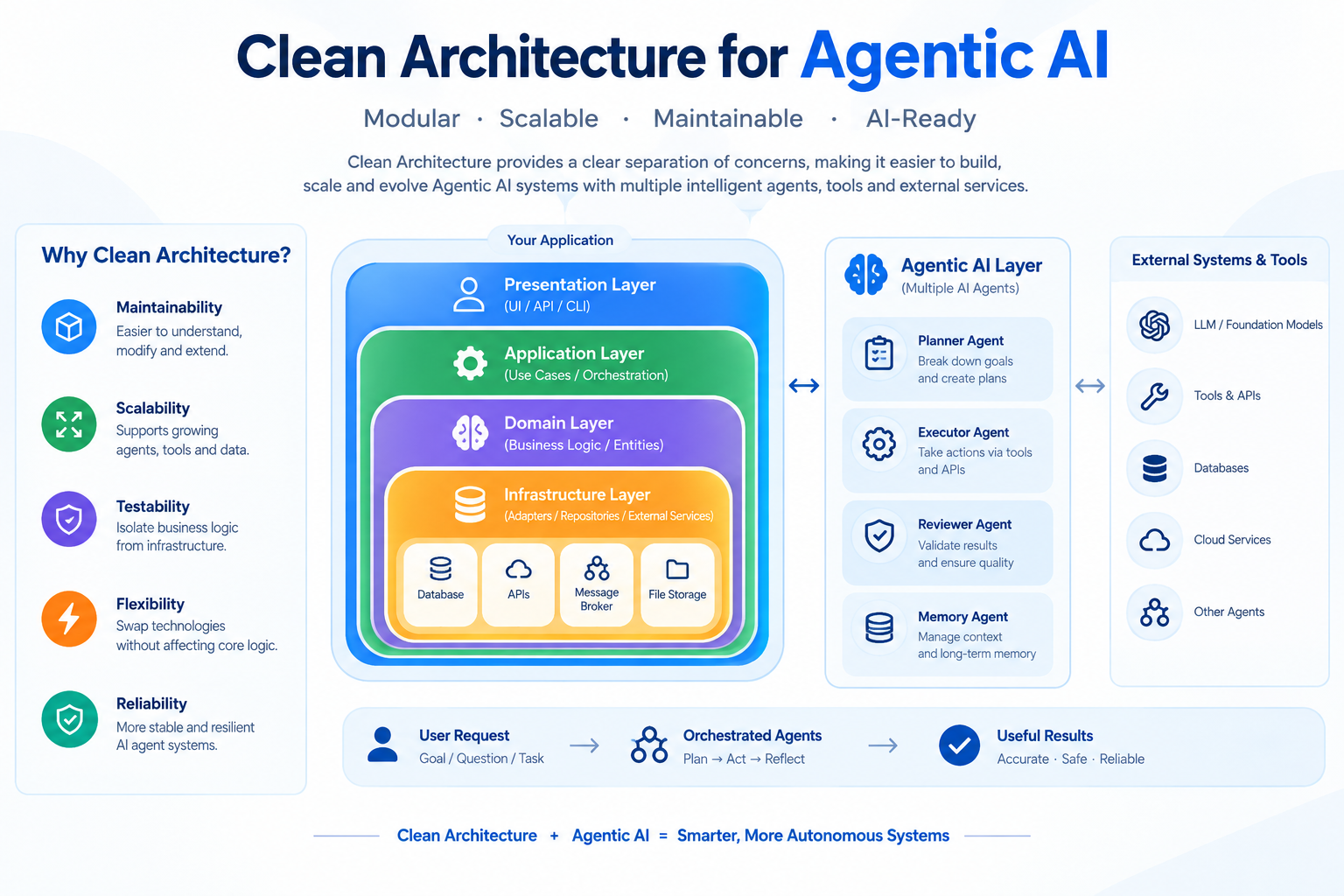
1. Enterprise Layer: AI Business Rules
This is the core intelligence of the organization.
It contains:
- Business policies
- Domain knowledge
- Decision rules
- AI objectives
- Agent responsibilities
Example:
A Finance Agent may have rules:
Approve expense reports only when:

- Amount < $5,000
- Required documents exist
- Compliance rules are satisfied
The business rules should not depend on:
- LLM providers
- Databases
- APIs
- Cloud platforms
2. Application Layer: Agent Workflows
This layer controls how AI agents execute tasks.
It includes:
- Agent orchestration
- Task planning
- Workflow execution
- Human approval flows
- Agent collaboration
Example:
Customer Request

        ↓

Planner Agent

        ↓

Research Agent

        ↓

Analysis Agent

        ↓

Decision Agent

        ↓

Human Approval
The application layer defines what should happen, but not how technologies perform those actions.
3. Interface Adapter Layer: AI Integration
This layer connects business workflows with external capabilities.
Examples:
LLM Adapter
Agent Interface

       ↓

LLM Adapter

       ↓

GPT
Claude
Gemini
Llama
Memory Adapter
Memory Interface

       ↓

Vector Database Adapter

       ↓

Pinecone
Weaviate
Chroma
Milvus
Tool Adapter
Tool Interface

       ↓

External APIs

CRM
ERP
Search
Payment
Email
Adapters allow technologies to be replaced easily.
4. Infrastructure Layer: External Technologies
This is where technical implementations live:
- Cloud services
- Databases
- APIs
- Authentication
- Monitoring
- Message queues
- AI model providers
Examples:
- AWS Bedrock
- Azure AI
- Google Vertex AI
- OpenAI API
- Kubernetes
- PostgreSQL
- Kafka
The infrastructure layer supports the AI system but does not control business decisions.
Example: Enterprise AI Assistant Architecture
A company builds an AI Assistant for employees.
The request:
“Find the latest sales strategy document and summarize the key changes.”
The workflow:
Employee

   │

AI Assistant Interface

   │

Agent Orchestrator

   │

Knowledge Retrieval Use Case

   │

RAG Service

   │

Vector Database Adapter

   │

Document Storage
If the company changes:
- OpenAI → Claude
- Pinecone → Milvus
- AWS → Azure
The core agent logic remains unchanged.
Benefits of Clean Architecture for Agentic AI
1. LLM Independence
Organizations are no longer locked into one AI provider.
They can switch between:
- GPT models
- Claude
- Gemini
- Open-source LLMs
without redesigning the entire platform.
2. Easier Testing
AI behavior can be tested independently.
Examples:
- Test agent decisions without calling real LLM APIs.
- Simulate tool responses.
- Validate workflows automatically.
This improves reliability.
3. Better Security and Governance
Sensitive operations can be controlled centrally.
Examples:
- Permission checking
- Data filtering
- Prompt validation
- Audit logging
- Human approval
AI agents cannot directly access critical systems without passing through controlled interfaces.
4. Faster Innovation
Teams can experiment with:
- New AI models
- New agents
- New tools
- New workflows
without disrupting existing systems.
5. Enterprise Scalability
Clean Architecture works well with:
- Modular Monolith
- Event-Driven Architecture
- Microservices
- Multi-Agent Systems
It becomes the foundation that supports different deployment strategies.
Clean Architecture vs Traditional AI Architecture
| Aspect | Traditional AI Application | Clean Architecture for Agentic AI |
|---|---|---|
| LLM Dependency | Direct integration | Abstracted through interfaces |
| Business Logic | Mixed with AI code | Separated |
| Model Switching | Difficult | Easy |
| Testing | Limited | Comprehensive |
| Scalability | Application-dependent | Architecture-driven |
| Security | Reactive | Built-in governance |
| Long-term Evolution | Expensive | Flexible |
Clean Architecture Combined with Other Agentic AI Patterns
A mature enterprise Agentic AI platform often combines multiple architectural approaches:
                 User

                  │

        Clean Architecture Core

                  │

        Agent Orchestrator

                  │

 ┌──────────┬──────────┬──────────┐

Agent A   Agent B    Agent C

                  │

        Event-Driven Layer

                  │

        Microservices Layer

                  │

 External Systems & AI Models
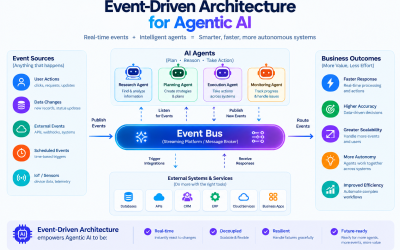
Clean Architecture becomes the foundation, while:
- Event-Driven Architecture enables communication.
- Microservices enable scaling.
- RAG provides knowledge access.
- MCP enables tool integration.
Conclusion
Clean Architecture provides a strong foundation for building reliable and future-ready Agentic AI systems.
As AI platforms evolve, organizations need architectures that allow them to:
- Replace models easily.
- Add new agents quickly.
- Integrate new tools safely.
- Maintain business logic independently.
- Scale from prototypes to enterprise platforms.
Rather than building AI systems tightly coupled to specific models or technologies, Clean Architecture creates a flexible foundation where intelligence, business processes, and infrastructure can evolve independently.
For enterprise Agentic AI, Clean Architecture is not just a software pattern—it is a strategy for building AI systems that can survive rapid technological change.
Write Your Review
No reviews yet. Be the first to share your experience!