
As organizations adopt Agentic AI at scale, connecting applications directly to Large Language Models (LLMs) quickly becomes difficult to manage.
Different teams may use different models. Some applications require OpenAI, while others use Claude, Gemini, or on-premises models. Each has its own APIs, authentication methods, pricing, rate limits, and operational characteristics.
Without a centralized layer, enterprises face challenges such as:
- Inconsistent security policies
- Uncontrolled AI spending
- Duplicate prompt logic
- Limited observability
- Vendor lock-in
- Difficult governance
- Poor user experience
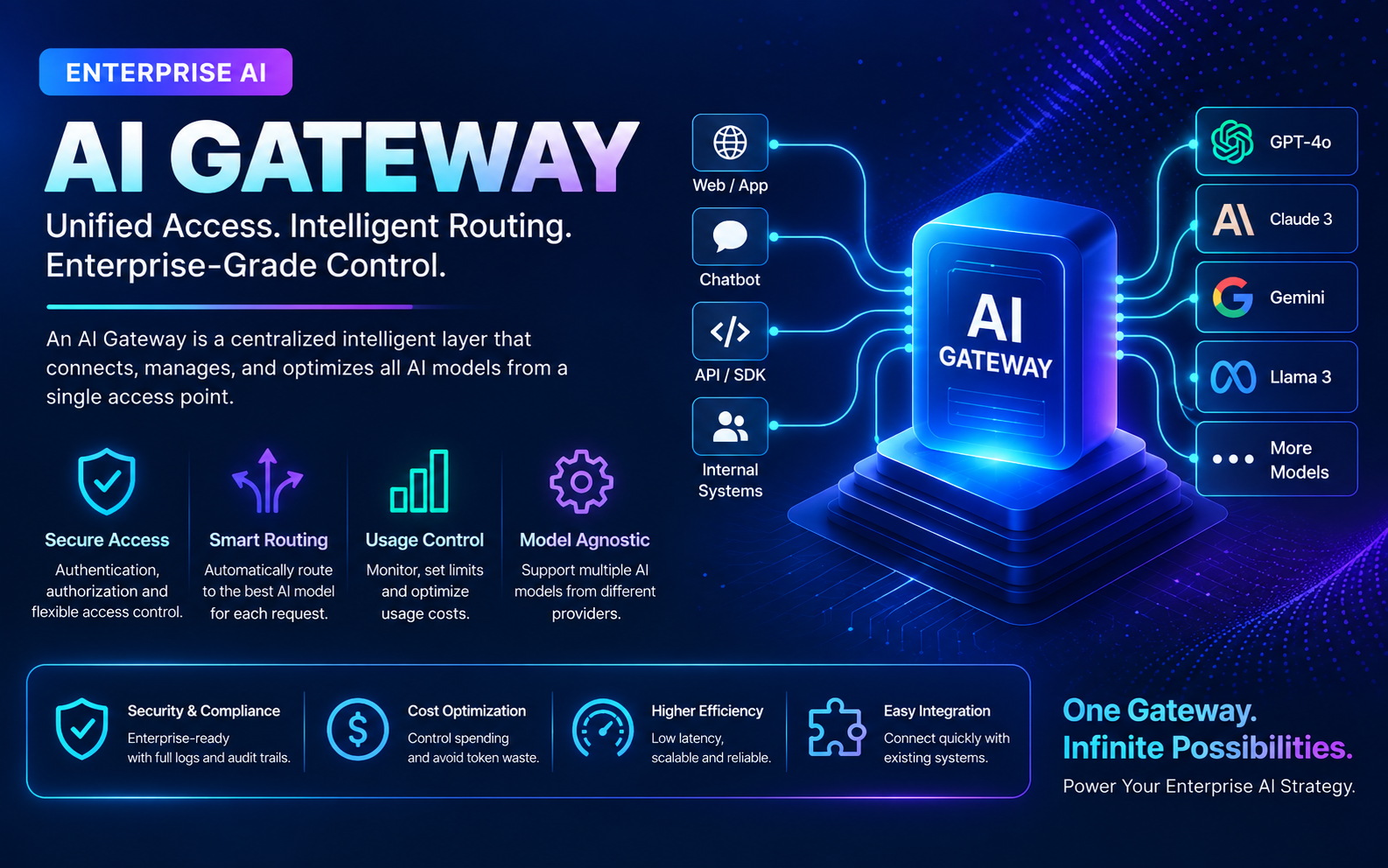
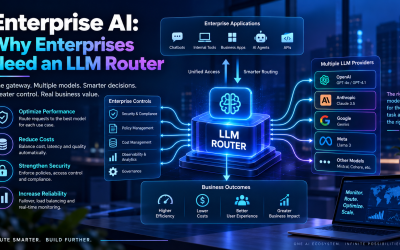
To solve these problems, enterprises are increasingly introducing an AI Gateway—a centralized control plane that manages every interaction between applications and AI services.
Rather than allowing applications to communicate directly with AI models, all requests pass through the AI Gateway, where they can be secured, monitored, optimized, and governed.
What Is an AI Gateway?
An AI Gateway is a centralized platform that sits between enterprise applications and AI providers.
It provides a single entry point for all AI requests while abstracting the underlying model providers.
Instead of:
Application

      │

   OpenAI
Applications communicate with:
Application

      │

 AI Gateway

      │

 ┌───────────────┐
 │ OpenAI        │
 │ Claude        │
 │ Gemini        │
 │ Azure OpenAI  │
 │ Local LLM     │
 └───────────────┘
Applications no longer need to know which model is actually executing the request.
Why Enterprises Need an AI Gateway
As AI adoption grows, so does operational complexity.
Different business units often require:
- Different LLM providers
- Different model versions
- Different prompt templates
- Different security policies
- Different budgets
- Different compliance requirements
Managing these independently becomes unsustainable.
An AI Gateway centralizes these responsibilities into a single platform.
Core Capabilities of an AI Gateway
1. Model Routing
Not every request should use the same model.
For example:
- Customer support → Fast, low-cost model
- Financial analysis → High-accuracy reasoning model
- Code generation → Coding-optimized model
- Translation → Multilingual model
The gateway automatically routes requests to the most appropriate model.
Example:
Incoming Request

       │

 AI Gateway

       │

 ├── GPT-5.6
 ├── Claude
 ├── Gemini
 ├── Llama
 └── Internal Model
Applications don't need to implement model-selection logic.
2. Centralized Authentication
Instead of every application managing AI credentials, the gateway securely stores provider API keys and authentication tokens.
Benefits include:
- Credential isolation
- Secret rotation
- Reduced security risks
- Centralized access management
Applications authenticate only with the gateway.
3. Cost Management
LLM usage can grow rapidly across an enterprise.
The gateway tracks:
- Token consumption
- Cost per application
- Cost per department
- Cost per user
- Cost per workflow
- Monthly spending
Organizations gain complete visibility into AI expenses.
4. Rate Limiting and Quotas
Different teams often have different usage limits.
Examples:
Marketing Team
- 2 million tokens/day
Engineering Team
- 20 million tokens/day
Customer Support
- Unlimited production usage
The AI Gateway enforces quotas automatically.
5. Prompt Governance
Enterprise prompts often include sensitive business logic.
The gateway can:
- Store reusable prompt templates
- Version prompts
- Validate prompt format
- Block unsafe prompts
- Inject system instructions
- Apply organization-wide guardrails
This ensures consistent AI behavior across all applications.
6. Security and Compliance
Every AI request passes through a security layer.
Examples include:
- Personally Identifiable Information (PII) detection
- Data masking
- Prompt injection protection
- Output filtering
- Content moderation
- Compliance validation
Sensitive information can be removed before requests reach external AI providers.
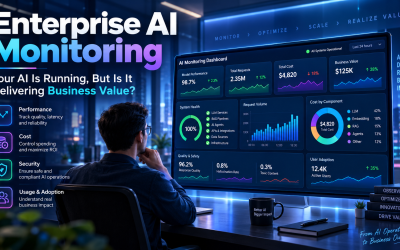
7. Observability
The gateway becomes the ideal place to collect telemetry.
Typical metrics include:
- Request volume
- Token usage
- Response latency
- Error rates
- Model utilization
- Workflow completion
- Cost metrics
This creates complete visibility into enterprise AI operations.
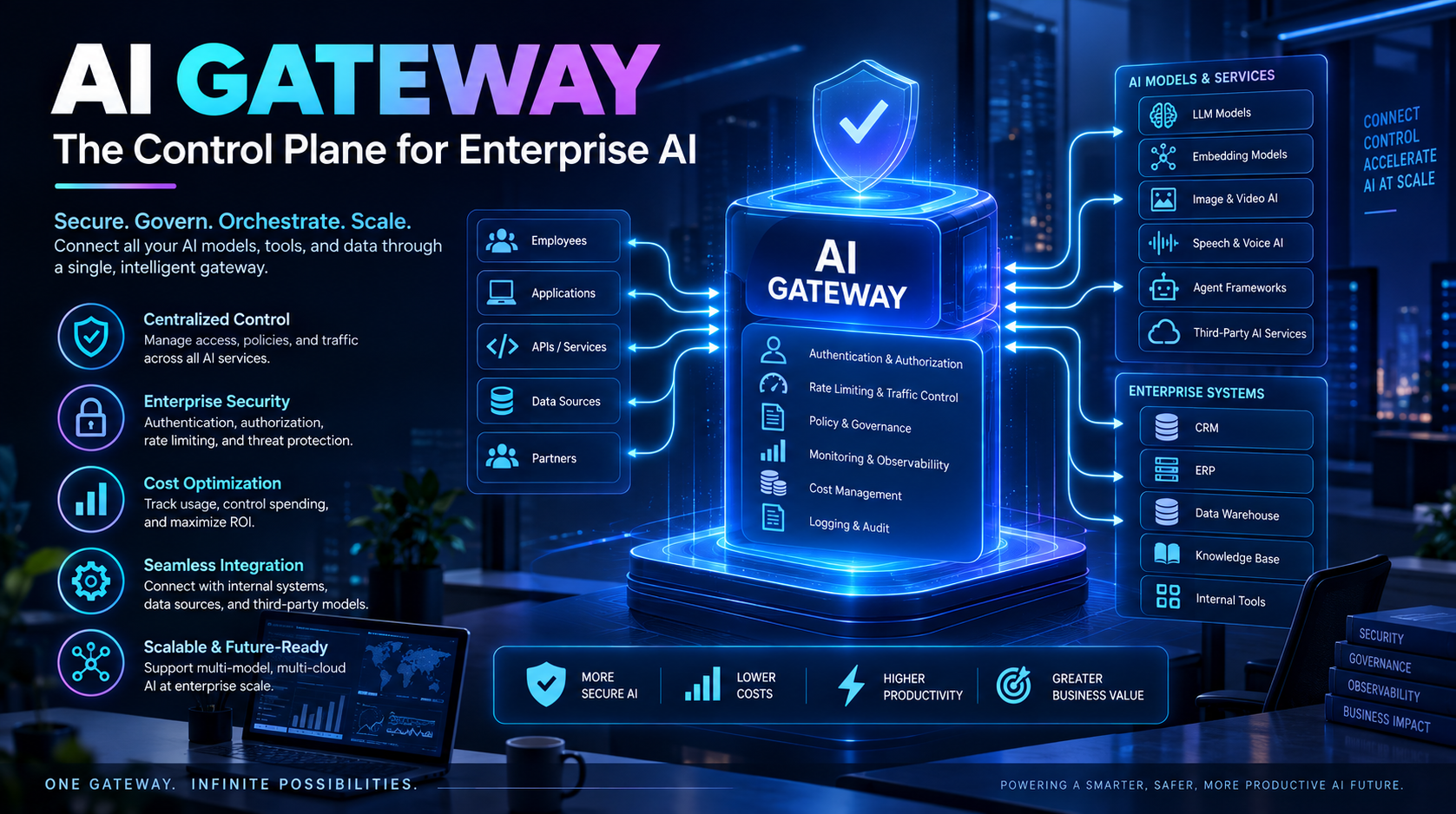
AI Gateway Architecture
A typical enterprise architecture looks like this:
Enterprise Applications

        │

Chatbots
AI Agents
Business Apps
Developer Tools

        │

──────── AI Gateway ────────

Authentication

Authorization

Model Routing

Prompt Templates

Caching

Observability

Cost Tracking

Security Policies

Rate Limiting

        │

────────────────────────────

GPT

Claude

Gemini

Azure OpenAI

AWS Bedrock

Local Models
The gateway separates enterprise governance from AI providers.
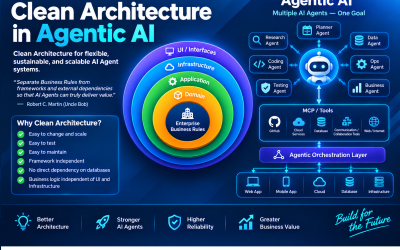
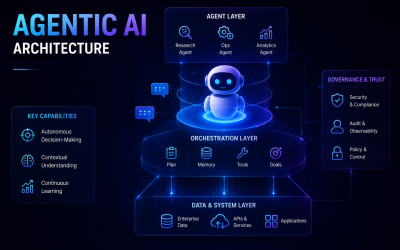
AI Gateway in an Agentic AI Platform
Within an Agentic AI architecture, the gateway is shared by all AI agents.
Planner Agent

Research Agent

Finance Agent

Coding Agent

Customer Agent

        │

    AI Gateway

        │

LLM Providers
Each agent uses the same governance, monitoring, authentication, and routing policies.
Benefits of an AI Gateway
1. Reduced Vendor Lock-in
Organizations can switch providers without modifying every application.
Changing:
OpenAI → Claude
requires updating only the gateway configuration.
2. Consistent Governance
Every request follows the same:
- Security policies
- Compliance rules
- Prompt standards
- Monitoring practices
No application bypasses enterprise controls.
3. Lower Operational Costs
The gateway can optimize costs by:
- Routing simple requests to cheaper models
- Caching repeated responses
- Limiting unnecessary token usage
- Selecting the most cost-effective
Write Your Review
No reviews yet. Be the first to share your experience!