
Artificial intelligence has become an essential tool for modern businesses, but many AI assistants still have one major limitation—they forget. Every new conversation often starts from scratch, requiring users to repeat instructions, explain company policies, and provide the same context over and over again.
Lindy.ai addresses this challenge with one of its most powerful capabilities: AI Memory.
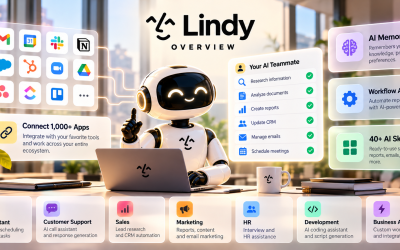
Instead of treating every interaction as a new conversation, Lindy.ai remembers important business information, workflows, customer preferences, and organizational knowledge. This persistent memory allows AI agents to make better decisions, provide more personalized assistance, and automate complex business processes with minimal human input.
In this article, we'll explore how Lindy.ai's AI Memory works, why it matters, and how businesses can use it to build smarter AI-powered workflows.
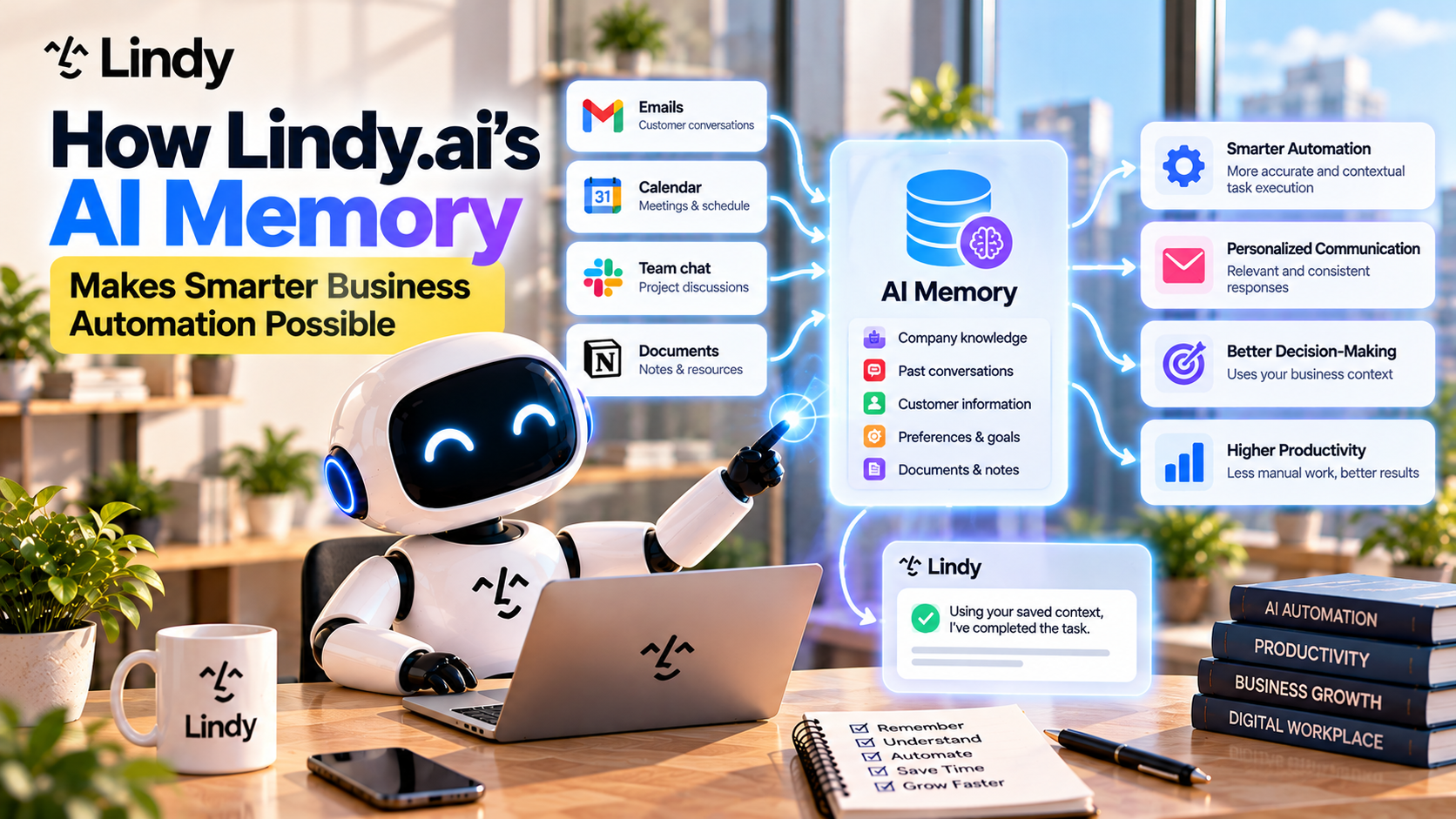
Table of Contents
- What Is AI Memory?
- Why Traditional AI Has Memory Limitations
- How Lindy.ai AI Memory Works
- What AI Memory Can Store
- Real Business Use Cases
- Benefits of Persistent Memory
- Best Practices
- Final Thoughts
- Frequently Asked Questions
What Is AI Memory?
AI Memory is a feature that allows an AI system to retain important information over time instead of forgetting everything after each conversation.
Think of it as giving your AI teammate a long-term memory similar to a human employee.
Instead of repeatedly telling the AI:
- who your customers are,
- how your business operates,
- which tools your team uses,
- or what your internal policies are,
Lindy.ai remembers that information and applies it automatically when completing future tasks.
The result is faster, more accurate, and more personalized automation.
Why Traditional AI Has Memory Limitations
Most AI chatbots are designed primarily for conversations.
Although they can generate impressive responses, they often have limited long-term memory.
This creates several challenges.
Repetitive Instructions
Users repeatedly explain:
- company policies
- writing styles
- workflows
- customer preferences
- project information
Every new conversation requires additional setup.
Inconsistent Responses
Without memory, AI may answer the same question differently depending on how it's prompted.
This inconsistency becomes problematic for customer support, sales, and internal operations.
Limited Personalization
Traditional AI usually cannot remember:
- previous meetings
- customer history
- internal documentation
- business processes
As a result, employees still spend significant time providing context.
How Lindy.ai AI Memory Works
Lindy.ai introduces persistent organizational memory for AI agents.
Instead of treating every workflow independently, AI teammates continuously reference stored business knowledge before taking action.
A simplified process looks like this:
- Information is added to AI Memory.
- AI agents securely store that knowledge.
- Future workflows automatically access relevant information.
- AI uses that context to make better decisions.
- New information can be added and updated over time.
This allows AI teammates to become more useful the longer they work with your organization.
What Can Lindy.ai AI Memory Store?
One of the biggest advantages of Lindy.ai is the flexibility of its memory system.
Here are some examples.
Company Knowledge
AI can remember:
- Company overview
- Products and services
- Internal terminology
- Brand guidelines
- Pricing information
- Business policies
This helps AI generate more accurate and consistent responses.
Customer Information
AI Memory can retain customer-related context such as:
- Previous conversations
- Preferences
- Purchase history
- Meeting notes
- Account details
- Follow-up schedules
This enables more personalized customer interactions.
Internal Documentation
Instead of searching through multiple documents, AI agents can remember:
- SOPs
- Employee handbooks
- HR policies
- Product documentation
- Training materials
- Technical documentation
Employees receive answers much faster.
Team Preferences
Different teams often work differently.
AI Memory can remember:
- Communication style
- Approval workflows
- Reporting formats
- Preferred templates
- Meeting structures
- Department-specific processes
This allows AI teammates to adapt to each department automatically.
Workflow History
Lindy.ai can also remember how previous workflows were completed.
For example:
- recurring reports
- project milestones
- completed automations
- previous decisions
- task status
Historical knowledge helps AI make better recommendations in future workflows.
Real Business Use Cases
Customer Support
Without AI Memory:
Support agents repeatedly explain company policies to AI before drafting responses.
With AI Memory:
Lindy.ai already understands:
- refund policies
- shipping procedures
- warranty terms
- product documentation
Support responses become faster and more consistent.
Sales Teams
AI Memory allows sales agents to remember:
- customer preferences
- previous meetings
- buying history
- contract details
- sales pipeline information
This helps sales representatives prepare for meetings with minimal manual research.
Marketing Teams
Marketing departments benefit from AI remembering:
- brand voice
- campaign guidelines
- messaging frameworks
- target audiences
- content strategy
This improves consistency across blogs, emails, advertisements, and social media campaigns.
Human Resources
HR teams can use AI Memory to retain:
- onboarding procedures
- company policies
- employee benefits
- interview processes
- recruitment workflows
New employees receive more accurate onboarding support without requiring HR to answer the same questions repeatedly.
Executive Assistants
Executives often rely on AI to manage:
- calendars
- meetings
- travel
- reports
- communications
Because AI remembers preferences and schedules, administrative work becomes significantly more efficient.
Benefits of AI Memory
Less Repetitive Prompting
Employees no longer need to provide the same instructions every day.
AI already understands the business context.
Better Personalization
Customer interactions become more relevant because AI remembers previous conversations and preferences.
More Accurate Automation
AI makes better decisions because it has access to historical knowledge and organizational information.
Consistent Business Processes
Every AI teammate follows the same internal standards and documentation.
This reduces inconsistencies between departments.
Improved Productivity
Employees spend less time searching for information and more time completing valuable work.
Best Practices for Using AI Memory
To maximize the benefits of Lindy.ai AI Memory:
Keep Information Updated
Review stored knowledge regularly to ensure policies and documentation remain accurate.
Organize Business Knowledge
Structure documentation clearly so AI can retrieve relevant information efficiently.
Create Department-Specific Memory
Different teams should maintain separate knowledge bases where appropriate.
For example:
- Sales
- Marketing
- HR
- Customer Support
- Operations
Combine Memory with Automation
AI Memory becomes even more powerful when paired with workflow automation.
For example:
Customer submits support ticket.
↓
AI retrieves customer history.
↓
Reviews company policies.
↓
Drafts personalized response.
↓
Updates CRM.
↓
Schedules follow-up.
The entire workflow happens automatically using stored organizational knowledge.
Why AI Memory Matters for the Future of Business
As businesses adopt more AI-powered workflows, context becomes increasingly important.
The most valuable AI systems won't simply generate responses—they'll understand:
- how your company works,
- how your employees collaborate,
- what your customers expect,
- and how business processes evolve over time.
Persistent memory transforms AI from a helpful assistant into a knowledgeable digital teammate.
Instead of repeatedly teaching AI about your organization, the AI continuously learns from your workflows and becomes more useful with every interaction.
Final Thoughts
Lindy.ai's AI Memory is one of the platform's most valuable features because it addresses one of the biggest challenges facing traditional AI assistants: the inability to retain meaningful business context.
By remembering company knowledge, customer information, internal documentation, workflow history, and team preferences, Lindy.ai enables smarter automation, more personalized interactions, and greater operational efficiency.
As organizations continue adopting AI agents, persistent memory will become a critical foundation for scalable business automation—and Lindy.ai is well positioned to lead that transition.
Write Your Review
No reviews yet. Be the first to share your experience!