
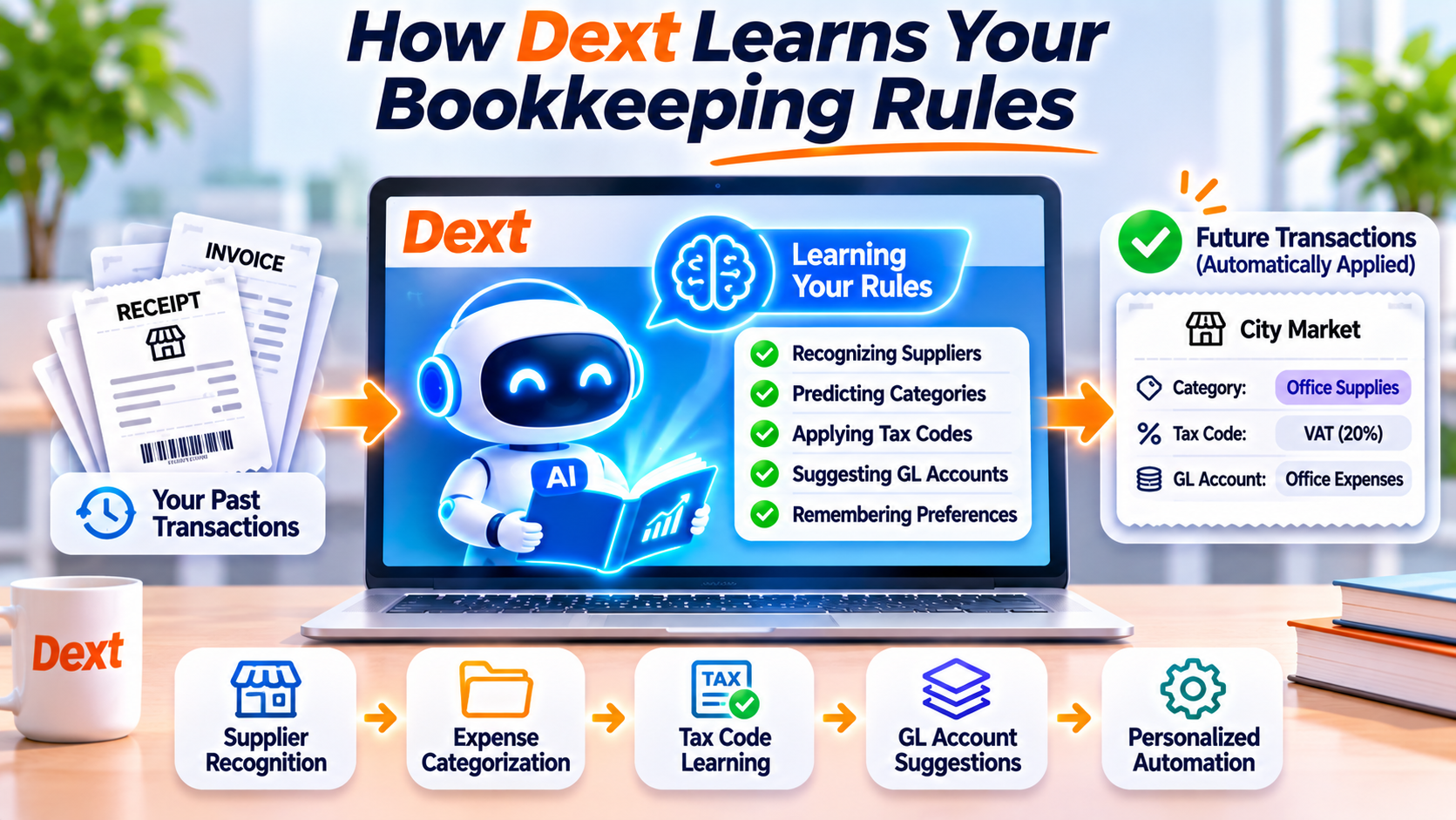
Every business has its own bookkeeping process. The same supplier may always be assigned to a specific expense category, certain purchases may use predefined tax codes, and recurring transactions often follow consistent accounting rules.
Instead of requiring users to make these decisions repeatedly, Dext uses Artificial Intelligence (AI) and machine learning to understand your bookkeeping preferences. As you process more documents, the platform continuously learns your accounting habits and automatically applies them to future transactions.
Let's explore how Dext learns your bookkeeping rules and why this makes bookkeeping faster and more accurate.
Why Bookkeeping Rules Matter
Consistency is one of the foundations of good accounting.
Applying the same bookkeeping rules across every transaction helps businesses:
- Produce accurate financial reports
- Simplify tax preparation
- Improve month-end reconciliation
- Reduce manual corrections
- Maintain compliance with accounting standards
Without automation, these decisions must often be made manually for every receipt or invoice.
Learning from Every Transaction
Every time you review and approve a document, Dext analyzes your bookkeeping decisions.
Over time, the platform begins recognizing patterns such as:
- Preferred expense categories
- Supplier assignments
- Tax treatments
- General Ledger (GL) accounts
- Payment methods
- Accounting preferences
Rather than starting from scratch each time, Dext uses this historical data to recommend similar bookkeeping decisions for future transactions.
Intelligent Supplier Recognition
Many businesses purchase from the same suppliers repeatedly.
For example:
- Office supply stores
- Software vendors
- Internet providers
- Fuel stations
- Marketing platforms
After processing multiple transactions from the same supplier, Dext automatically recognizes the vendor and suggests the correct accounting information.
This reduces repetitive manual work while improving consistency.
Automatic Expense Categorization
One of Dext's most valuable machine learning features is automatic expense categorization.
Instead of manually selecting an expense account every time, Dext recommends categories based on previous bookkeeping history.
Examples include:
- Office Supplies
- Software Subscriptions
- Business Travel
- Meals and Entertainment
- Utilities
- Marketing Expenses
- Professional Services
As more transactions are processed, these recommendations become increasingly accurate.
Smarter Tax Code Recommendations
Tax reporting requires consistent application of tax codes.
Dext learns which tax codes are typically assigned to different suppliers and expense types.
When similar transactions appear, the platform recommends the appropriate:
- VAT code
- Sales tax category
- Purchase tax treatment
- Zero-rated or exempt classifications (where applicable)
This reduces mistakes while helping businesses maintain tax compliance.
General Ledger Account Suggestions
Businesses often use specific General Ledger (GL) accounts for recurring purchases.
Dext remembers these accounting preferences and automatically recommends the correct GL account based on:
- Supplier history
- Expense type
- Previous approvals
- Business-specific bookkeeping rules
Finance teams spend less time searching through account lists and more time reviewing transactions.
Continuous Machine Learning
Unlike static automation tools, Dext improves continuously.
Every correction, approval, and categorization teaches the AI something new.
Over time, the platform becomes better at:
- Recognizing suppliers
- Predicting categories
- Applying tax codes
- Suggesting GL accounts
- Detecting unusual transactions
- Reducing manual adjustments
The result is a bookkeeping system that becomes smarter as your business grows.
Benefits of Personalized Bookkeeping Automation
By learning your bookkeeping rules, Dext helps businesses:
- Reduce repetitive data entry
- Improve accounting consistency
- Minimize human error
- Accelerate document processing
- Simplify month-end closing
- Produce more reliable financial reports
- Improve collaboration with accountants
- Scale bookkeeping operations efficiently
For businesses processing hundreds of transactions each month, these improvements translate into significant time savings.
Final Thoughts
Dext's ability to learn your bookkeeping rules is one of its most powerful AI capabilities. Instead of forcing users to repeat the same accounting decisions every day, the platform remembers your preferences and applies them intelligently to future transactions.
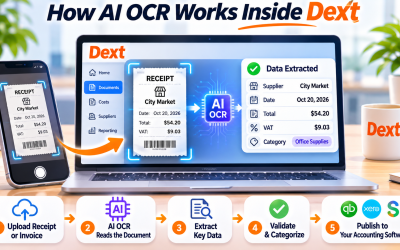
By combining machine learning, OCR, and automation, Dext creates a personalized bookkeeping experience that becomes more accurate with every document you process.
Whether you're a small business owner, bookkeeper, or accountant, Dext helps you automate routine tasks while maintaining consistent and reliable financial records.
Frequently Asked Questions
How does Dext learn bookkeeping rules?
Dext uses machine learning to analyze approved transactions and recognize patterns in suppliers, expense categories, tax codes, and accounting preferences.
Does Dext remember previous supplier settings?
Yes. After processing multiple transactions from the same supplier, Dext automatically recognizes the vendor and recommends the appropriate bookkeeping settings.
Can Dext recommend expense categories automatically?
Yes. Based on historical bookkeeping data, Dext suggests the most appropriate expense category for new transactions.
Does Dext become more accurate over time?
Absolutely. As users continue reviewing and approving transactions, Dext's AI learns from those decisions and delivers increasingly accurate recommendations.

Write Your Review
No reviews yet. Be the first to share your experience!