
Many businesses create landing pages exclusively for paid advertising campaigns. While this strategy can generate immediate traffic, it also requires continuous investment in advertising. Once the budget stops, so does the traffic.
Search engine optimization (SEO) offers a more sustainable approach. Well-optimized landing pages can rank in Google search results, bringing consistent organic traffic without paying for every click.
Although Leadpages is widely recognized as a landing page builder, it also provides features that support SEO when used correctly. Combined with high-quality content, proper keyword optimization, and a strong user experience, Leadpages landing pages can become valuable assets for long-term lead generation.
In this guide, you'll learn practical SEO strategies to help your Leadpages landing pages attract more organic traffic while maintaining high conversion rates.
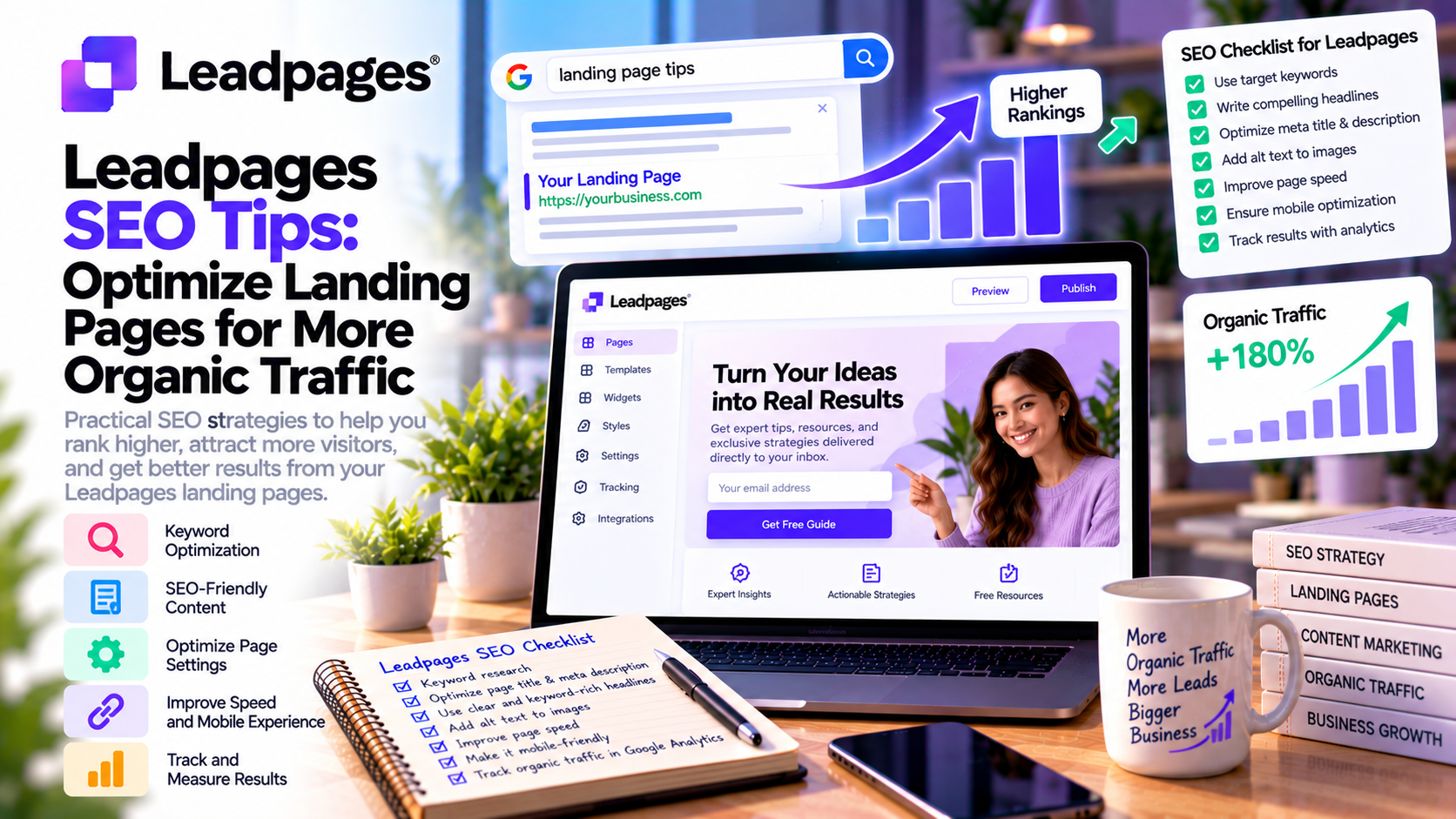
Why SEO Matters for Landing Pages
Many marketers focus solely on conversion optimization.
However, a landing page must first attract visitors before it can convert them.
SEO helps businesses:
- Increase organic traffic
- Reduce paid advertising costs
- Improve brand visibility
- Generate qualified leads
- Build long-term marketing assets
- Reach users actively searching for solutions
A landing page that ranks well on Google can continue generating leads long after a paid campaign has ended.
Understand Search Intent
Before optimizing your landing page, identify what users are actually searching for.
Search intent generally falls into four categories:
Informational
Example:
- What is CRM software?
- How does email marketing work?
Commercial
Example:
- Best landing page builders
- Leadpages review
Transactional
Example:
- Buy Leadpages
- Leadpages pricing
Navigational
Example:
- Leadpages login
- Leadpages templates
Your landing page should match the user's intent as closely as possible.
1. Perform Keyword Research
Every SEO strategy begins with choosing the right keywords.
Focus on:
- Primary keyword
- Secondary keywords
- Long-tail keywords
- Related search terms
For example:
Primary Keyword:
Leadpages SEO
Related Keywords:
- Leadpages landing pages
- Leadpages optimization
- Landing page SEO
- Leadpages templates
- Landing page builder
Naturally include these keywords throughout your content without keyword stuffing.
2. Optimize Your Page Title
The page title is one of Google's strongest ranking signals.
A good SEO title should:
- Include the primary keyword
- Stay under 60 characters
- Clearly describe the page
- Encourage clicks
Example:
Leadpages SEO Tips: Optimize Landing Pages for More Organic Traffic
Avoid vague titles such as:
Welcome to Our Landing Page
3. Write an Effective Meta Description
Although meta descriptions don't directly influence rankings, they improve click-through rates.
A good meta description should:
- Include the target keyword
- Explain the page value
- Stay between 150–160 characters
- Encourage action
Example:
“Learn how to optimize Leadpages landing pages for SEO, improve Google rankings, increase organic traffic, and generate more qualified leads.”
4. Create High-Quality Content
Google rewards pages that provide useful information.
Instead of writing only promotional copy, include:
- Educational content
- Practical tips
- Examples
- Frequently asked questions
- Case studies
- Actionable advice
Long-form, informative content often performs better than thin landing pages.
Aim to answer the questions your audience is already asking.
5. Optimize Heading Structure
Use headings to improve readability and help search engines understand your content.
A recommended structure includes:
- One H1 title
- Multiple H2 sections
- Supporting H3 subsections where needed
Example:
H1:
Leadpages SEO Tips
H2:
Why SEO Matters
H2:
Keyword Research
H2:
Best Practices
Organized content benefits both users and search engines.
6. Optimize Images
Large image files slow page loading.
Best practices include:
- Compress images
- Use descriptive filenames
- Add keyword-rich alt text
- Choose modern image formats when appropriate
- Avoid unnecessarily large files
Example filename:
leadpages-seo-guide.webp
Instead of:
image1.jpg
Optimized images improve both SEO and page speed.
7. Improve Page Speed
Google considers page speed an important ranking factor.
Leadpages provides optimized hosting, but marketers should still:
- Compress images
- Remove unnecessary sections
- Limit heavy animations
- Reduce oversized videos
- Keep page layouts clean
Fast pages improve user experience and reduce bounce rates.
8. Optimize for Mobile Devices
Google primarily indexes the mobile version of websites.
Before publishing your landing page, verify:
- Mobile responsiveness
- Font readability
- Button spacing
- Form usability
- Loading performance
Leadpages automatically generates responsive pages, but manual review is still recommended.
9. Build Internal Links
Internal links help visitors discover additional content while helping search engines understand your website structure.
For example, a Leadpages SEO article can link to:
- Leadpages Review
- Leadpages Pricing Guide
- Leadpages Templates
- A/B Testing Guide
- Email Marketing Strategies
Internal linking also encourages visitors to spend more time on your website.
10. Build High-Quality Backlinks
Backlinks remain one of Google's strongest ranking signals.
Effective ways to earn backlinks include:
- Guest blogging
- Original research
- Industry reports
- Case studies
- Resource pages
- Expert interviews
- Digital PR campaigns
Focus on earning links from relevant, authoritative websites rather than pursuing large quantities of low-quality backlinks.
11. Track SEO Performance
SEO requires continuous monitoring.
Use tools such as:
- Google Analytics
- Google Search Console
- Ahrefs
- SEMrush
- Moz
Track metrics including:
- Organic traffic
- Keyword rankings
- Click-through rates
- Bounce rates
- Conversion rates
- Page performance
Review data regularly and refine your optimization strategy based on actual results.
Best Practices for Leadpages SEO
Focus on User Experience
Google increasingly rewards pages that provide excellent user experiences.
Prioritize:
- Fast loading
- Clear navigation
- Readable typography
- Helpful content
- Mobile usability
Satisfied visitors are more likely to convert and return.
Match Content to Search Intent
Don't create landing pages that promise one thing but deliver another.
If users search for:
Best Leadpages Templates
provide an in-depth guide instead of a generic sales page.
Relevance improves both rankings and user satisfaction.
Include Trust Signals
Increase credibility by adding:
- Testimonials
- Customer reviews
- Certifications
- Awards
- Security badges
Trust encourages both search engines and users to view your page more favorably.
Update Content Regularly
SEO is not a one-time task.
Refresh your landing pages by:
- Updating statistics
- Adding new examples
- Improving visuals
- Revising outdated information
- Expanding FAQs
Fresh content can help maintain rankings over time.
Common SEO Mistakes
Avoid these frequent mistakes:
❌ Keyword stuffing
❌ Duplicate content
❌ Slow loading pages
❌ Missing meta descriptions
❌ Poor mobile optimization
❌ Weak headlines
❌ Thin content
❌ Broken links
❌ Ignoring search intent
❌ Forgetting internal links
Correcting these issues can improve both search visibility and user experience.
Real-World Use Cases
SaaS Companies
Publish SEO-optimized feature pages that rank for software-related keywords and drive free trial sign-ups.
Ecommerce Brands
Create optimized promotional landing pages targeting seasonal search terms and product categories.
Marketing Agencies
Develop educational content that ranks for industry keywords while generating client inquiries.
Coaches and Consultants
Build authority by publishing keyword-focused landing pages promoting webinars, guides, and consultation services.
Bloggers and Publishers
Use Leadpages to create SEO-friendly resource pages that grow email lists and support affiliate marketing strategies.
Final Verdict
SEO and conversion optimization should work together—not compete with each other. While Leadpages is best known for helping businesses build high-converting landing pages, its flexible design, mobile responsiveness, and optimization features also make it a solid foundation for attracting organic traffic when combined with a strong SEO strategy.
By focusing on keyword research, high-quality content, fast page speed, mobile optimization, internal linking, and ongoing performance analysis, businesses can create landing pages that rank well in search engines and convert visitors into customers. Rather than relying solely on paid advertising, SEO-optimized Leadpages pages provide a sustainable source of long-term traffic and lead generation.
For marketers, entrepreneurs, and businesses looking to maximize both visibility and conversions, applying these SEO best practices can significantly increase the long-term value of every Leadpages campaign.
Write Your Review
No reviews yet. Be the first to share your experience!