
Creating multiple landing page variations is a proven strategy for improving conversion rates. However, deciding which version each visitor should see can be challenging. Traditional A/B testing typically divides traffic evenly between page variations until enough data is collected to determine a winner. While effective, this approach means that many visitors continue to see lower-performing pages during the testing process.
To solve this problem, Leadpages introduced Smart Traffic, an AI-powered optimization feature designed to automatically direct visitors to the landing page variation most likely to convert.
Instead of relying solely on fixed traffic distribution, Smart Traffic continuously analyzes visitor behavior and adapts in real time. The result is a more personalized experience for users and, in many cases, higher conversion rates for businesses.
In this article, we'll explore how Smart Traffic works, its key benefits, and why it's becoming an essential tool for marketers focused on maximizing campaign performance.
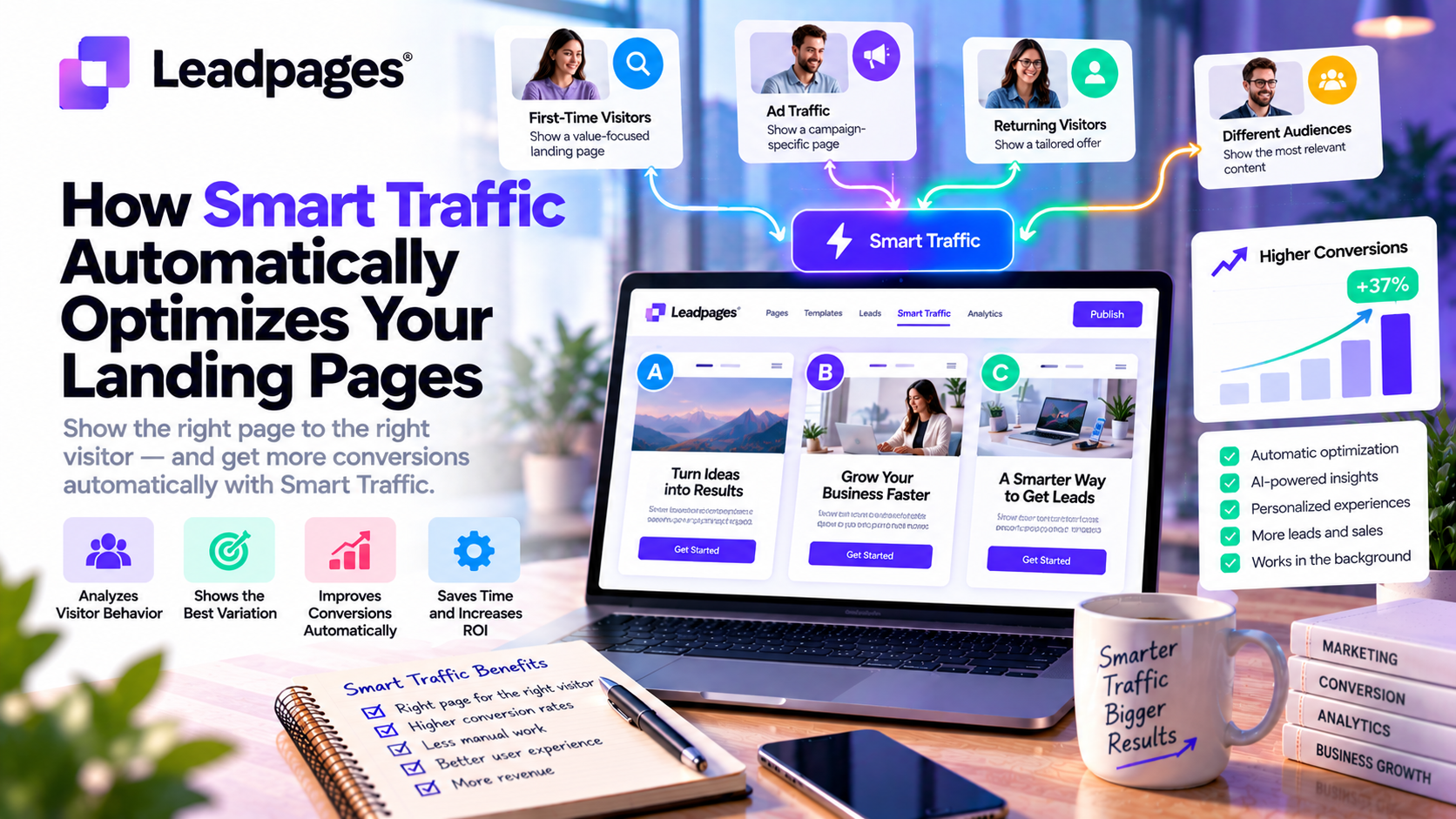
What Is Smart Traffic?
Smart Traffic is an AI-driven optimization feature available in Leadpages that intelligently routes visitors to different landing page variations based on behavioral data and conversion patterns.
Unlike traditional A/B testing, which generally sends an equal percentage of visitors to each page, Smart Traffic learns from user interactions and automatically increases traffic to the page variation that is more likely to achieve the desired outcome.
Rather than simply identifying a single winning page, Smart Traffic aims to match different types of visitors with the page experience that best suits them.
How Smart Traffic Works
The process is simple but highly effective.
Step 1: Create Multiple Landing Pages
Marketers build two or more versions of a landing page.
These variations might differ in:
- Headlines
- Hero images
- CTA buttons
- Page layouts
- Testimonials
- Product messaging
- Offer presentation
Each version is designed to appeal to slightly different audiences or messaging strategies.
Step 2: Launch Your Campaign
After publishing the landing pages, traffic begins flowing from various marketing channels such as:
- Google Ads
- Facebook Ads
- LinkedIn Ads
- Email marketing
- Organic search
- Social media
Initially, Smart Traffic gathers performance data from visitor interactions.
Step 3: AI Learns Visitor Behavior
As more visitors arrive, Leadpages analyzes patterns such as:
- Conversion history
- Engagement behavior
- Visitor interactions
- Campaign performance
The AI continuously improves its understanding of which page variation performs best for different visitor profiles.
Step 4: Automatic Traffic Optimization
Instead of continuing to distribute visitors equally, Smart Traffic begins routing each new visitor toward the page most likely to generate a conversion.
The optimization process happens automatically without requiring manual adjustments from the marketing team.
Smart Traffic vs Traditional A/B Testing
Although both tools aim to improve conversion rates, they serve different purposes.
| Feature | Traditional A/B Testing | Smart Traffic |
|---|---|---|
| Traffic Distribution | Equal split | AI-optimized |
| Learns Over Time | Limited | Continuous |
| Personalization | No | Yes |
| Manual Analysis | Required | Minimal |
| Optimization Speed | Moderate | Faster |
| Best For | Controlled experiments | Ongoing optimization |
A/B testing is ideal for validating specific hypotheses, while Smart Traffic is better suited for continuously improving campaign performance after enough data has been collected.
Benefits of Smart Traffic
1. Higher Conversion Rates
The primary advantage of Smart Traffic is its ability to improve conversions.
By directing visitors to the page variation most likely to resonate with them, businesses can generate more leads without increasing advertising spend.
Even small percentage improvements can produce significant revenue gains over time.
2. Less Manual Optimization
Traditional optimization often requires marketers to:
- Review reports
- Analyze conversion data
- Pause losing variations
- Redirect traffic manually
Smart Traffic automates much of this process, allowing marketers to focus on strategy rather than repetitive analysis.
3. Better Visitor Experience
Not every visitor responds to the same messaging.
Some users prefer:
- Detailed product information
- Social proof
- Strong discounts
- Educational content
- Simpler page layouts
Smart Traffic helps match visitors with the landing page most likely to meet their expectations, creating a more personalized experience.
4. Improved Advertising ROI
Paid advertising costs continue to rise.
Improving landing page conversion rates means businesses generate more leads from the same advertising budget.
This can:
- Reduce customer acquisition costs
- Increase return on ad spend (ROAS)
- Improve marketing efficiency
5. Continuous Learning
Unlike static optimization methods, Smart Traffic becomes more effective as it gathers additional data.
The more visitors your campaigns receive, the better the AI can identify successful patterns and optimize traffic distribution.
Real-World Use Cases
SaaS Companies
A software company may create separate landing pages focusing on:
- Ease of use
- Advanced features
- Pricing
- Security
- Customer success stories
Smart Traffic helps determine which message resonates best with different visitors.
Ecommerce Businesses
Online retailers can test different promotional strategies such as:
- Percentage discounts
- Free shipping
- Limited-time offers
- Product bundles
The AI automatically promotes the most effective experience for each visitor.
Marketing Agencies
Agencies managing multiple client campaigns can use Smart Traffic to improve results without constantly adjusting traffic manually.
This saves time while delivering better campaign performance.
Coaches and Consultants
Different audiences may respond to:
- Free consultations
- Webinar invitations
- Success stories
- Educational resources
Smart Traffic identifies which landing page version generates more appointments.
Best Practices for Using Smart Traffic
Create Meaningful Variations
Avoid making only tiny cosmetic changes.
Instead, test significantly different approaches, including:
- Headlines
- Offers
- Messaging
- Visual design
- Calls-to-action
The AI performs better when it has distinct options to evaluate.
Combine Smart Traffic with A/B Testing
A/B testing helps discover new ideas.
Smart Traffic helps maximize their performance over time.
Using both features together creates a stronger optimization strategy than relying on either one alone.
Continue Monitoring Analytics
Although Smart Traffic automates optimization, marketers should still review:
- Conversion rates
- Lead quality
- Advertising performance
- Customer acquisition costs
AI supports decision-making but does not replace strategic oversight.
Optimize the Entire Funnel
Landing pages are only one part of the customer journey.
Businesses should also optimize:
- Ad copy
- Email follow-ups
- CRM workflows
- Checkout pages
- Thank-you pages
Strong end-to-end experiences produce better long-term results.
Common Misconceptions
“Smart Traffic eliminates the need for A/B testing.”
Not entirely.
A/B testing remains valuable for validating new ideas and measuring specific changes.
“AI guarantees higher conversions.”
No technology can guarantee results.
Success still depends on:
- Quality offers
- Clear messaging
- Audience targeting
- Page design
Smart Traffic improves optimization but cannot compensate for weak marketing fundamentals.
“Smart Traffic replaces marketers.”
It doesn't.
The AI automates traffic distribution while marketers continue to define strategy, create compelling content, and interpret campaign performance.
Why Smart Traffic Matters in Modern Marketing
Today's marketers manage campaigns across multiple channels while facing increasing competition and rising advertising costs.
Manual optimization is becoming more time-consuming.
AI-powered tools like Smart Traffic allow businesses to:
- Launch campaigns faster
- Reduce repetitive optimization work
- Improve personalization
- Increase marketing efficiency
- Make better use of advertising budgets
As artificial intelligence becomes more integrated into digital marketing, automated optimization is likely to become a standard feature rather than a competitive advantage.
Final Verdict
Leadpages Smart Traffic is one of the platform's most innovative conversion optimization features. By using AI to automatically direct visitors toward the landing page variation most likely to convert, it helps businesses improve campaign performance without the constant manual adjustments required by traditional optimization methods.
While Smart Traffic is not a replacement for thoughtful marketing strategy or A/B testing, it complements both by continuously learning from visitor behavior and adapting traffic distribution over time. This creates a more personalized experience for users while helping marketers achieve better results from their existing traffic.
For businesses running paid advertising campaigns, generating leads, or managing multiple landing page variations, Smart Traffic can become a valuable competitive advantage. Combined with Leadpages' AI page builder, heatmaps, analytics, and A/B testing, it forms part of a comprehensive conversion optimization platform that helps businesses turn more visitors into customers.
Write Your Review
No reviews yet. Be the first to share your experience!