
Customer Relationship Management (CRM) software has become an essential tool for businesses that want to organize sales processes, manage customer interactions, and improve revenue growth. Whether you're a startup, small business, or enterprise organization, having a centralized system for tracking leads and opportunities is critical to building long-term customer relationships.
For years, platforms like Salesforce, HubSpot CRM, Zoho CRM, and Pipedrive have dominated the CRM market. However, many businesses are now looking for solutions that combine CRM functionality with project management, workflow automation, and cross-department collaboration.
This is where monday CRM, built on the monday.com Work Operating System (Work OS), offers a different approach.
Instead of functioning as a traditional standalone CRM, monday CRM combines customer relationship management with customizable workflows, automation, dashboards, AI-powered productivity, and integrations. The result is a flexible platform that connects sales teams with marketing, customer success, finance, and operations.
But can monday CRM truly replace traditional CRM software?
In this review, we'll examine its key features, strengths, limitations, pricing considerations, ideal users, and how it compares with established CRM platforms.
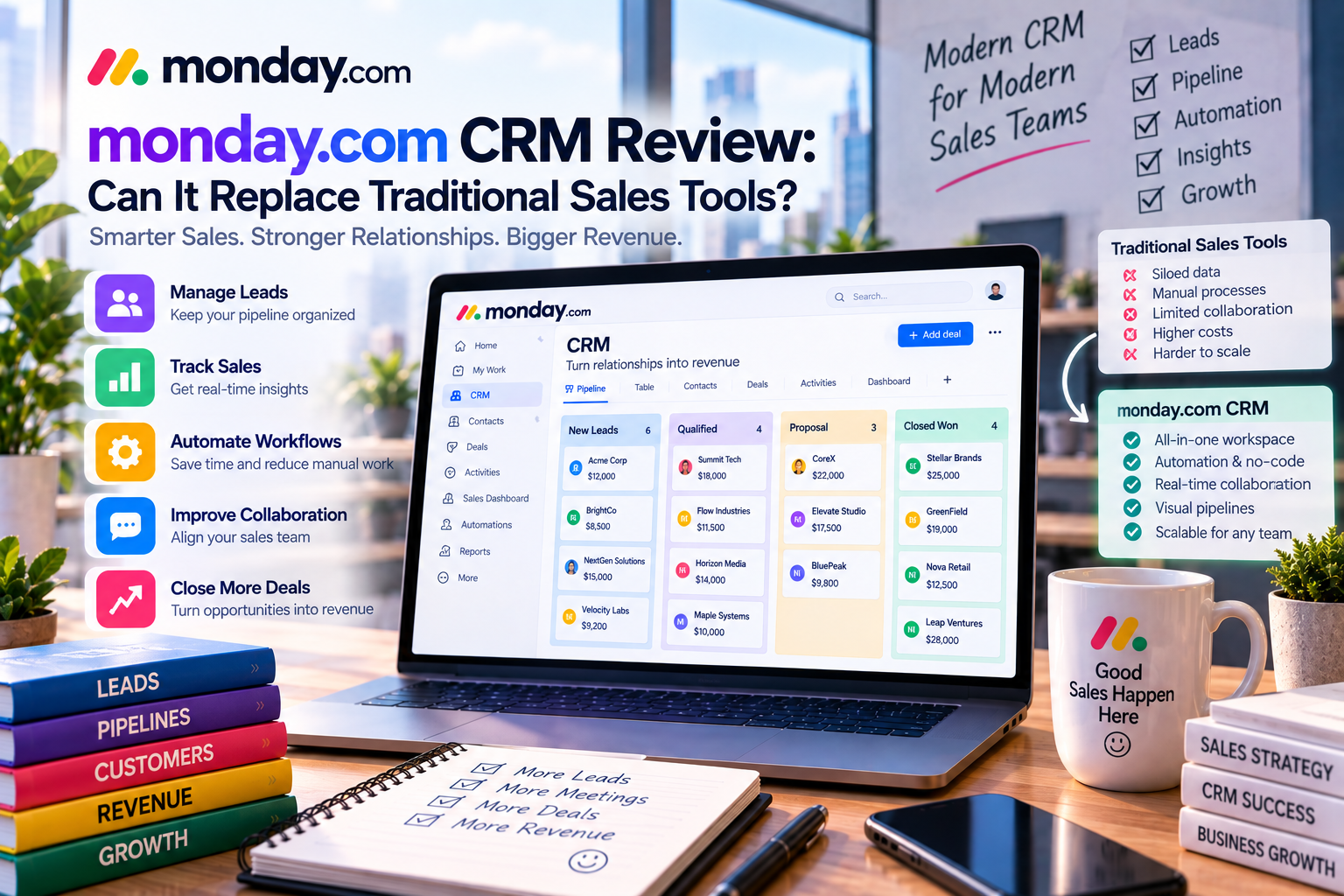
What Is monday CRM?
monday CRM is a customer relationship management solution built on the monday.com platform.
Rather than focusing solely on contact management, it enables businesses to manage the complete customer lifecycle, including:
- Lead generation
- Contact management
- Sales pipeline
- Deal tracking
- Customer onboarding
- Account management
- Sales reporting
- Workflow automation
Because it's based on monday.com's flexible architecture, businesses can customize nearly every aspect of their CRM workflow.
Instead of adapting your sales process to the software, the software adapts to your business.
Key Features of monday CRM
1. Visual Sales Pipeline
One of monday CRM's strongest features is its visual pipeline.
Sales representatives can organize deals into stages such as:
- New Lead
- Contacted
- Qualified
- Proposal Sent
- Negotiation
- Closed Won
- Closed Lost
Each deal displays valuable information including:
- Company name
- Contact person
- Deal value
- Expected closing date
- Assigned salesperson
- Priority level
Managers can quickly identify stalled opportunities and monitor pipeline health.
2. Customizable CRM Workflows
Every business follows a different sales process.
Unlike many traditional CRMs, monday CRM allows users to customize:
- Deal stages
- Status labels
- Custom fields
- Views
- Dashboards
- Automations
For example, a software company may include stages for product demos and free trials, while a consulting firm might track proposal reviews and contract approvals.
This flexibility makes monday CRM suitable for a wide range of industries.
3. Workflow Automation
Administrative tasks often consume a significant portion of a salesperson's day.
monday CRM reduces manual work through no-code automation.
Examples include:
- Assign new leads automatically
- Notify managers when high-value deals are created
- Send reminders before follow-up dates
- Update deal status after task completion
- Trigger onboarding projects after a sale closes
Automation improves consistency while allowing sales representatives to focus on building customer relationships.
4. Email and Activity Tracking
Sales teams rely heavily on communication.
monday CRM helps centralize customer interactions by allowing teams to:
- Log emails
- Record meetings
- Track calls
- Attach documents
- Store notes
- Maintain customer history
Keeping all customer information in one location makes future interactions more informed and personalized.
5. Dashboards and Sales Analytics
Sales leaders need accurate data to make informed decisions.
monday CRM dashboards provide visual reports including:
- Sales pipeline value
- Revenue forecasts
- Conversion rates
- Team performance
- Closed deals
- Average sales cycle
- Activity tracking
These real-time insights allow managers to identify opportunities and address performance issues before they affect revenue.
6. AI-Powered Productivity
monday CRM includes AI-powered features that assist sales teams with routine tasks.
AI can help:
- Summarize customer interactions
- Generate meeting notes
- Draft follow-up emails
- Organize customer information
- Create task descriptions
These tools reduce administrative work while improving communication quality.
Real-World Business Use Cases
SaaS Companies
Software companies often manage long sales cycles involving multiple stakeholders.
monday CRM helps track:
- Product demos
- Trial users
- Contract negotiations
- Customer onboarding
- Renewal opportunities
Automation ensures every lead receives timely follow-up.
Marketing Agencies
Agencies use monday CRM to manage:
- New inquiries
- Sales proposals
- Client onboarding
- Contract approvals
- Account management
Because monday CRM integrates seamlessly with project management boards, agencies can move from sales to project delivery without switching platforms.
Professional Services
Consulting firms, accounting companies, and legal practices use monday CRM to monitor client relationships while coordinating internal project execution.
Small Businesses
Growing businesses benefit from a CRM that combines customer management with project tracking, reducing the need for multiple software subscriptions.
Integrations
Most businesses use several sales and communication tools.
monday CRM integrates with popular applications such as:
- Gmail
- Outlook
- Slack
- Microsoft Teams
- Zoom
- HubSpot
- Salesforce
- Google Workspace
- Zapier
These integrations help synchronize customer information across the business.
Advantages of monday CRM
Easy to Customize
Businesses can tailor workflows without programming knowledge.
Excellent User Interface
The visual layout is intuitive and easier to learn than many traditional CRM platforms.
Strong Collaboration
Sales, marketing, customer success, and operations can work together within the same system.
Powerful Automation
Routine administrative work can be automated, allowing sales teams to focus on selling.
Flexible Reporting
Dashboards provide real-time insights into pipeline performance and revenue forecasting.
Potential Limitations
Although monday CRM offers many advantages, it may not be the ideal solution for every business.
Advanced Enterprise CRM Features
Large enterprises with highly specialized sales processes may find Salesforce offers more advanced customization and ecosystem capabilities.
Pricing
Advanced CRM functionality, automation, and reporting are generally available on higher-tier subscription plans.
Businesses should compare plan features carefully before making a decision.
Industry-Specific Requirements
Organizations with complex regulatory or industry-specific CRM needs may require additional customization or third-party integrations.
monday CRM vs Traditional CRM Platforms
| Feature | monday CRM | Salesforce | HubSpot CRM | Pipedrive |
|---|---|---|---|---|
| Ease of Use | ⭐⭐⭐⭐⭐ | ⭐⭐⭐ | ⭐⭐⭐⭐ | ⭐⭐⭐⭐ |
| Workflow Customization | ⭐⭐⭐⭐⭐ | ⭐⭐⭐⭐⭐ | ⭐⭐⭐ | ⭐⭐⭐ |
| Automation | ⭐⭐⭐⭐⭐ | ⭐⭐⭐⭐⭐ | ⭐⭐⭐⭐ | ⭐⭐⭐⭐ |
| Project Management | ⭐⭐⭐⭐⭐ | Limited | Limited | Limited |
| Collaboration | ⭐⭐⭐⭐⭐ | ⭐⭐⭐⭐ | ⭐⭐⭐⭐ | ⭐⭐⭐ |
| Learning Curve | Low | High | Moderate | Low |
monday CRM stands out by combining CRM and work management within one flexible platform.
Who Should Use monday CRM?
monday CRM is an excellent choice for:
- Small businesses
- Growing startups
- Marketing agencies
- SaaS companies
- Professional services firms
- Consulting businesses
- Sales teams collaborating with project managers
Organizations already using monday.com for project management will benefit most because CRM workflows integrate seamlessly with existing workspaces.
Expert Tips
To maximize value from monday CRM:
- Customize your sales pipeline to match your buying process.
- Automate repetitive follow-up tasks.
- Build dashboards for sales managers and executives.
- Integrate CRM with marketing and customer support tools.
- Review pipeline reports regularly to identify bottlenecks and improve forecasting.
These practices help businesses increase sales efficiency while maintaining better customer relationships.
Final Verdict
monday CRM is more than a traditional customer relationship management system. It combines CRM functionality with project management, workflow automation, AI-powered productivity, dashboards, and collaboration tools in a single platform.
For small and medium-sized businesses, agencies, SaaS companies, and professional service firms, this integrated approach offers significant advantages over maintaining separate systems for sales and operations.
While enterprises requiring highly specialized CRM functionality may still prefer platforms like Salesforce, most growing businesses will appreciate monday CRM's flexibility, ease of use, and ability to connect customer management with everyday work.
If you're looking for a modern CRM that supports collaboration across multiple departments while remaining intuitive and customizable, monday CRM is one of the strongest options available in 2026.

Write Your Review
No reviews yet. Be the first to share your experience!