
As enterprises adopt multiple Large Language Models (LLMs), a common question emerges:
Why send every request to the same model?
Many organizations begin their AI journey with a single provider—such as GPT, Claude, or Gemini. While this approach works for prototypes and small-scale deployments, it quickly becomes inefficient as AI usage expands across different departments and business functions.
Not every AI task requires the most powerful—or the most expensive—model.
A simple email summary does not need the same reasoning capability as financial risk analysis. Likewise, code generation and multilingual translation have very different performance requirements.
This is where an LLM Router becomes essential.
An LLM Router intelligently selects the best model for each request based on cost, performance, latency, capability, security, and business policies.
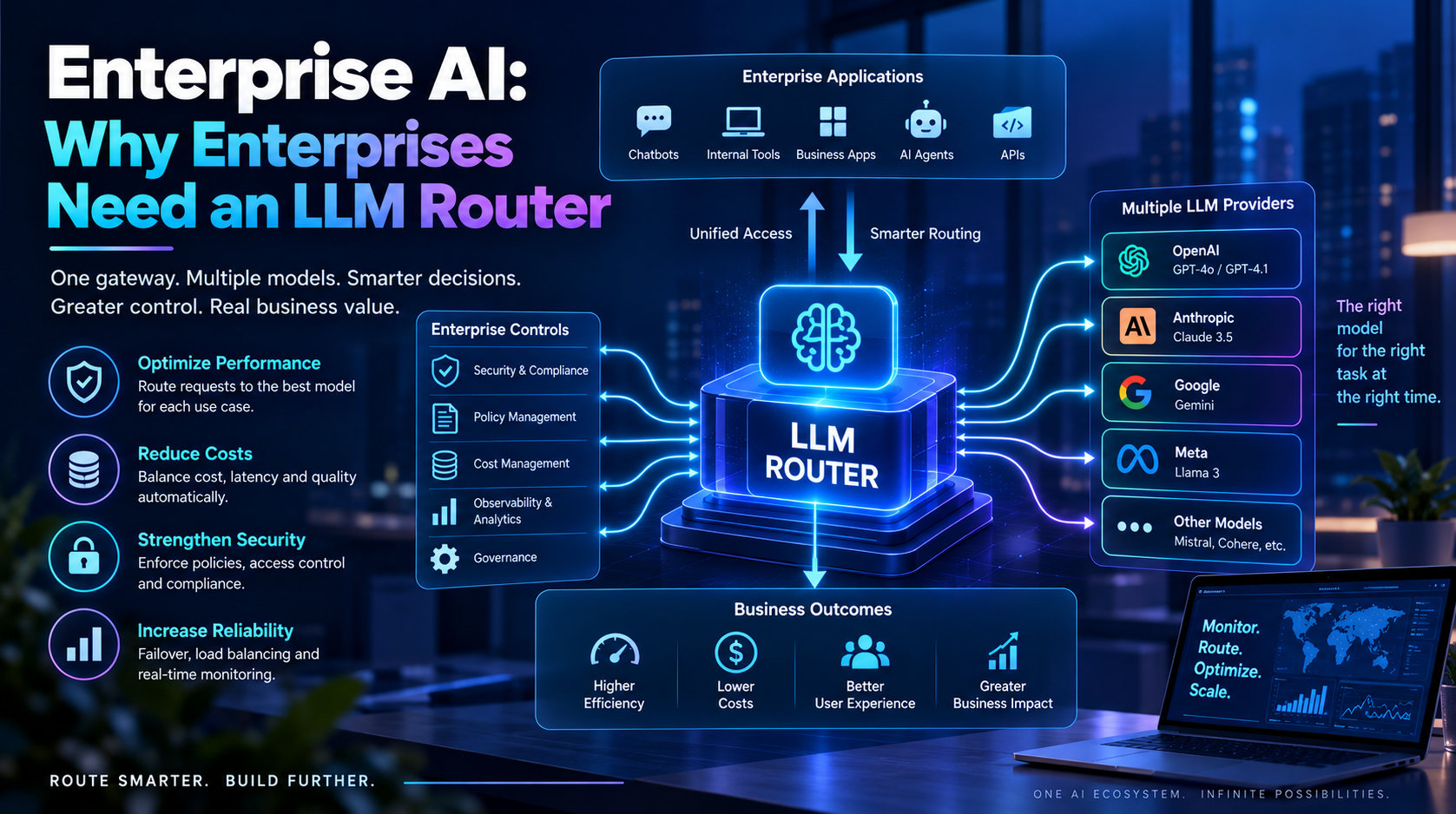
What Is an LLM Router?
An LLM Router is a decision engine that sits between enterprise applications and multiple AI models.
Instead of applications choosing which model to call, they send every request to the router.
The router evaluates the request and automatically selects the most appropriate model.
Enterprise Application

        │

   LLM Router

        │

 ┌──────────────┐
 │ GPT-5.6      │
 │ Claude       │
 │ Gemini       │
 │ Llama        │
 │ Internal LLM │
 └──────────────┘
Applications no longer need provider-specific logic.
Why One Model Is Not Enough
Different models excel at different tasks.
For example:
| Task | Best Model Characteristics |
|---|---|
| Email summarization | Low cost, low latency |
| Customer support | Fast response time |
| Financial analysis | Strong reasoning |
| Software development | Excellent coding ability |
| Translation | High multilingual accuracy |
| Enterprise search | Large context window |
| Internal knowledge | On-premises deployment |
Choosing one model for every workload often leads to:
- Higher AI costs
- Increased latency
- Lower response quality
- Vendor lock-in
An LLM Router solves this optimization problem automatically.
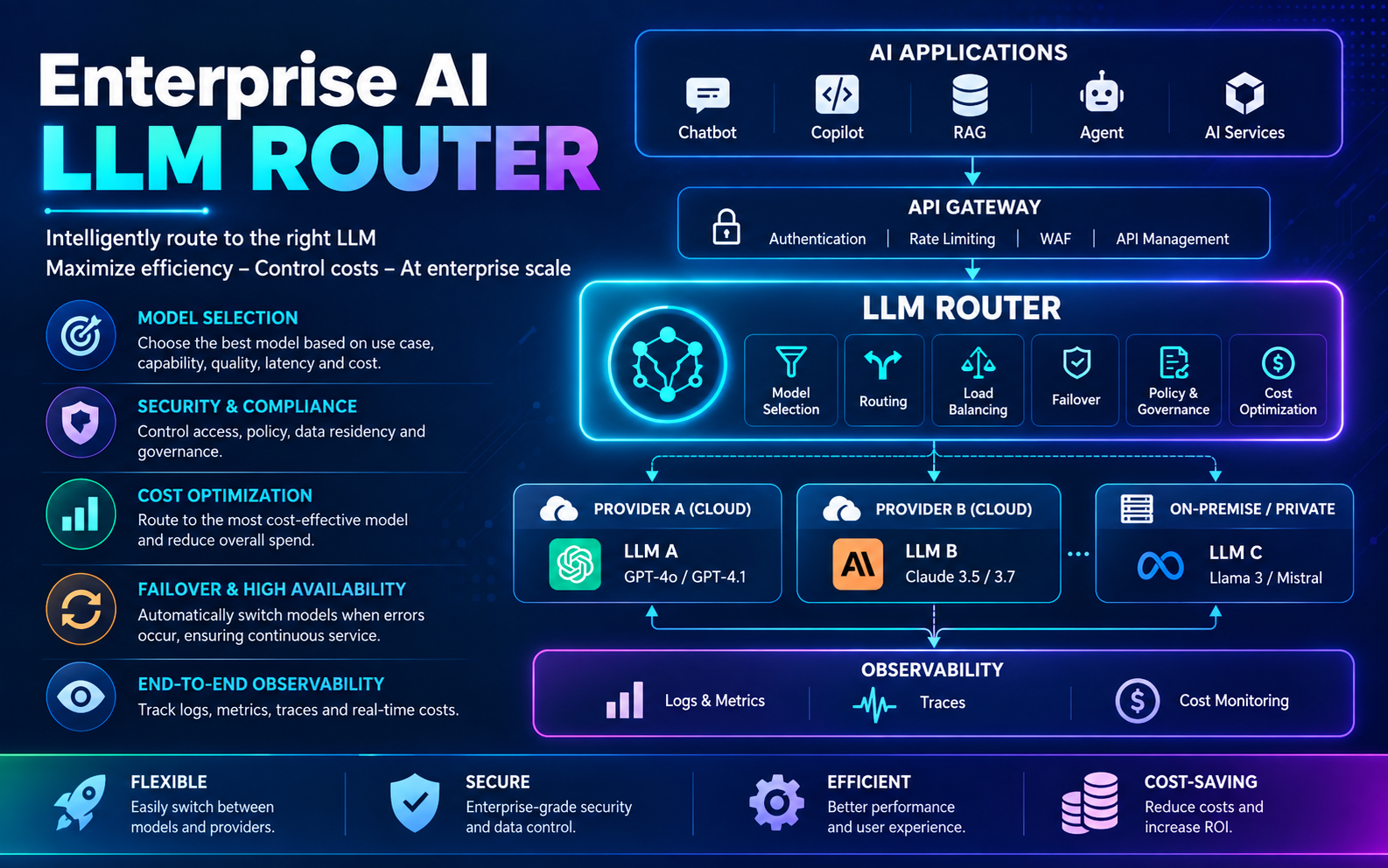
How an LLM Router Works
A typical routing workflow looks like this:
User Request

      │

Enterprise Application

      │

LLM Router

      │

Evaluate:

• Task Type
• Cost Policy
• Latency Target
• Security Rules
• Model Availability

      │

Select Best Model

      │

Response
The router makes the decision before the request reaches an LLM.
Common Routing Strategies
1. Task-Based Routing
Different tasks are assigned to different models.
Example:
Coding Request
      │
      ▼
Code Model

Translation
      │
      ▼
Multilingual Model

Reasoning
      │
      ▼
Reasoning Model
This is the most common routing strategy in enterprise environments.
2. Cost-Based Routing
Organizations can optimize AI spending.
Example:
Simple questions
→ Small, inexpensive model
Complex reasoning
→ Premium reasoning model
This significantly reduces operational costs while maintaining quality.
3. Latency-Based Routing
Some applications require extremely fast responses.
Examples:
- Live chat
- Customer support
- Voice assistants
The router selects the fastest available model instead of the most capable one.
4. Quality-Based Routing
Mission-critical business processes may require the highest accuracy.
Examples include:
- Legal document analysis
- Financial reporting
- Medical decision support
- Compliance reviews
The router prioritizes model quality over speed or cost.
5. Security-Based Routing
Some enterprise data must never leave private infrastructure.
For example:
Public information
→ Cloud LLM
Confidential documents
→ Private LLM
Highly regulated data
→ On-premises model
The router enforces enterprise security policies automatically.
Dynamic Routing
Modern LLM Route





Write Your Review
No reviews yet. Be the first to share your experience!