
As organizations deploy Agentic AI across customer service, software engineering, finance, and business operations, one question becomes increasingly important:
Your AI is running—but is it actually creating business value?
Traditional application monitoring answers questions like:
- Is the service online?
- Is the API responding?
- Is CPU utilization too high?
- Are there infrastructure failures?
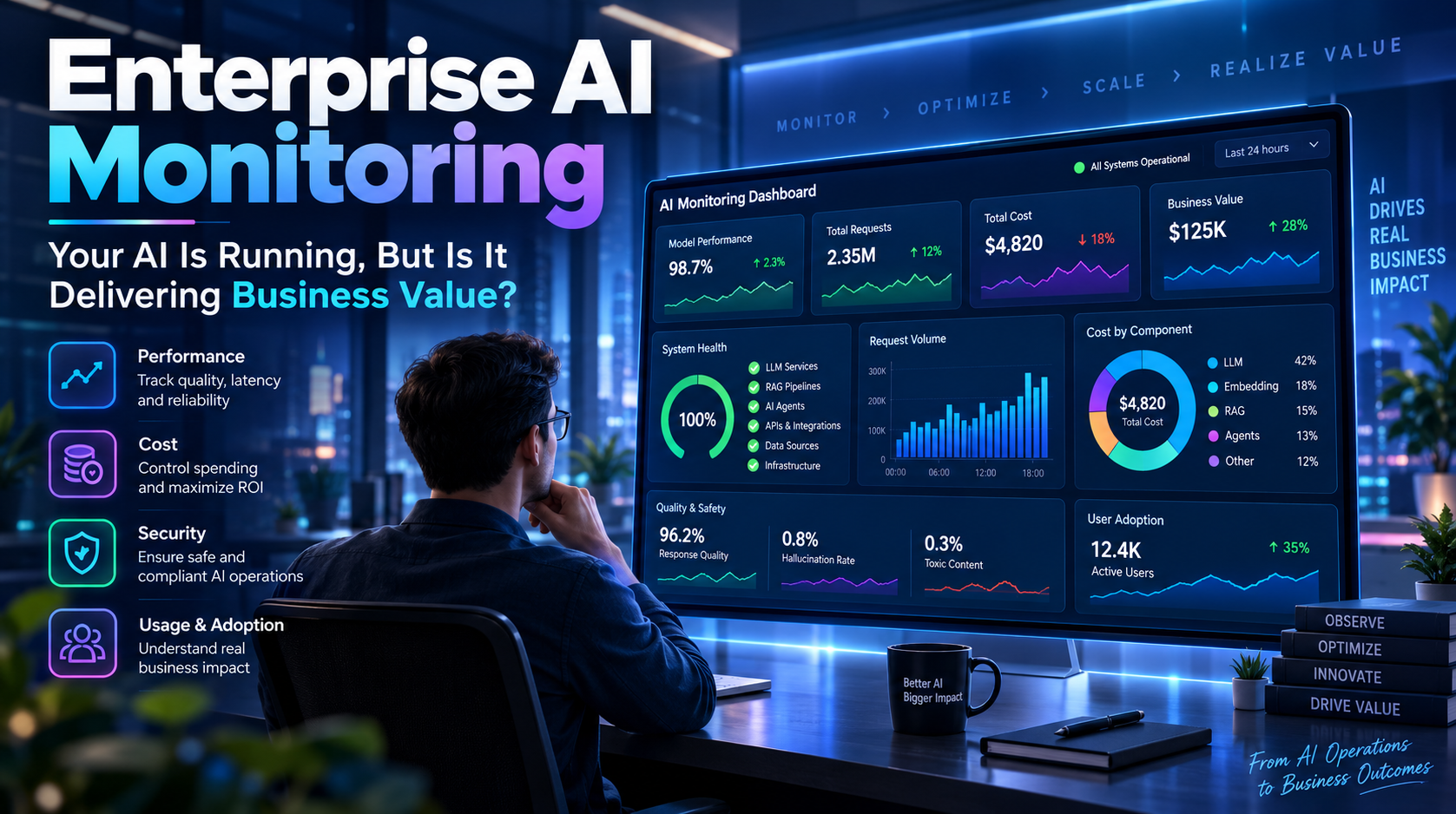
While these metrics remain essential, they tell only part of the story.
Enterprise AI systems introduce entirely new operational challenges. A model may be available, an AI agent may complete its workflow, and every API call may succeed—yet the system could still generate inaccurate responses, waste tokens, increase operational costs, or fail to achieve business objectives.
This is why Enterprise AI Monitoring has become a critical capability for organizations building production-grade Agentic AI platforms.
Why Traditional Monitoring Is No Longer Enough
Monitoring conventional software is relatively straightforward.
Engineers typically track:
- Application availability
- Request latency
- Error rates
- CPU and memory utilization
- Database performance
For AI systems, however, these metrics provide only operational health.
They cannot answer questions such as:
- Are AI responses accurate?
- Are agents making good decisions?
- How much does each workflow cost?
- Which prompts produce the best results?
- Is model quality improving or degrading?
- Are users satisfied with AI-generated outcomes?
AI introduces an entirely new operational layer that requires dedicated observability.
What Should Enterprise AI Monitoring Measure?
A mature AI monitoring strategy should combine technical, operational, and business metrics.
1. Infrastructure Monitoring
The foundation remains traditional infrastructure monitoring.
Typical metrics include:
- CPU utilization
- GPU utilization
- Memory usage
- Network performance
- API availability
- Database health
- Queue length
- Service uptime
These metrics ensure the platform is technically healthy.
2. Model Performance Monitoring
Enterprise AI teams also need visibility into model behavior.
Key indicators include:
- Response latency
- Token consumption
- Prompt execution time
- Context window utilization
- Model selection
- Completion success rate
- Timeout frequency
- Retry rate
These metrics help optimize both performance and operational costs.
3. Agent Monitoring
Agentic AI platforms introduce another layer of complexity.
Each AI agent should be monitored individually.
Important metrics include:
- Tasks completed
- Task success rate
- Planning accuracy
- Tool execution success
- Decision quality
- Average workflow duration
- Failure reasons
- Human intervention rate
This provides insight into how effectively autonomous agents perform their responsibilities.
4. Business KPI Monitoring
Ultimately, AI exists to deliver business outcomes.
Examples include:
Customer Service
- First-contact resolution rate
- Average handling time
- Customer satisfaction (CSAT)
Sales
- Qualified leads generated
- Proposal turnaround time
- Revenue influenced by AI
Software Engineering
- Code review time
- Bug detection rate
- Developer productivity
Finance
- Invoice processing time
- Fraud detection accuracy
- Manual work eliminated
These metrics determine whether AI investments generate measurable value.
5. Cost Monitoring
LLMs consume tokens, APIs, compute resources, and cloud infrastructure.
Organizations should continuously monitor:
- Token usage
- Cost per request
- Cost per workflow
- Cost per department
- Monthly AI spending
- Model-specific costs
Without cost visibility, AI adoption can become financially unsustainable.
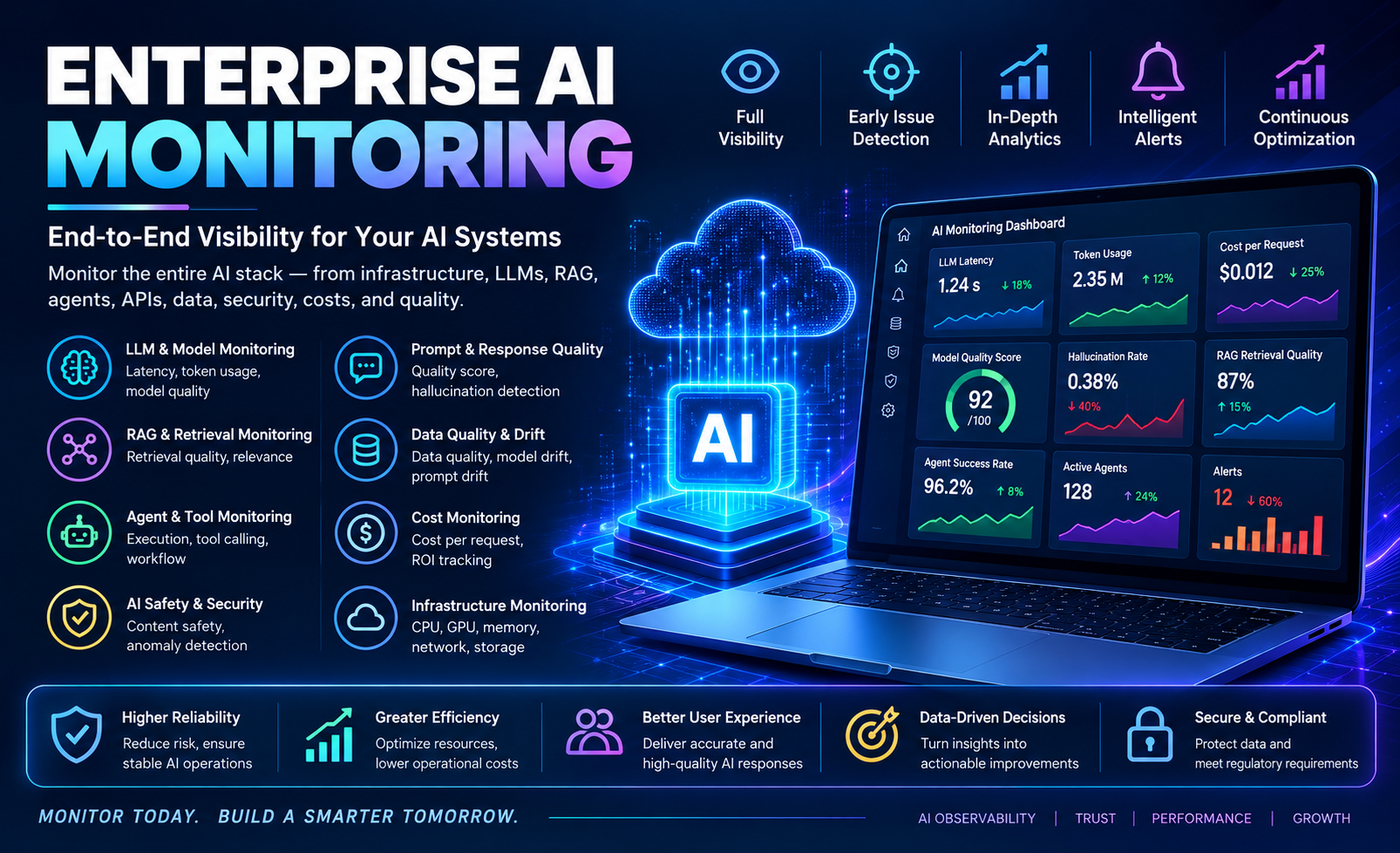
AI Observability Architecture
A modern Enterprise AI Monitoring platform typically includes:
Users

    │

AI Applications

    │

Agent Orchestrator

    │

LLMs ─ Memory ─ Tools ─ RAG

    │

Telemetry Collection

    │

Logs ─ Metrics ─ Traces ─ Evaluations

    │

Monitoring Platform

    │

Dashboards ─ Alerts ─ Reports
Every interaction generates telemetry that enables engineering teams to understand how AI systems behave in production.
Beyond Monitoring: AI Evaluation
Monitoring answers:
“What happened?”
Evaluation answers:
“Was the AI output actually good?”
Organizations should evaluate:
- Response accuracy
- Factual correctness
- Hallucination rate
- Instruction following
- Retrieval quality
- Tool selection accuracy
- Planning quality
- Safety compliance
Many enterprise teams now combine automated LLM-based evaluation with human review to continuously improve model performance.
Tracing Multi-Agent Workflows
Enterprise Agentic AI rarely consists of a single model call.
A typical request may involve:
User

   │

Planner Agent

   │

Research Agent

   │

Retrieval Service

   │

LLM

   │

Report Agent

   │

Approval Agent

   │

Email Agent
If the final result is incorrect, teams need to identify exactly where the workflow failed.
Distributed tracing makes every decision visible across the entire agent pipeline.
Alerting for AI Systems
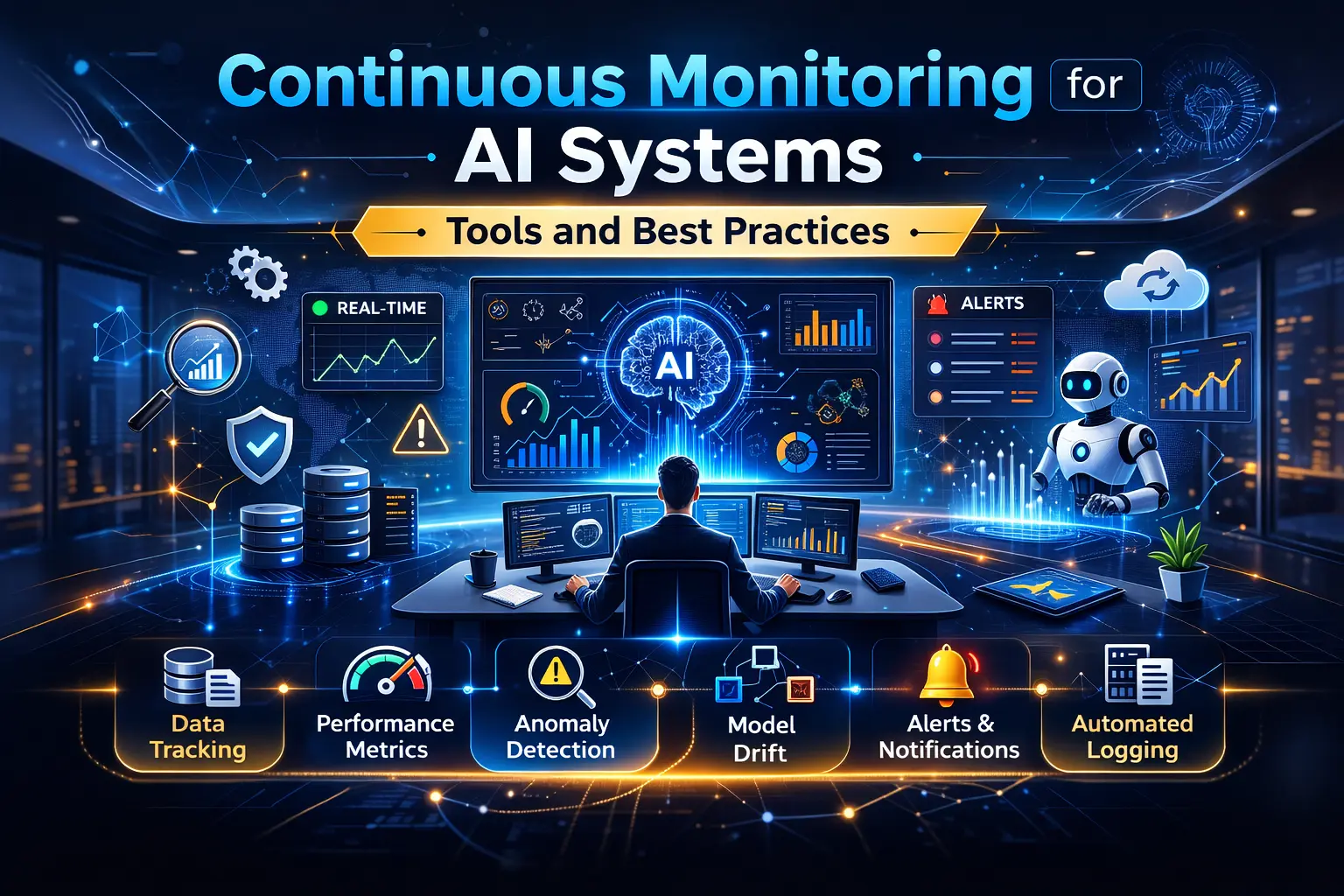
Enterprise AI monitoring should trigger alerts not only for infrastructure failures but also for AI-specific anomalies.
Examples include:
- Hallucination rate exceeds threshold
- Token usage spikes unexpectedly
- Prompt latency increases
- Tool execution failures
- Workflow completion rate declines
- AI cost exceeds budget
- Customer satisfaction drops
- Human override frequency increases
These alerts help teams detect problems before they impact users.
Recommended Monitoring Stack
Many enterprise organizations build AI observability using tools such as:
Infrastructure
- Prometheus
- Grafana
- OpenTelemetry
Logging
- Elasticsearch
- Loki
- Splunk
Tracing
- Jaeger
- Grafana Tempo
- OpenTelemetry
AI Evaluation
- Langfuse
- LangSmith
- Arize AI
- Weights & Biases
- MLflow
Business Analytics
- Microsoft Power BI
- Tableau
- Looker
Together, these tools provide end-to-end visibility across infrastructure, AI workflows, and business outcomes.
Best Practices
Organizations implementing Enterprise AI Monitoring should:
- Define business KPIs before deployment.
- Monitor every AI agent independently.
- Trace every workflow end to end.
- Measure AI quality, not just availability.
- Track token usage and costs continuously.
- Evaluate prompts regularly.
- Combine automated metrics with human feedback.
- Build dashboards for both engineering and business teams.
- Continuously improve AI systems using monitoring insights.
Conclusion
Running an AI system successfully is only the beginning.
The true measure of success is whether AI consistently delivers measurable business value while remaining reliable, cost-effective, and trustworthy.
Enterprise AI Monitoring extends beyond traditional observability by combining infrastructure metrics, model performance, agent behavior, business KPIs, cost analysis, and AI evaluation into a unified operational strategy.
Organizations that invest in comprehensive AI monitoring gain the visibility needed to optimize performance, reduce operational risk, control costs, and maximize the return on their AI investments.
In the era of Agentic AI, the most successful enterprises will not simply build intelligent systems—they will continuously measure, evaluate, and improve them.
Write Your Review
No reviews yet. Be the first to share your experience!