
As Agentic AI systems evolve from proof-of-concept projects to enterprise-scale platforms, architectural requirements change dramatically. While a Modular Monolith is often the best starting point, organizations eventually reach a stage where independent scaling, autonomous development teams, and high availability become essential.
At this point, Microservices Architecture becomes a natural evolution.
Rather than building one large application, each AI capability is deployed as an independent service that can be developed, deployed, and scaled separately.
The key is not to start with microservices too early, but to adopt them when business and operational needs justify the additional complexity.
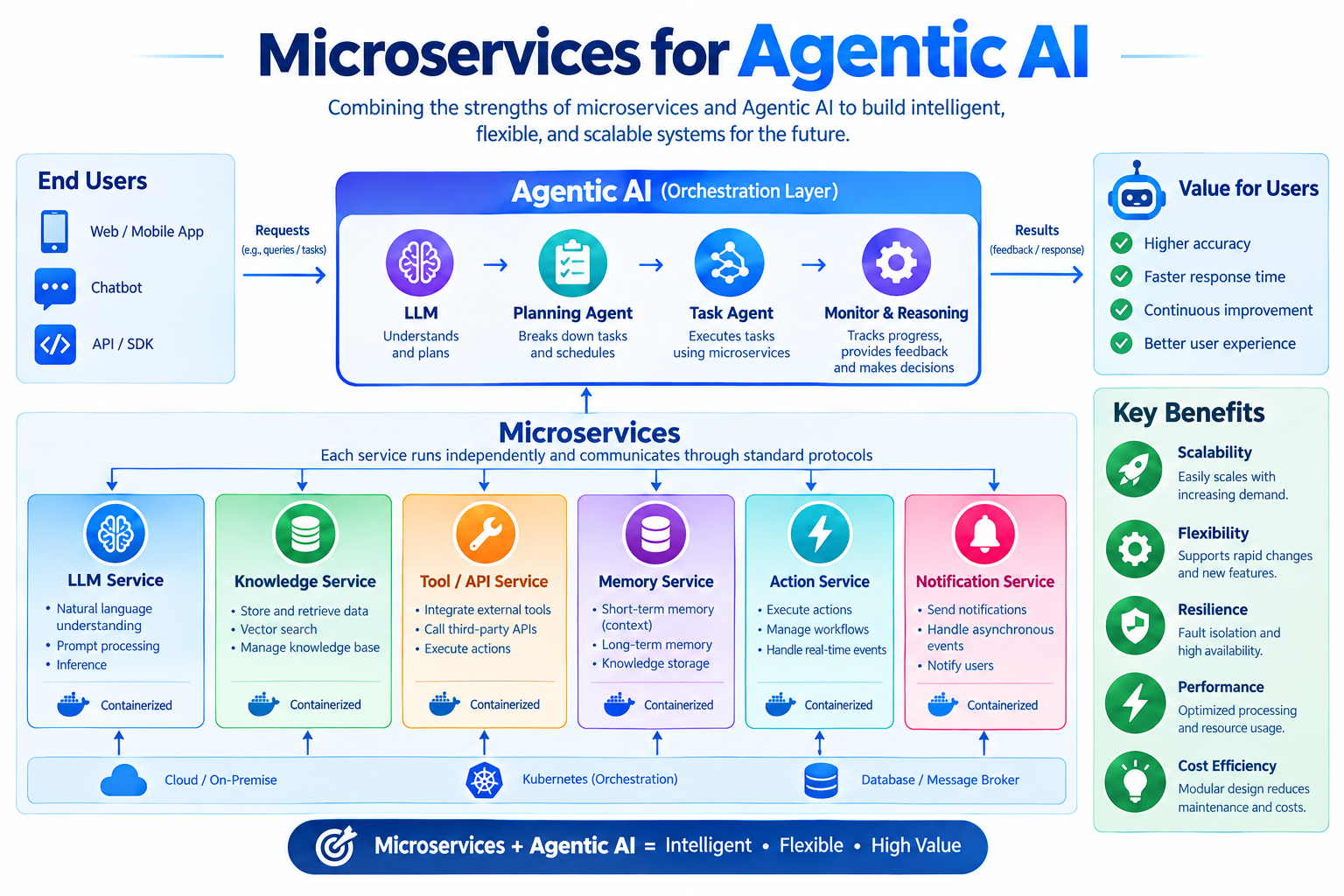
What Is a Microservices Architecture?
Microservices Architecture is a software design approach in which an application is divided into a collection of small, independently deployable services.
Each service owns:
- A specific business capability
- Its own deployment lifecycle
- Independent scalability
- Dedicated APIs or event interfaces
- Often its own data storage
In an Agentic AI platform, each specialized AI agent can become its own microservice.
For example:
Enterprise AI Platform

├── Planner Service
├── Research Service
├── Retrieval (RAG) Service
├── Memory Service
├── Coding Service
├── Analytics Service
├── Report Service
├── Email Service
├── Notification Service
└── Orchestrator
Each service focuses on a single responsibility while collaborating with others through APIs, message queues, or event streams.
Why Use Microservices for Agentic AI?
As AI platforms grow, a single application may no longer meet performance and organizational requirements.
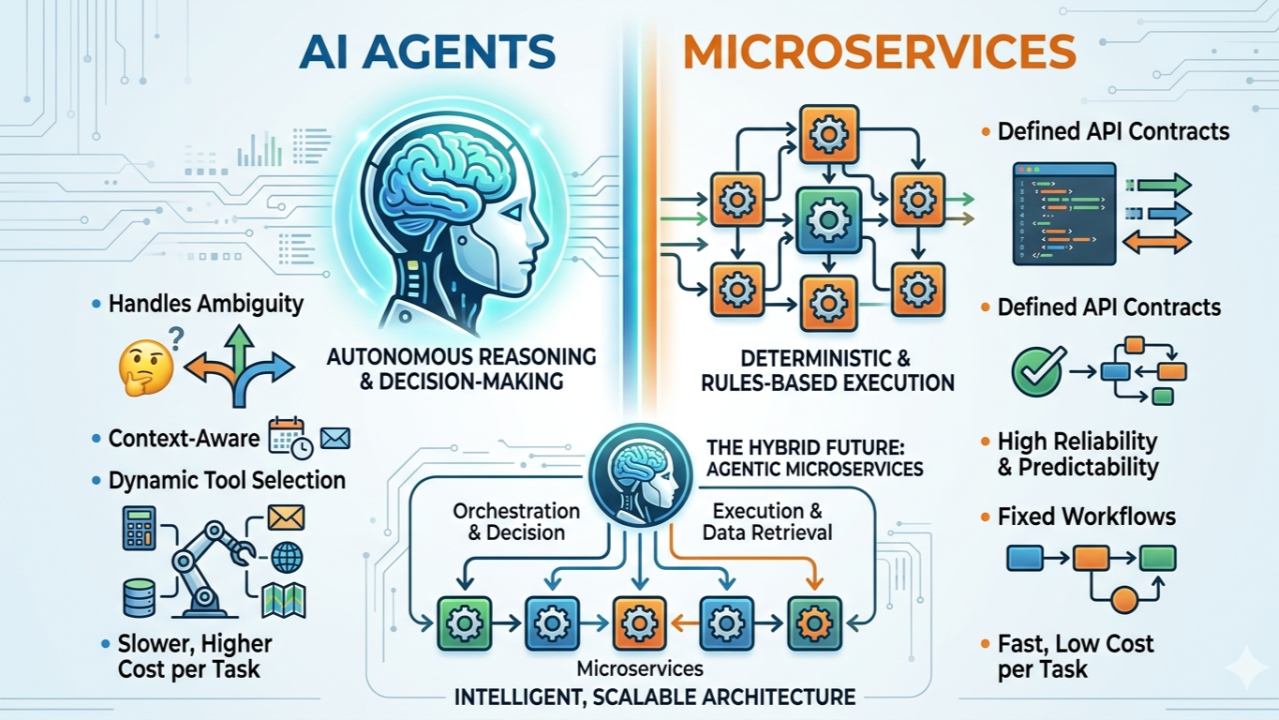
Microservices provide several important advantages.
1. Independent Scaling
Not every AI agent experiences the same workload.
For example:
- Document Processing receives thousands of requests per hour.
- Email Agent processes only hundreds.
- Memory Service serves every workflow.
With microservices, each component can scale independently.
This optimizes infrastructure costs while improving performance.
2. Independent Deployment
Enterprise AI platforms evolve rapidly.
One team may update the Retrieval Agent while another improves the Report Generator.
With microservices:
- Services can be deployed independently.
- New features ship faster.
- Rollbacks affect only one service.
- Downtime is minimized.
3. Technology Flexibility
Different AI workloads may require different technologies.
Examples include:
- Python for LLM orchestration
- Go for high-performance APIs
- Java for enterprise integrations
- Rust for compute-intensive services
Microservices allow each team to choose the most appropriate technology stack.
4. Fault Isolation
Failures should not bring down the entire AI platform.
If the Translation Service becomes unavailable:
- Report generation can continue.
- Analytics remains operational.
- Notifications still work.
Proper isolation improves overall system resilience.
5. Dedicated Infrastructure
Some AI services require specialized hardware.
Examples include:
- GPU clusters for large language models
- Vector databases for semantic search
- High-memory instances for document processing
- CPU-optimized services for orchestration
Microservices enable each workload to run on the infrastructure best suited to its requirements.
Example Enterprise Workflow
Consider the following request:
“Generate a quarterly business report and email it to all regional managers.”
A microservices-based workflow might involve:
User
   │
   ▼
API Gateway
   │
   ▼
Planner Service
   │
   ├────────► Retrieval Service
   ├────────► Analytics Service
   ├────────► Memory Service
   ├────────► Report Service
   ├────────► Compliance Service
   └────────► Email Service
Each service performs its specialized task and returns results through APIs or publishes events to continue the workflow.
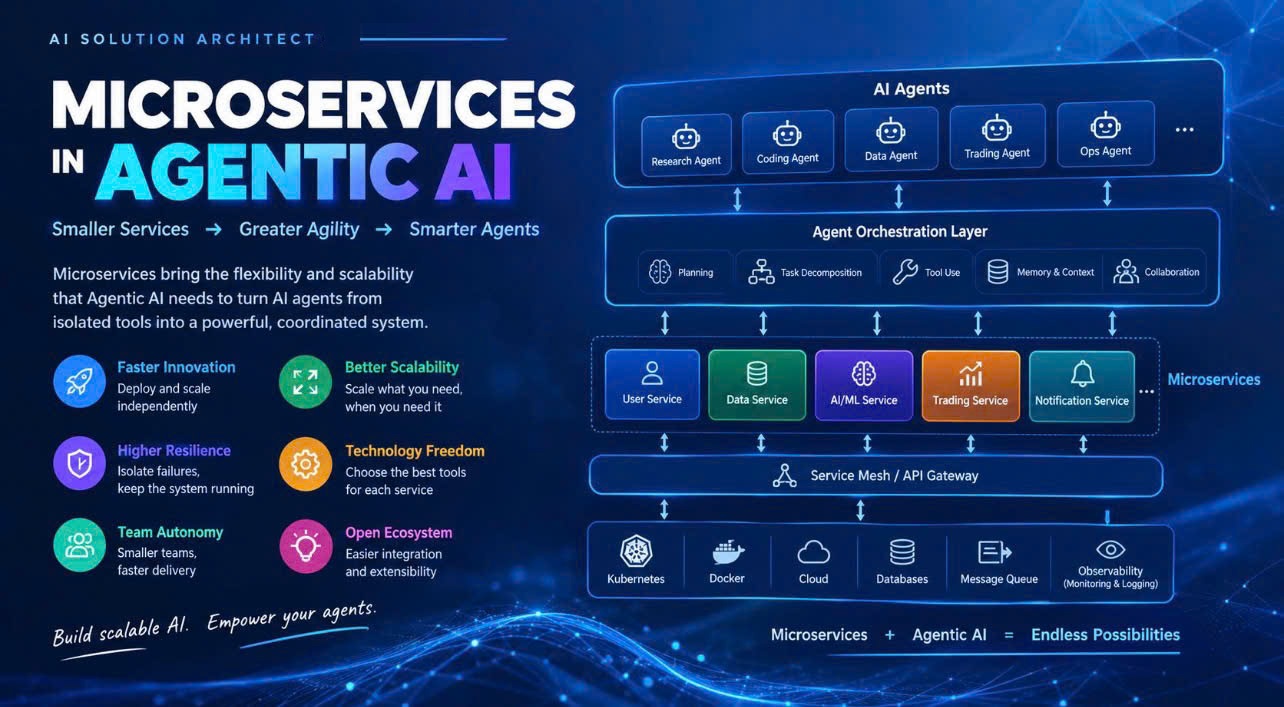
Challenges of Microservices
Despite their advantages, microservices introduce significant operational complexity.
Organizations must address challenges such as:
- Service discovery
- API gateways
- Authentication and authorization
- Network latency
- Distributed transactions
- Observability
- Centralized logging
- Distributed tracing
- Configuration management
- CI/CD pipelines
- Kubernetes orchestration
- Service versioning
Without mature DevOps practices, these challenges can outweigh the benefits.
Best Practices
Successful enterprise Agentic AI platforms often follow these principles:
- Design services around business capabilities rather than technical layers.
- Keep services loosely coupled and highly cohesive.
- Prefer asynchronous communication for long-running AI tasks.
- Implement retries, circuit breakers, and timeout policies.
- Use centralized observability for logs, metrics, and traces.
- Secure inter-service communication with strong authentication.
- Version APIs and events to maintain backward compatibility.
- Automate testing and deployment through CI/CD pipelines.
These practices improve maintainability, resilience, and operational efficiency.
When Should You Adopt Microservices?
Microservices become the right choice when:
- The platform serves millions of requests.
- Multiple engineering teams work independently.
- AI workloads have different scaling requirements.
- Individual agents require dedicated GPU resources.
- High availability and fault isolation are critical.
- Services need to be reused across multiple products.
- Independent release cycles become necessary.
If these conditions do not yet exist, a modular monolith is often the simpler and more cost-effective solution.
Modular Monolith vs. Microservices
| Aspect | Modular Monolith | Microservices |
|---|---|---|
| Initial Development | Faster | Slower |
| Operational Complexity | Low | High |
| Deployment | Single application | Independent services |
| Performance | Higher (in-process communication) | Lower (network communication) |
| Scalability | Application-level | Service-level |
| Fault Isolation | Limited | Excellent |
| Team Independence | Moderate | High |
| Infrastructure Cost | Lower | Higher |
| Best For | Startups, MVPs, Early Enterprise | Large-scale Enterprise Platforms |
Conclusion
Microservices are not the starting point for most Agentic AI initiatives—they are the next stage of architectural evolution.
Organizations should first validate business value with a modular monolith, establish clear boundaries between AI agents, and then extract individual services as demand grows.
When implemented at the right time, Microservices Architecture enables enterprise Agentic AI platforms to achieve greater scalability, resilience, deployment agility, and operational flexibility.
The most successful organizations do not adopt microservices because they are fashionable—they adopt them because their scale, teams, and business requirements genuinely demand a distributed architecture.
Write Your Review
No reviews yet. Be the first to share your experience!