
What Is Agentic AI?
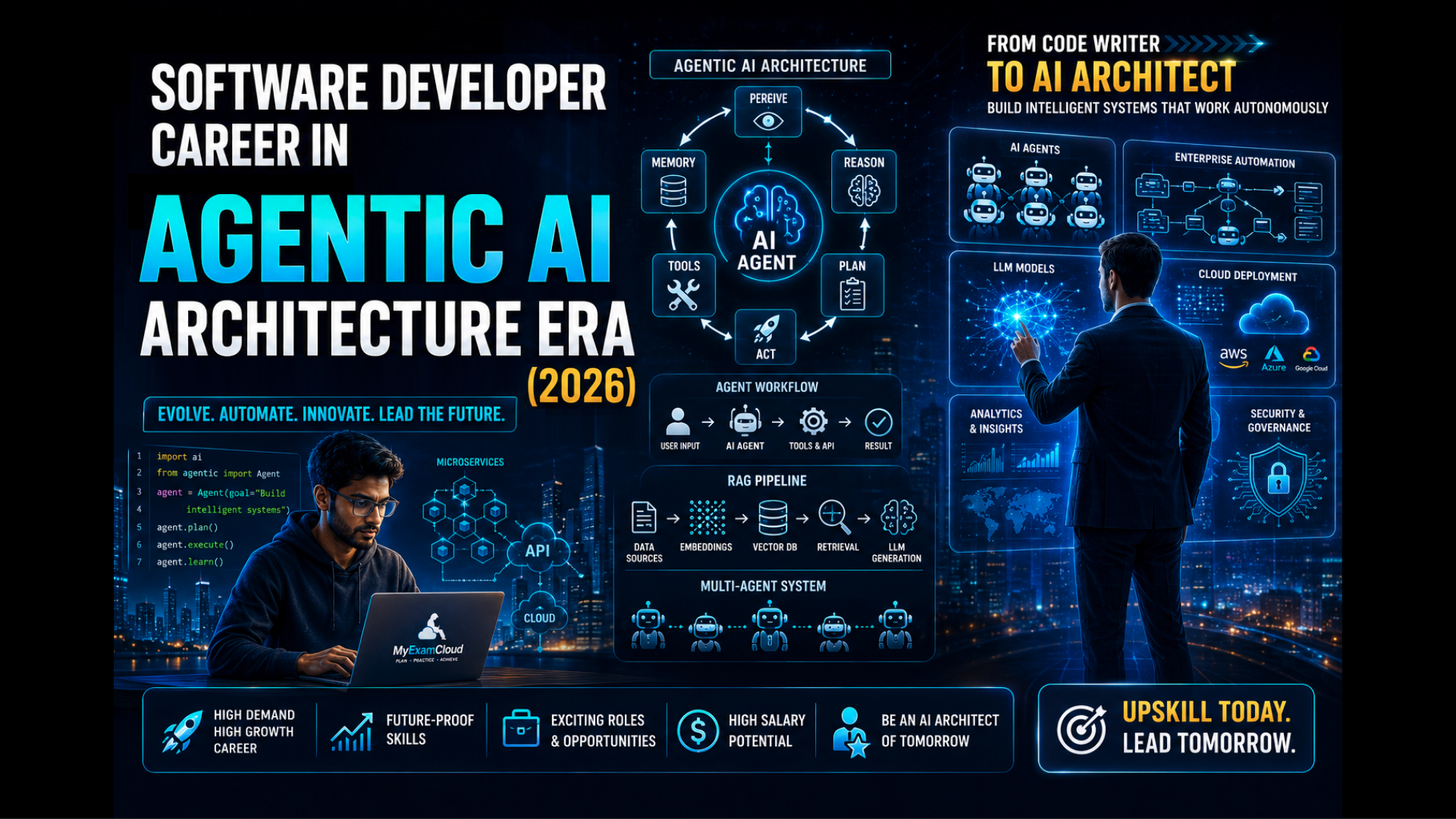
Agentic AI represents the next generation of artificial intelligence capable of planning, reasoning, using tools, maintaining memory, and taking actions to accomplish complex goals rather than simply responding to prompts like traditional chatbots.
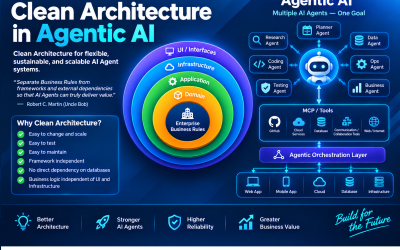
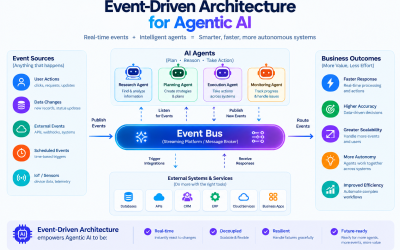
An Agentic AI system typically consists of one or more AI agents coordinated by an orchestrator, allowing them to collaborate and execute multi-step workflows autonomously.
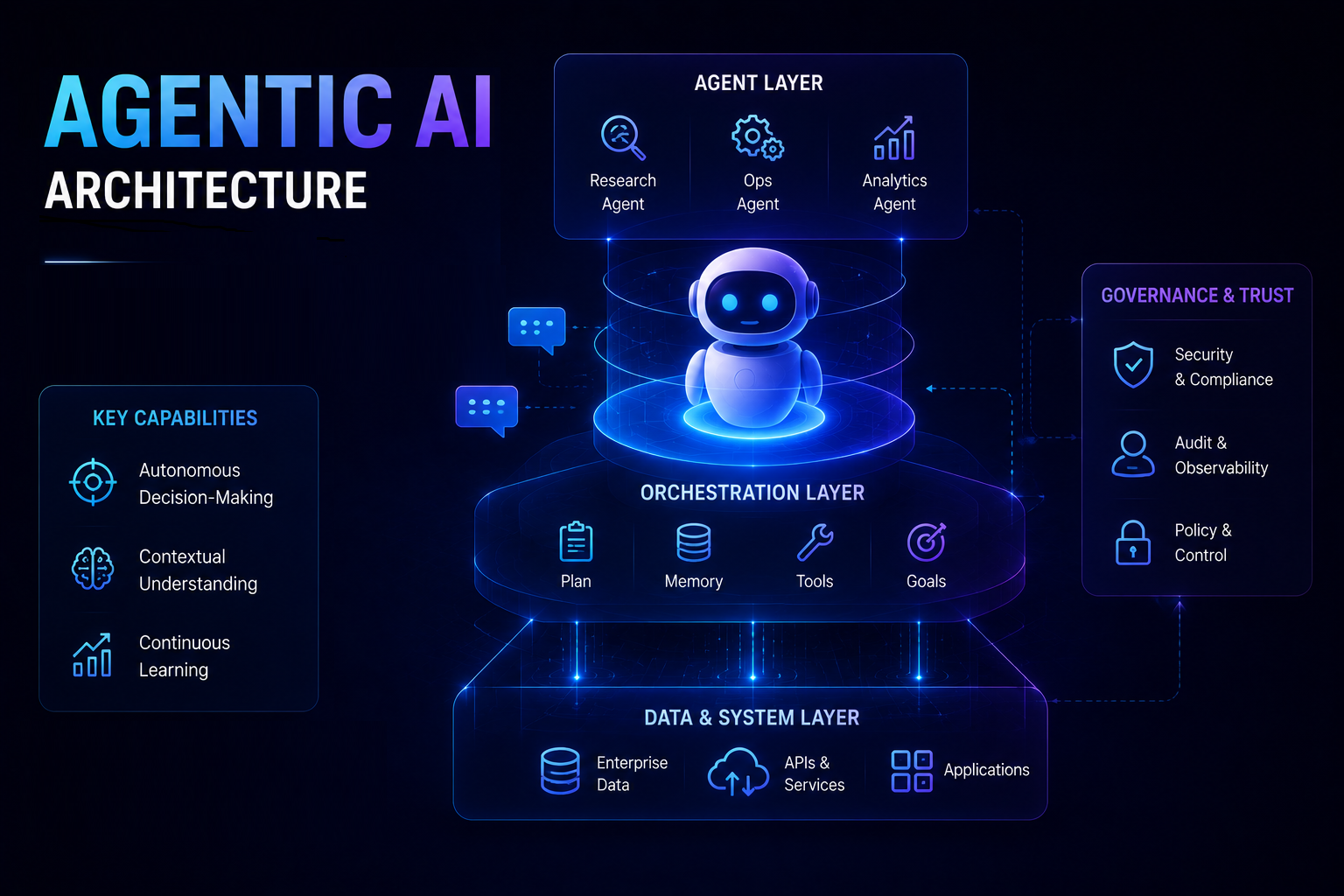
For example:
A user asks:
“Prepare this month's sales report and email it to the executive team.”
Instead of generating only a response, an Agentic AI system can:
- Retrieve data from CRM or ERP systems.
- Analyze sales performance.
- Generate the report.
- Validate the results.
- Draft the email.
- Send it after approval.
This transforms AI from a conversational assistant into an autonomous execution engine.
Why Businesses Shouldn't Start with Microservices
When organizations hear about Multi-Agent AI, many immediately assume that each AI agent should be deployed as an independent microservice.
In reality, this often introduces unnecessary complexity.
A microservices architecture requires solving challenges such as:
- Service Discovery
- API Gateway
- Authentication & Authorization
- Message Queues
- Distributed Logging
- Monitoring
- Versioning
- CI/CD Pipelines
- Network Latency
At the early stages of AI adoption, these operational costs frequently outweigh the business value the system delivers.
For most organizations building their first Agentic AI solution, starting with microservices creates more engineering overhead than practical benefit.
Why a Monolithic Architecture Is a Better Starting Point
Instead of separating every AI agent into its own service, organizations can implement the entire Agentic AI platform as a Modular Monolith.
This does not mean putting all application logic into one large codebase without structure.
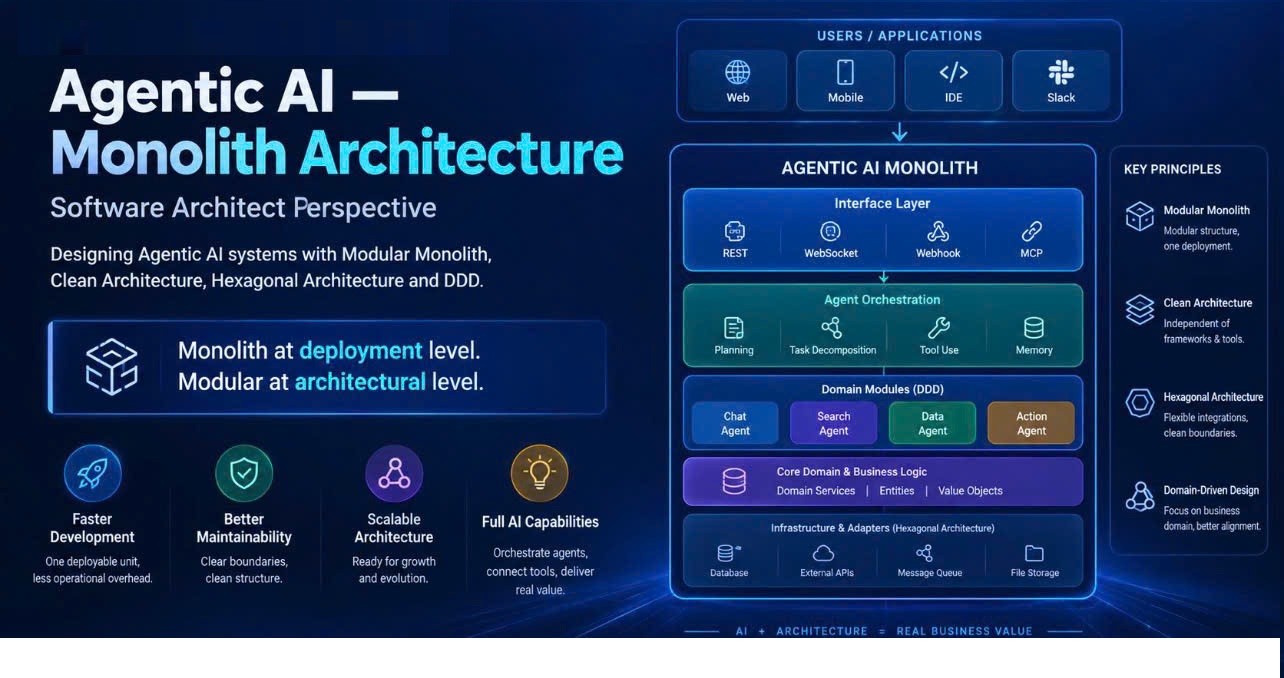
Instead, each agent remains an independent module:
Application

├── Planner Agent
├── Research Agent
├── Data Agent
├── Coding Agent
├── Report Agent
├── Email Agent
├── Memory
├── Tools
└── Orchestrator
Rather than communicating through HTTP or messaging systems, these modules interact via internal interfaces within the same application process.
This approach significantly reduces operational complexity while maintaining clear boundaries between agents, making future migration to microservices much easier.
Benefits of Starting with a Monolithic Architecture
1. Faster Development and Deployment
A modular monolith requires only:
- One repository
- One Docker image
- One deployment
- One database
There is no immediate need for Kubernetes, service meshes, or complex infrastructure.
2. Easier Debugging
When an AI agent behaves unexpectedly, all logs exist within a single application.
Developers no longer need to trace requests across multiple distributed services.
This dramatically simplifies troubleshooting.
3. Efficient Context Sharing
AI agents often need access to shared information, including:
- User context
- Memory
- Cache
- Session data
- Prompt history
Within a monolithic application, this data can be shared directly in memory, eliminating unnecessary API calls and reducing latency.
4. Better Performance
With microservices, a workflow might look like:
Planner
    ↓ HTTP
Research
    ↓ HTTP
Data
    ↓ HTTP
Report
Each service call introduces:
- Network latency
- Serialization overhead
- Authentication
- Retry mechanisms
In a monolithic architecture, the workflow becomes:
Planner
    ↓
Research
    ↓
Data
    ↓
Report
Since communication occurs through internal function calls, execution is significantly faster and more efficient.
5. Centralized Governance
Cross-cutting concerns such as:
- Authentication
- Authorization
- AI Safety
- Prompt Guardrails
- Logging
- Auditing
can all be managed in one place.
This simplifies governance, compliance, and security across the entire AI platform.
When Should You Move to Microservices?
A monolithic architecture is an excellent starting point, but it is not necessarily the final destination.
Organizations should consider extracting individual AI agents into microservices when:
- A specific agent experiences very high traffic.
- Multiple development teams require independent deployments.
- Certain agents require dedicated GPU resources.
- Independent horizontal scaling becomes necessary.
- Other applications need to consume an agent as a standalone service.
If the system was originally designed as a well-structured modular monolith, migrating individual agents into microservices becomes a gradual and low-risk process.
A Recommended Evolution Path
A practical adoption roadmap is:
| Stage | Architecture |
|---|---|
| Proof of Concept | Single AI Agent |
| MVP | Modular Monolith |
| Growth | Multi-Agent Modular Monolith |
| Enterprise Scale | Hybrid or Microservices |
This strategy enables organizations to deliver business value quickly while introducing architectural complexity only when it becomes necessary.
Conclusion
Agentic AI is redefining enterprise automation by enabling AI agents to reason, plan, use tools, and collaborate to complete complex business tasks autonomously.
However, success depends not only on selecting the right AI models but also on choosing the right software architecture.
For most organizations, a Modular Monolith provides the ideal foundation. It reduces operational complexity, accelerates development, simplifies debugging, improves performance, and still offers a clear migration path toward microservices as the platform grows.
Instead of beginning with distributed complexity, businesses should focus on delivering value first—and evolve their architecture only when scale truly demands it.
Write Your Review
No reviews yet. Be the first to share your experience!