
How Artificial Intelligence Is Transforming Business Productivity in 2026?
In 2026, businesses are entering a new era of productivity powered by artificial intelligence. AI workflow automation is changing how companies operate by reducing manual tasks, improving efficiency, and allowing employees to focus on higher-value activities.
Unlike traditional automation, AI-powered workflows can understand information, make decisions, analyze data, and adapt to changing situations. From marketing and customer service to finance and operations, AI automation is becoming a key strategy for businesses looking to scale faster.
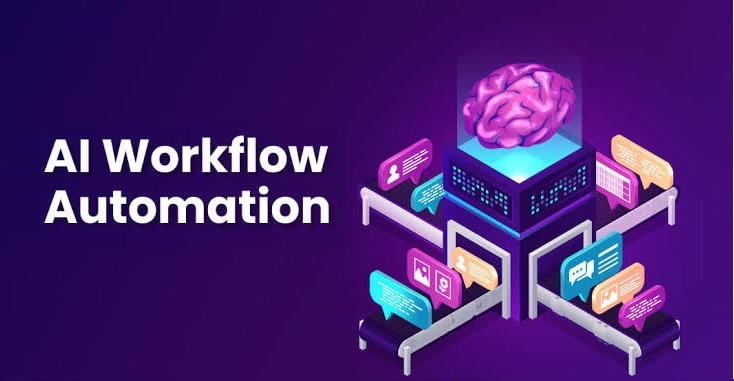
What Is AI Workflow Automation?
AI workflow automation combines artificial intelligence with automation technology to complete business processes with minimal human intervention.
Traditional automation follows fixed rules, while AI automation can learn from data, recognize patterns, and make intelligent decisions. This allows businesses to automate more complex tasks such as customer support, content creation, data analysis, and business reporting.
Examples of AI workflow automation include:
- Automatically responding to customer inquiries
- Generating marketing content
- Analyzing sales data
- Managing email campaigns
- Creating business reports
- Scheduling meetings and tasks
1. AI-Powered Content Creation
Content marketing requires significant time and resources. AI workflow automation helps businesses create articles, social media posts, product descriptions, and email campaigns faster.
Tools like ChatGPT, Jasper AI, and Canva AI allow marketers to generate ideas, create drafts, design visuals, and optimize content for different audiences.
Business impact:
- Faster content production
- Lower marketing costs
- More consistent brand communication
2. Automated Customer Support
AI chatbots and virtual assistants are transforming customer service. Businesses can provide 24/7 support while reducing the workload for human agents.
AI systems can answer common questions, process requests, recommend products, and transfer complex issues to human employees when necessary.
Business impact:
- Faster customer responses
- Improved customer satisfaction
- Reduced support costs

3. Intelligent Data Analysis
Modern businesses generate huge amounts of data every day. AI automation helps companies analyze information, identify trends, and make better decisions.
AI-powered analytics tools can automatically create reports, detect problems, and provide recommendations based on real-time data.
Business impact:
- Better decision-making
- Faster insights
- Improved business strategies
4. Automated Business Operations
AI workflow tools such as Zapier AI, Microsoft Copilot, and Notion AI help companies automate repetitive administrative tasks.
Businesses can connect different applications, manage documents, update databases, and coordinate projects without manual effort.
Business impact:
- Increased employee productivity
- Fewer repetitive tasks
- More efficient workflows
5. AI Marketing Automation
Marketing teams are using AI to personalize customer experiences and improve campaign performance. AI can analyze customer behavior, segment audiences, optimize advertisements, and recommend the best marketing strategies.
Business impact:
- Higher conversion rates
- Better customer targeting
- Improved ROI
Final Thoughts
AI workflow automation is becoming one of the most important technologies for businesses in 2026. By combining artificial intelligence with automation, companies can reduce operational costs, improve productivity, and create more efficient processes.
The future of work will not be about replacing humans with AI—it will be about enabling people to work smarter with intelligent technology. Businesses that successfully implement AI workflows will gain a significant advantage through faster operations, better decision-making, and increased innovation.
For companies starting their AI journey, the best approach is to begin with simple workflows such as content creation, customer support, and task automation before expanding into more advanced AI-powered systems.
Write Your Review
No reviews yet. Be the first to share your experience!