
Landing pages are a critical part of modern digital marketing, helping businesses convert website visitors into qualified leads and customers. Two popular solutions for creating landing pages are Leadpages and HubSpot Landing Pages. While both platforms allow users to build professional, high-converting pages without coding, they are designed with different priorities in mind.
Leadpages is a dedicated landing page builder focused on speed, simplicity, affordability, and conversion optimization. It is widely used by entrepreneurs, small businesses, agencies, coaches, and SaaS startups that need to launch marketing campaigns quickly.
HubSpot Landing Pages, on the other hand, are part of the broader HubSpot CRM Platform. Instead of functioning as a standalone landing page builder, HubSpot integrates landing pages with CRM, email marketing, marketing automation, customer service, and sales tools, making it an attractive solution for businesses seeking an all-in-one growth platform.
This comparison examines the strengths and weaknesses of Leadpages and HubSpot Landing Pages, covering features, pricing, ease of use, integrations, marketing automation, and the types of businesses each platform serves best.
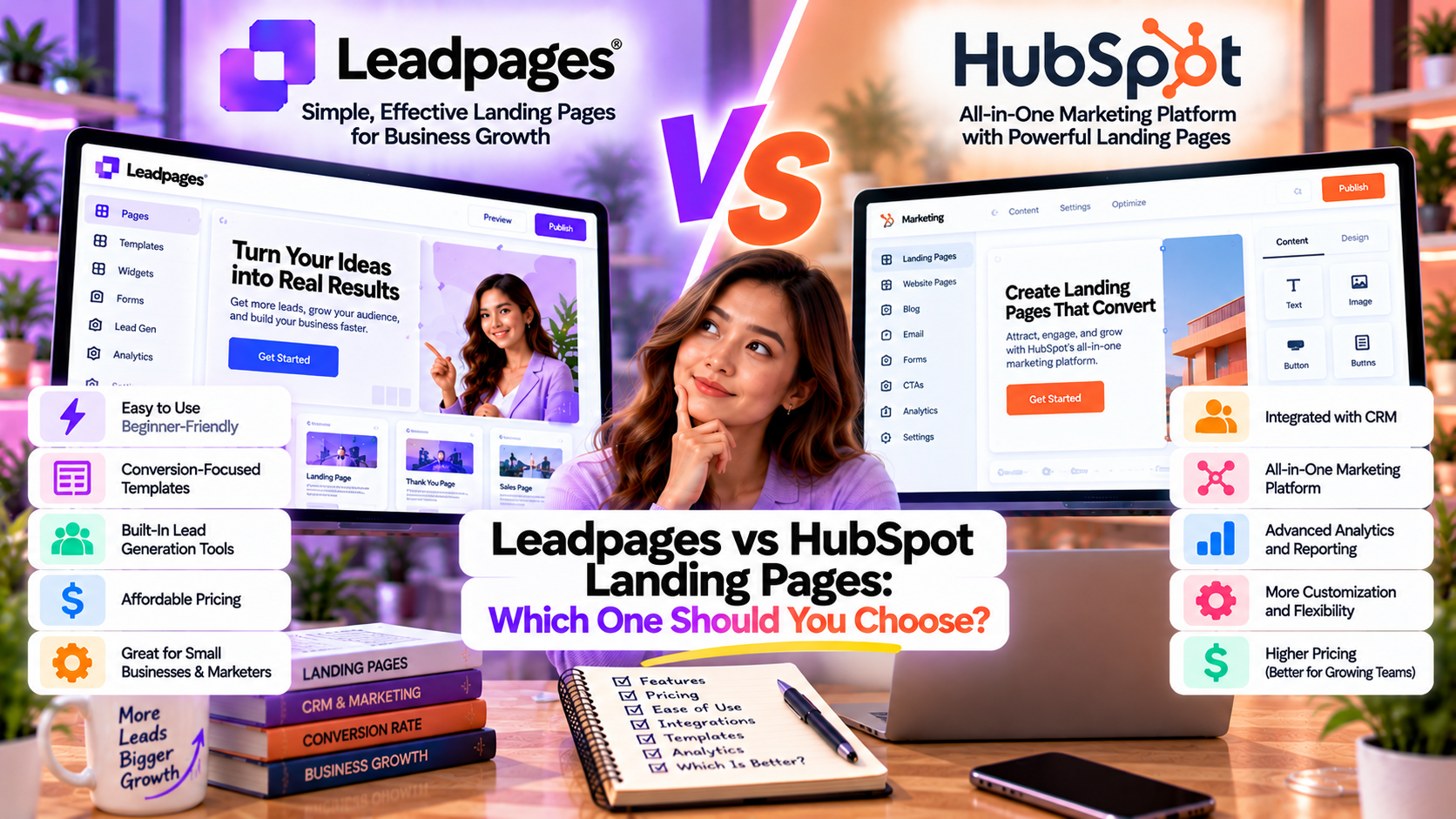
Quick Comparison
| Feature | Leadpages | HubSpot Landing Pages |
|---|---|---|
| Primary Purpose | Landing Page Builder | CRM & Marketing Platform |
| Ease of Use | ⭐⭐⭐⭐⭐ | ⭐⭐⭐⭐☆ |
| Landing Page Builder | Excellent | Excellent |
| CRM | Integrates with CRM | Built-in CRM |
| Marketing Automation | Via Integrations | Native |
| AI Features | Good | Very Good |
| Templates | 250+ | 200+ |
| A/B Testing | Yes | Yes |
| Best For | SMBs & Entrepreneurs | Growing Businesses & Enterprises |
| Pricing | More Affordable | Higher |
Platform Overview
What is Leadpages?
Leadpages is a no-code platform designed to help businesses create landing pages that generate leads and improve conversions.
Key features include:
- Drag-and-drop editor
- AI-powered page creation
- Landing page templates
- Pop-ups
- Alert bars
- Lead capture forms
- A/B testing
- Analytics
- CRM integrations
It focuses on helping businesses publish landing pages quickly without requiring technical expertise.
What is HubSpot Landing Pages?
HubSpot Landing Pages are part of HubSpot's Marketing Hub.
Instead of operating as a standalone landing page builder, they connect directly with:
- HubSpot CRM
- Email marketing
- Marketing automation
- Lead scoring
- Sales pipelines
- Customer segmentation
- Analytics dashboards
The platform is designed to manage the entire customer lifecycle from first visit to long-term customer retention.
Landing Page Builder
Both platforms offer intuitive visual editors.
Leadpages
Strengths include:
- Fast page creation
- Beginner-friendly interface
- AI-generated landing pages
- Conversion-focused templates
- Quick publishing
Perfect for marketers who prioritize speed.
HubSpot
HubSpot's builder is also user-friendly and integrates directly with the CRM.
Advantages include:
- Personalized content
- Smart modules
- Dynamic CTAs
- CRM-connected forms
However, many advanced capabilities depend on higher-tier HubSpot plans.
Winner: Leadpages for simplicity.
CRM Integration
This is HubSpot's biggest advantage.
Leadpages
Integrates with:
- HubSpot
- Salesforce
- Zoho CRM
- Pipedrive
- ActiveCampaign
- Mailchimp
Businesses can continue using their preferred CRM.
HubSpot
CRM functionality is built directly into the platform.
Every landing page submission automatically becomes a CRM contact, allowing businesses to:
- Track interactions
- Score leads
- Assign sales representatives
- Trigger workflows
- Manage customer relationships
Winner: HubSpot
Marketing Automation
Leadpages
Automation is achieved through integrations with third-party platforms.
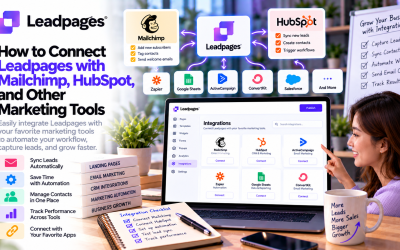
Users commonly connect Leadpages with:
- HubSpot
- Mailchimp
- ActiveCampaign
- ConvertKit
- Zapier
This approach offers flexibility while allowing businesses to keep existing workflows.
HubSpot
HubSpot includes advanced native automation features such as:
- Email sequences
- Lead nurturing
- Workflow automation
- Behavioral triggers
- Customer segmentation
- Lifecycle management
Everything operates from a single dashboard.
Winner: HubSpot
AI Features
Leadpages
Provides AI tools that assist with:
- Landing page creation
- Content generation
- Faster design
Useful for accelerating campaign development.
HubSpot
HubSpot's AI capabilities extend across the entire platform.
Examples include:
- AI content assistance
- Email generation
- Workflow recommendations
- CRM insights
- Predictive reporting
Its AI ecosystem is broader than Leadpages.
Winner: HubSpot
Templates
Leadpages
Offers more than 250 professionally designed templates covering:
- SaaS
- Ecommerce
- Consulting
- Coaching
- Lead magnets
- Webinars
- Product launches
Templates are optimized for conversions and easy customization.
HubSpot
Provides high-quality templates integrated with the HubSpot ecosystem.
Templates support:
- Dynamic personalization
- CRM data
- Smart content
Although slightly fewer in number, they integrate deeply with marketing automation.
Winner: Tie
Integrations
Leadpages
Supports over 90 integrations, including:
- HubSpot
- Salesforce
- Zapier
- Mailchimp
- Stripe
- Google Analytics
- Facebook Pixel
Its open ecosystem makes it easy to connect with existing marketing tools.
HubSpot
Although it integrates with thousands of applications through its marketplace, many users rely primarily on HubSpot's native ecosystem.
Businesses already using HubSpot benefit from seamless connectivity.
Winner: Tie
Ease of Use
Leadpages
One of the easiest landing page builders available.
Most users can launch campaigns within an hour.
HubSpot
Although user-friendly, the platform includes CRM, automation, reporting, and sales tools that require more training.
New users often need additional time to understand the complete ecosystem.
Winner: Leadpages
Pricing
Pricing can significantly influence the decision.
Leadpages
Advantages:
- Lower monthly cost
- Affordable for startups
- Excellent value
- Predictable pricing
HubSpot
Landing Pages are included within HubSpot's broader platform.
As businesses require additional automation, CRM, or reporting capabilities, subscription costs can increase substantially.
However, organizations replacing multiple marketing tools may find strong long-term value.
Winner: Leadpages
Performance
Both platforms provide:
- Secure hosting
- Mobile-responsive pages
- Fast loading
- Reliable infrastructure
HubSpot offers additional customer intelligence through CRM data, while Leadpages emphasizes simplicity and rapid deployment.
Winner: Tie
Pros and Cons
Leadpages
Pros
- Affordable pricing
- Extremely easy to use
- AI-powered page creation
- Excellent template library
- Strong conversion tools
- Fast deployment
- Works with multiple CRM platforms
Cons
- CRM sold separately
- Automation depends on integrations
- Limited personalization compared to HubSpot
HubSpot Landing Pages
Pros
- Built-in CRM
- Advanced automation
- Smart personalization
- Powerful reporting
- AI throughout the platform
- Excellent customer lifecycle management
Cons
- Higher pricing
- Larger learning curve
- Best value when using the full HubSpot ecosystem
Which Platform Should You Choose?
Choose Leadpages if:
- You need standalone landing pages.
- You already use another CRM.
- Budget is important.
- You want rapid campaign deployment.
- You're a startup or small business.
- Simplicity is your priority.
Choose HubSpot Landing Pages if:
- You already use HubSpot CRM.
- Marketing automation is essential.
- You need lead scoring.
- You want personalized customer journeys.
- Your sales and marketing teams work together in one platform.
- You prefer an all-in-one growth solution.
Real-World Use Cases
SaaS Startups
Leadpages enables startups to launch free trial pages, product announcements, and lead generation campaigns quickly while integrating with their preferred CRM.
Enterprise Organizations
HubSpot Landing Pages integrate directly with CRM records, allowing marketing and sales teams to manage leads, automate follow-ups, and track customer journeys from a single platform.
Marketing Agencies
Leadpages is often the preferred choice for agencies managing campaigns across multiple clients because it integrates easily with different CRM and email marketing systems.
B2B Companies
Businesses with long sales cycles benefit from HubSpot's lead scoring, workflow automation, and CRM-powered personalization to nurture prospects more effectively.
Small Businesses
For organizations seeking an affordable and easy-to-use landing page solution, Leadpages offers all the essential features needed to generate leads without investing in a complete marketing automation platform.
Final Verdict
Leadpages and HubSpot Landing Pages are both excellent tools, but they are designed for different marketing strategies.
Leadpages is the better choice for businesses that need a dedicated landing page platform. Its intuitive drag-and-drop editor, AI-powered page generation, extensive template library, affordable pricing, and strong conversion-focused features make it ideal for entrepreneurs, consultants, agencies, SaaS startups, and small businesses looking to launch campaigns quickly and efficiently.
HubSpot Landing Pages, however, are part of a much larger ecosystem. Their true strength lies in seamless integration with HubSpot CRM, marketing automation, lead scoring, personalization, and analytics. Businesses already invested in HubSpot can manage the entire customer journey—from first visit to closed sale—without relying on multiple third-party tools.
If your priority is creating high-converting landing pages at an affordable price, Leadpages delivers exceptional value. If your business requires advanced CRM capabilities, marketing automation, and an integrated sales and marketing platform, HubSpot Landing Pages provide a more comprehensive long-term solution.

Write Your Review
No reviews yet. Be the first to share your experience!