
Time has become one of the most valuable assets in today's workplace. Professionals across industries are expected to accomplish more with fewer resources while maintaining high-quality results. Fortunately, artificial intelligence (AI) has evolved from an experimental technology into an everyday productivity assistant.
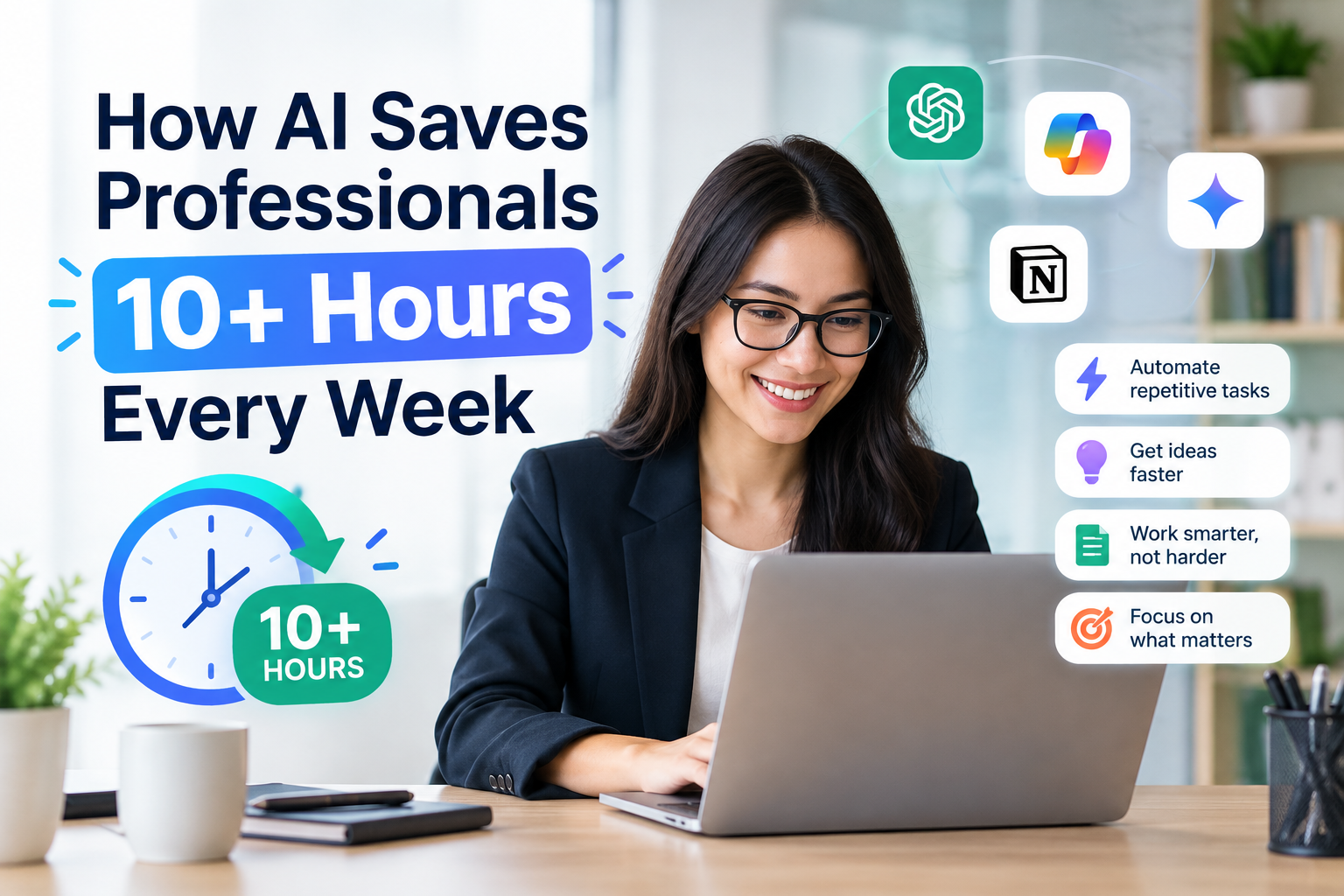
Whether you're a marketer, developer, project manager, consultant, freelancer, or business owner, AI can eliminate repetitive work, accelerate decision-making, and improve overall efficiency. By automating routine tasks, many professionals are now reclaiming more than 10 hours every week—time that can be redirected toward strategic thinking, creativity, and business growth.
This article explores where those hours are saved and how AI is transforming daily work.
1. Writing Emails in Minutes Instead of Hours
Email remains one of the biggest productivity drains.
Many professionals spend one to two hours every day writing, replying to, and organizing emails.
AI assistants can:
- Draft professional emails instantly
- Rewrite messages with different tones
- Summarize long email threads
- Translate multilingual conversations
- Generate follow-up responses
Typical time saved:
- Before AI: 15–20 minutes per important email
- With AI: 2–5 minutes
For professionals handling dozens of emails daily, this alone can save several hours each week.
2. Instant Document Summarization
Business professionals constantly review:
- Reports
- Contracts
- Research papers
- Meeting notes
- Technical documentation
Instead of reading every page, AI can extract:
- Key points
- Risks
- Action items
- Executive summaries
- Important deadlines
A 40-page report that once required an hour to review can often be understood in less than 10 minutes.
3. Faster Content Creation
Creating quality content usually involves:
- Research
- Brainstorming
- Writing
- Editing
- SEO optimization
AI accelerates every stage.
Examples include:
- Blog articles
- Marketing copy
- Product descriptions
- Social media posts
- Newsletters
- Presentation outlines
Instead of replacing human creativity, AI removes the repetitive portions of content production.
Average weekly savings:
3–5 hours

4. Meeting Summaries Without Manual Notes
Meetings often consume valuable time, and documenting them consumes even more.
Modern AI meeting assistants can automatically:
- Record discussions
- Generate transcripts
- Identify decisions
- Highlight action items
- Assign responsibilities
Instead of manually writing meeting notes afterward, teams receive organized summaries immediately.
Average weekly savings:
1–2 hours
5. Research in Minutes
Professionals regularly search for:
- Industry trends
- Competitor analysis
- Customer insights
- Market statistics
- Technical solutions
AI search assistants dramatically shorten research time by organizing information and summarizing reliable sources.
Instead of opening dozens of browser tabs, professionals receive concise, structured answers within minutes.
Average weekly savings:
2–3 hours
6. Automating Repetitive Administrative Tasks
Administrative work often includes:
- Scheduling appointments
- Updating spreadsheets
- Organizing files
- Creating reports
- Data entry
- Task management
AI-powered automation platforms can connect applications and execute repetitive workflows automatically.
Examples include:
- Moving data between systems
- Sending notifications
- Updating CRM records
- Creating invoices
- Managing project status
These automations run continuously without manual intervention.
7. Better Data Analysis
Business decisions increasingly depend on data.
AI can quickly analyze:
- Sales performance
- Marketing campaigns
- Customer behavior
- Website analytics
- Financial reports
Instead of spending hours building formulas and charts, professionals receive:
- Visual dashboards
- Trend analysis
- Performance summaries
- Forecasts
- Recommendations
This enables faster, more informed decision-making.
Weekly Time Savings Breakdown
| Task | Time Saved per Week |
|---|---|
| Email Management | 2–3 hours |
| Document Summaries | 1–2 hours |
| Content Creation | 3–5 hours |
| Meeting Notes | 1–2 hours |
| Research | 2–3 hours |
| Administrative Automation | 2–4 hours |
| Data Analysis | 1–3 hours |
Estimated Total Savings: 10–20+ hours every week
Real-World Benefits Beyond Saving Time
The impact of AI extends far beyond productivity.
Professionals report improvements in:
- Reduced mental fatigue
- Faster decision-making
- Higher-quality output
- Better work-life balance
- Increased creativity
- More time for strategic projects
- Improved customer service
- Greater consistency across tasks
Rather than spending the day on repetitive work, employees can focus on activities that generate the greatest value.
Best AI Tools for Everyday Professionals
| Tool | Best For |
|---|---|
| ChatGPT | Writing, brainstorming, analysis |
| Microsoft Copilot | Microsoft 365 productivity |
| Google Gemini | Google Workspace collaboration |
| Claude | Long-document analysis |
| Perplexity AI | Research and fact-finding |
| Notion AI | Notes, documentation, project management |
| Grammarly | Writing improvement |
| Canva AI | Design and presentations |
| Zapier AI | Workflow automation |
Each tool addresses a different productivity challenge, and together they can create a highly efficient digital workspace.
Best Practices for Using AI Effectively
To maximize productivity gains:
- Use AI to automate repetitive tasks—not critical decision-making.
- Review AI-generated content before sharing it.
- Protect sensitive company information.
- Build standardized prompts for recurring tasks.
- Combine multiple AI tools into integrated workflows.
- Continuously measure time saved and optimize your processes.
Successful professionals treat AI as a collaborative assistant rather than a complete replacement for human expertise.
Conclusion
Artificial intelligence is no longer a technology reserved for large enterprises or technical specialists. It has become a practical tool that helps professionals complete routine work faster, reduce administrative burdens, and make better use of their time.
Saving 10 or more hours every week is no longer an ambitious goal—it is an achievable outcome for individuals who integrate AI into their daily workflows. Those extra hours can be invested in innovation, client relationships, skill development, or simply achieving a healthier work-life balance.
As AI continues to evolve, the greatest competitive advantage will belong to professionals who know how to combine human judgment with intelligent automation. AI won't replace productive people—but it will significantly amplify what they can accomplish.



Write Your Review
No reviews yet. Be the first to share your experience!