
Artificial intelligence (AI) is no longer a futuristic concept reserved for tech companies. Today, it has become a practical tool that supports professionals across nearly every industry. From managing emails and scheduling meetings to analyzing data and generating reports, AI acts as a reliable personal work assistant—available 24/7.
Unlike traditional software that performs only predefined tasks, modern AI can understand natural language, learn from context, and assist with complex workflows. Whether you're a freelancer, marketer, manager, developer, consultant, or entrepreneur, AI helps reduce repetitive work, improve productivity, and free up time for strategic thinking.
This article explores how AI functions as a personal work assistant, the tasks it can handle, and how professionals can use it effectively in their daily routines.

Why Every Professional Needs an AI Assistant
The average professional spends a large portion of the workday on repetitive administrative tasks rather than high-value work.
These tasks often include:
- Writing emails
- Scheduling meetings
- Organizing files
- Taking meeting notes
- Searching for information
- Preparing presentations
- Updating project statuses
- Creating reports
While individually small, these activities add up to several hours each week.
AI eliminates much of this workload, allowing professionals to focus on creativity, decision-making, and collaboration.
AI Roles Throughout Your Workday
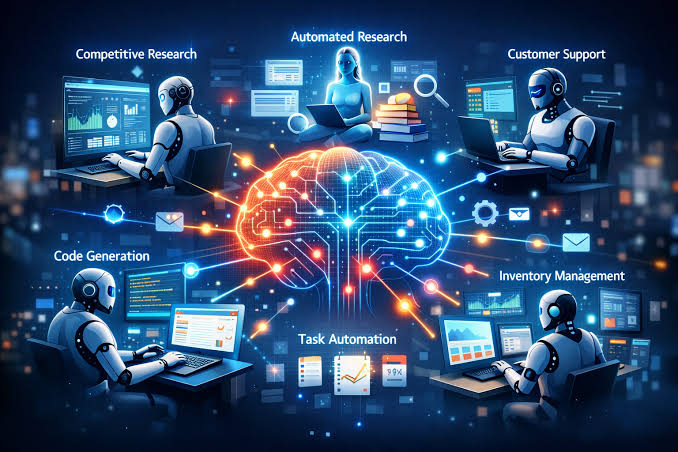
Think of AI as a team of specialized assistants rather than a single tool. Throughout the day, it can switch between different roles depending on your needs.
1. Writing Assistant
Strong written communication is essential in almost every profession.
AI can help:
- Draft professional emails
- Rewrite content in different tones
- Improve grammar and clarity
- Generate reports
- Write proposals
- Create presentations
- Produce blog articles
- Draft social media posts
Instead of starting with a blank page, professionals begin with a solid first draft and spend their time refining ideas.
2. Research Assistant
Finding accurate information often requires searching multiple sources and organizing notes.
AI accelerates research by:
- Summarizing articles
- Comparing products or services
- Explaining complex topics
- Identifying industry trends
- Gathering statistics
- Organizing findings into clear summaries
This reduces research time from hours to minutes.
3. Planning Assistant
Managing priorities is one of the biggest challenges in modern work.
AI helps professionals:
- Prioritize tasks
- Build daily schedules
- Plan weekly objectives
- Organize projects
- Break large goals into actionable steps
- Recommend time-blocking strategies
Instead of reacting to work, professionals can proactively manage their workload.
4. Meeting Assistant
Meetings generate valuable information but often require additional time to document.
AI can automatically:
- Record meetings
- Generate transcripts
- Summarize discussions
- Identify decisions
- Create action items
- Assign responsibilities
- Draft follow-up emails
This ensures everyone leaves meetings with clear next steps.
5. Data Analysis Assistant
Business decisions increasingly rely on data, but analyzing spreadsheets and reports can be time-consuming.
AI can:
- Interpret spreadsheets
- Create summaries
- Identify trends
- Generate charts
- Forecast performance
- Explain complex metrics in plain language
Professionals gain insights more quickly and make better-informed decisions.
6. Creative Brainstorming Partner
Creativity often begins with exploration.
AI supports brainstorming by generating:
- Marketing campaign ideas
- Product names
- Content topics
- Business strategies
- Presentation structures
- Headlines
- Advertising copy
Rather than replacing human creativity, AI expands the range of possibilities to consider.
A Typical Workday with AI
Imagine a marketing manager using AI throughout the day:
8:30 AM – Email Review
AI summarizes overnight emails and drafts replies to routine messages.
9:00 AM – Project Planning
AI organizes priorities, highlights deadlines, and recommends the day's schedule.
10:30 AM – Market Research
AI gathers competitor information and summarizes current industry trends.
1:00 PM – Content Creation
AI generates a first draft for a blog article, while the manager edits and adds expertise.
3:00 PM – Team Meeting
AI records the discussion, creates meeting notes, and lists action items.
5:00 PM – Performance Analysis
AI reviews campaign metrics, identifies key trends, and prepares a summary report.
By the end of the day, repetitive work has been reduced significantly, leaving more time for strategic decisions and collaboration.
AI Across Different Professions
Marketing
AI assists with:
- Campaign planning
- SEO optimization
- Content creation
- Advertising analysis
- Audience insights
Sales
AI helps sales professionals:
- Prioritize leads
- Draft personalized follow-up emails
- Analyze customer behavior
- Forecast sales opportunities
Human Resources
HR teams use AI for:
- Resume screening
- Job description writing
- Interview scheduling
- Employee onboarding
- Policy documentation
Software Development
Developers use AI to:
- Generate code suggestions
- Explain programming concepts
- Detect bugs
- Write documentation
- Review code quality
Project Management
AI supports project managers by:
- Tracking deadlines
- Updating task progress
- Summarizing project status
- Identifying potential risks
- Improving team communication
Benefits of an AI Work Assistant
Professionals who use AI consistently often experience:
- Higher productivity
- Faster task completion
- Better organization
- Reduced administrative workload
- Improved communication
- Better decision-making
- Greater creativity
- More time for strategic work
- Lower stress from repetitive tasks
Instead of working longer hours, they accomplish more within the same workday.
Best Practices for Working with AI
To get the most value from AI:
- Provide clear and specific prompts.
- Review AI-generated content before sharing it.
- Protect confidential business information.
- Use AI for repetitive work while keeping important decisions human-led.
- Combine AI tools to create efficient workflows.
- Continuously improve prompts based on previous results.
The best outcomes come from collaboration between human expertise and AI capabilities.
The Future of AI as a Personal Assistant
AI is evolving from a tool that responds to instructions into an intelligent assistant capable of anticipating needs. Future AI systems will proactively organize calendars, coordinate projects, monitor business performance, and automate routine workflows with minimal supervision.
Rather than replacing professionals, these assistants will enhance human capabilities, enabling individuals and teams to focus on innovation, relationship building, and complex problem-solving.
Organizations that embrace this partnership will be better equipped to adapt to changing business environments and remain competitive.
Conclusion
AI has become far more than a productivity tool—it is a dependable personal work assistant that supports professionals throughout every stage of the workday. From writing and research to planning, meetings, data analysis, and creative brainstorming, AI reduces repetitive work while helping users make smarter, faster decisions.
The true value of AI lies not in replacing human expertise but in amplifying it. Professionals who learn to integrate AI into their daily routines can save hours each week, improve the quality of their work, and dedicate more time to activities that require judgment, creativity, and human connection.
In the years ahead, the most successful professionals will be those who treat AI as a trusted partner—one that works alongside them to achieve better results with greater efficiency.

Write Your Review
No reviews yet. Be the first to share your experience!