
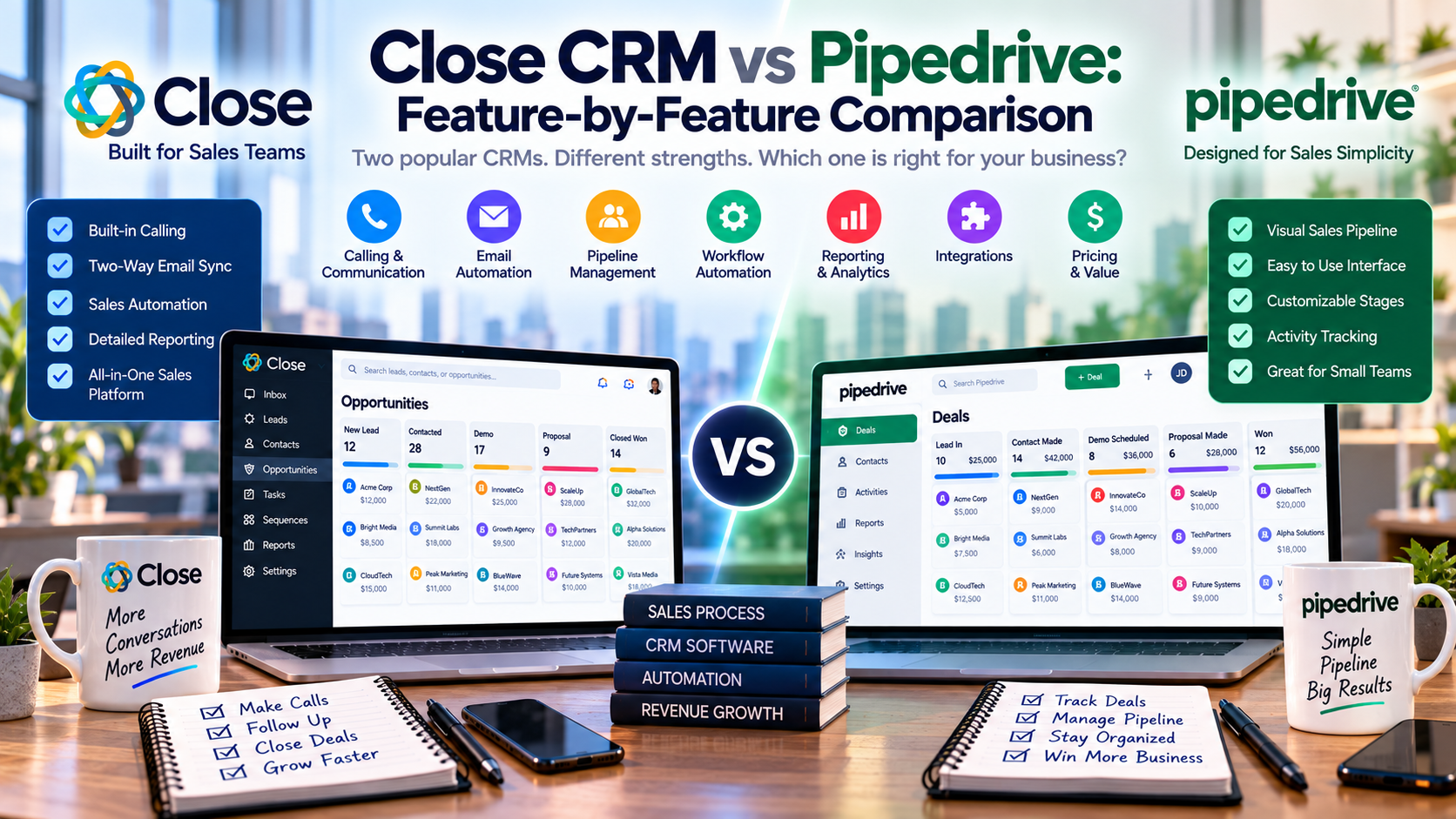
Close CRM and Pipedrive are two of the most popular CRM platforms for small and medium-sized businesses. Both are designed to help sales teams organize leads, manage pipelines, and close more deals, but they take different approaches.
Close CRM focuses on maximizing sales productivity by combining built-in communication tools, AI features, and workflow automation into a single platform. Pipedrive is known for its intuitive visual pipeline, ease of use, and affordable pricing, making it a favorite among growing businesses.
If you're trying to decide between these two platforms, this feature-by-feature comparison will help you understand their strengths, weaknesses, and ideal use cases.
Platform Overview
Close CRM
Close CRM is a cloud-based CRM built specifically for sales-driven organizations. It combines customer relationship management with built-in calling, email, SMS messaging, workflow automation, and AI-powered productivity tools.
Best for:
- SaaS companies
- Startups
- Outbound sales teams
- Sales agencies
- Growing SMBs
Pipedrive
Pipedrive is a sales CRM designed to simplify pipeline management. Its visual interface helps teams track opportunities, forecast revenue, and manage daily sales activities with minimal complexity.
Best for:
- Small businesses
- First-time CRM users
- Consultants
- Real estate agencies
- Service-based businesses
Feature Comparison
| Feature | Close CRM | Pipedrive |
|---|---|---|
| Contact Management | ✅ Excellent | ✅ Excellent |
| Visual Sales Pipeline | ✅ Yes | ⭐ Excellent |
| Built-in Calling | ✅ Native | Available on selected plans |
| Email Integration | ✅ Yes | ✅ Yes |
| SMS Messaging | ✅ Built-in | Via integrations |
| Workflow Automation | ✅ Advanced | ✅ Advanced |
| AI Features | AI summaries, email assistance | AI Sales Assistant, AI email creation |
| Reporting | Excellent | Excellent |
| Lead Management | Advanced | Advanced |
| Integrations | Extensive | Extensive |
Both platforms offer comprehensive sales management tools, but Close CRM places greater emphasis on communication, while Pipedrive excels in visual pipeline management.
Ease of Use
Both CRMs are beginner-friendly.
Pipedrive is widely recognized for its clean drag-and-drop interface, allowing users to visualize every deal stage easily.
Close CRM is equally intuitive but includes additional communication tools directly within the platform.
New users can become productive quickly with either solution.
Winner: Tie
Communication Features
Communication is where Close CRM has a clear advantage.
Close CRM includes:
- Built-in cloud calling
- SMS messaging
- Automatic call logging
- Call recording
- Email synchronization
- Power Dialer
Pipedrive supports calling and messaging, but several communication features require third-party integrations or higher-tier plans.
Businesses with heavy outbound sales activity will likely benefit more from Close CRM.
Winner: Close CRM
Pipeline Management
Pipedrive has built its reputation on visual pipeline management.
Users can:
- Drag and drop deals
- Customize pipeline stages
- Monitor sales progress
- Forecast revenue
Close CRM also offers customizable pipelines but focuses more heavily on integrating communication and automation into the sales workflow.
For businesses prioritizing visual opportunity tracking, Pipedrive has a slight edge.
Winner: Pipedrive
Automation and AI
Automation is a strength of both platforms.
Close CRM includes:
- Workflow automation
- Email sequences
- AI call summaries
- AI meeting notes
- AI email assistance
- Lead enrichment
Pipedrive offers:
- Workflow automation
- AI Sales Assistant
- AI email generation
- Smart recommendations
- Activity reminders
Close CRM's AI focuses on improving communication efficiency, while Pipedrive emphasizes sales recommendations and opportunity management.
Winner: Close CRM
Reporting and Analytics
Both CRMs provide customizable reports that help managers monitor:
- Sales activities
- Pipeline value
- Conversion rates
- Team performance
- Revenue forecasting
Pipedrive's reports are straightforward and easy to understand, while Close CRM integrates communication metrics such as calls, emails, and SMS activity into its dashboards.
Winner: Tie
Pricing
Pipedrive is generally more affordable for small businesses and first-time CRM users.
Close CRM is positioned as a premium sales CRM. While its subscription cost may be higher, it includes built-in calling, SMS messaging, and advanced communication tools that can replace multiple standalone applications.
Businesses should evaluate the total cost of ownership rather than subscription price alone.
Winner: Pipedrive for affordability
Winner: Close CRM for overall sales value
Pros and Cons
Close CRM
Pros
- Built-in calling and SMS
- AI-powered productivity tools
- Powerful automation
- Excellent outbound sales capabilities
- Complete communication history
- Fast implementation
Cons
- Higher pricing than some competitors
- Limited marketing functionality
- Fewer visual customization options
Pipedrive
Pros
- Extremely easy to use
- Outstanding visual pipeline
- Affordable pricing
- Strong automation
- Quick onboarding
- Good reporting
Cons
- Built-in communication is less comprehensive
- Some advanced features require higher-tier plans
- Fewer native AI productivity tools than Close CRM
Which CRM Should You Choose?
Choose Close CRM if you:
- Make frequent outbound calls
- Need built-in SMS messaging
- Want AI-powered sales productivity tools
- Manage high-volume outreach campaigns
- Prefer an all-in-one communication platform
Choose Pipedrive if you:
- Want an intuitive visual pipeline
- Are adopting your first CRM
- Prioritize affordability
- Need simple sales management
- Prefer a lightweight CRM solution
Real-World Scenarios
SaaS Startup
A SaaS startup running outbound prospecting campaigns can benefit from Close CRM's Power Dialer, email automation, and AI-generated call summaries.
Small Consulting Firm
A consulting company managing a moderate number of opportunities may prefer Pipedrive's clean interface and visual pipeline for tracking deals.
Sales Agency
An agency handling hundreds of outbound calls each week can improve efficiency with Close CRM's integrated communication tools.
Local Service Business
A service-based business with straightforward sales processes may find Pipedrive's simplicity and affordability more than sufficient.
Final Verdict
Close CRM and Pipedrive are both outstanding CRM solutions, but they excel in different areas.
Close CRM is the better choice for businesses that rely heavily on outbound sales and customer communication. Its built-in calling, SMS messaging, workflow automation, and AI-powered productivity features create an efficient environment for sales representatives who spend most of their day engaging with prospects.
Pipedrive, meanwhile, shines with its intuitive interface, excellent visual pipeline, and competitive pricing. It is ideal for businesses seeking an easy-to-use CRM that simplifies opportunity management without overwhelming users with unnecessary complexity.
If communication and sales engagement are your top priorities, Close CRM is the stronger option. If you value simplicity, affordability, and visual pipeline management, Pipedrive remains one of the best CRM platforms available in 2026.








Write Your Review
No reviews yet. Be the first to share your experience!