
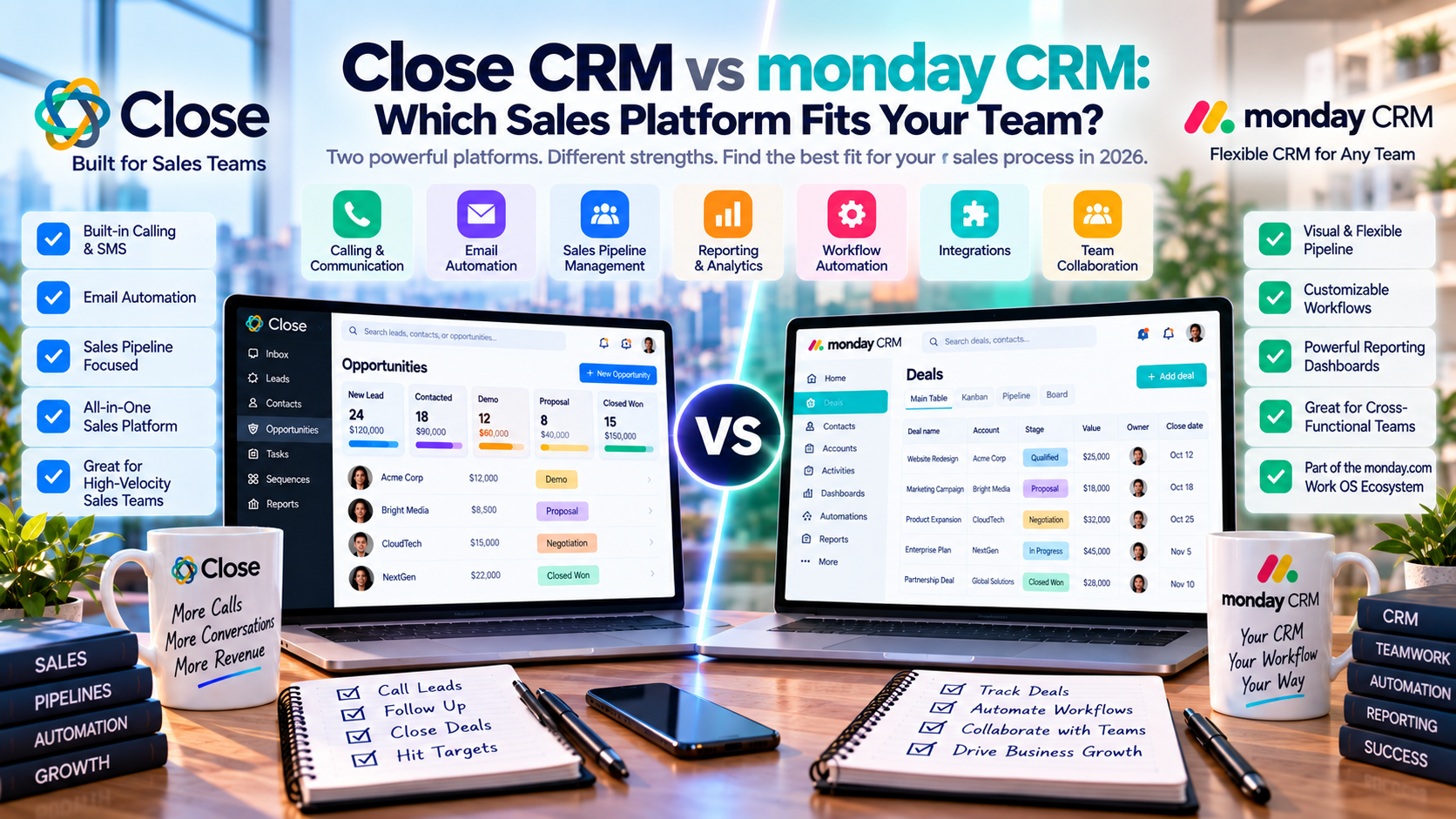
Choosing the right CRM is essential for improving sales productivity and supporting long-term business growth. Among today's leading CRM solutions, Close CRM and monday CRM stand out for their modern interfaces, automation capabilities, and flexibility. However, they are built with different priorities in mind.
Close CRM is a sales-first platform focused on helping teams communicate with prospects and close deals faster. It includes built-in calling, email, SMS, AI-powered tools, and workflow automation in one unified workspace.
monday CRM, part of the monday.com Work OS ecosystem, extends beyond sales management. It combines CRM functionality with project management, collaboration, task tracking, and customizable workflows, making it attractive for organizations that want to manage multiple business operations from a single platform.
This comparison examines the strengths of each platform to help you determine which one best fits your team's needs in 2026.
Platform Overview
Close CRM
Close CRM is designed specifically for sales organizations. It provides an all-in-one environment where representatives can communicate with leads, automate follow-ups, manage pipelines, and analyze sales performance.
Best for:
- SaaS companies
- Sales agencies
- Startups
- Outbound sales teams
- Small and medium-sized businesses
monday CRM
monday CRM is built on the monday.com Work OS platform, offering highly customizable workflows that combine sales management with project collaboration.
Businesses can manage:
- Sales pipelines
- Customer relationships
- Projects
- Marketing campaigns
- Internal operations
- Team collaboration
Best for:
- Cross-functional teams
- Agencies
- Marketing teams
- Professional service firms
- Growing businesses
Feature Comparison
| Feature | Close CRM | monday CRM |
|---|---|---|
| Contact Management | ✅ Excellent | ✅ Excellent |
| Sales Pipeline | ✅ Customizable | ✅ Highly customizable |
| Built-in Calling | ✅ Native | Via integrations |
| Email Integration | ✅ Yes | ✅ Yes |
| SMS Messaging | ✅ Built-in | Limited via integrations |
| Workflow Automation | ✅ Advanced | ✅ Advanced |
| AI Features | AI summaries, email assistance | monday AI automation, AI formulas, AI assistance |
| Project Management | Basic | ⭐ Excellent |
| Team Collaboration | Good | ⭐ Excellent |
| Reporting | Excellent | Excellent |
While both platforms provide strong CRM functionality, monday CRM offers broader operational capabilities beyond sales.
Ease of Use
Both Close CRM and monday CRM feature modern, intuitive interfaces.
Close CRM is optimized specifically for sales representatives, allowing teams to become productive with minimal training.
monday CRM is also user-friendly but provides more customization options. This flexibility is powerful, although configuring complex workflows may require additional setup time.
Winner: Close CRM for sales simplicity
Sales Communication
Communication is one of Close CRM's strongest advantages.
It includes:
- Built-in cloud calling
- SMS messaging
- Email synchronization
- Automatic call logging
- Call recording
- Power Dialer
Everything is available without relying heavily on third-party software.
monday CRM integrates with email and communication tools but generally depends on external services for advanced calling functionality.
Winner: Close CRM
Workflow Automation and AI
Automation is a major strength for both platforms.
Close CRM provides:
- Email sequences
- Automated follow-ups
- Lead assignment
- AI call summaries
- AI meeting notes
- AI email assistance
monday CRM offers:
- Custom workflow automation
- AI-powered formulas
- AI-generated task updates
- AI content suggestions
- Cross-department automation
- Custom notifications
Close CRM focuses on sales productivity, while monday CRM automates workflows across the entire organization.
Winner: Tie
Project Management and Collaboration
This category clearly favors monday CRM.
Because it is built on monday Work OS, businesses can manage:
- Projects
- Tasks
- Marketing campaigns
- Product development
- HR workflows
- Customer onboarding
from the same workspace.
Close CRM focuses primarily on customer relationship management and sales execution.
Winner: monday CRM
Reporting and Analytics
Both CRMs provide valuable reporting tools.
Managers can monitor:
- Sales activity
- Pipeline performance
- Revenue forecasts
- Team productivity
- Conversion rates
Close CRM emphasizes communication metrics such as calls, emails, and SMS activity.
monday CRM provides customizable dashboards that combine sales, projects, and operational data into one view.
Winner: Tie
Pricing
Both platforms offer tiered subscription plans suitable for growing businesses.
Close CRM delivers excellent value for organizations that prioritize outbound sales because many communication features are included natively.
monday CRM offers flexible pricing and becomes especially cost-effective for businesses already using monday Work OS for project management or operations.
The best value depends on how your organization uses the platform.
Pros and Cons
Close CRM
Pros
- Built-in calling and SMS
- Excellent outbound sales tools
- AI-powered productivity features
- Fast implementation
- Simple interface
- Strong workflow automation
Cons
- Limited project management
- Less suitable for cross-functional operations
- Smaller ecosystem than monday Work OS
monday CRM
Pros
- Highly customizable
- Excellent project management
- Powerful collaboration tools
- Strong workflow automation
- Flexible dashboards
- Integrates with the broader monday ecosystem
Cons
- Built-in communication is less comprehensive
- Advanced workflows require more setup
- Some features depend on integrations
Which CRM Should You Choose?
Choose Close CRM if you:
- Run an outbound sales team
- Need built-in calling and SMS
- Want AI-powered sales productivity tools
- Focus primarily on lead generation and closing deals
- Prefer a CRM that requires minimal setup
Choose monday CRM if you:
- Manage projects alongside sales
- Need cross-department collaboration
- Already use monday Work OS
- Want highly customizable workflows
- Coordinate sales, marketing, and operations in one platform
Real-World Scenarios
SaaS Startup
A SaaS startup focused on outbound prospecting can use Close CRM to automate email sequences, manage calls, and track opportunities from a single dashboard.
Marketing Agency
An agency managing sales, client projects, and creative work may benefit from monday CRM's ability to combine CRM and project management.
Consulting Firm
A consulting company delivering long-term client projects can use monday CRM to monitor both sales opportunities and project execution.
Sales Agency
A sales outsourcing agency making hundreds of calls each week will likely achieve higher productivity with Close CRM's native communication tools.
Final Verdict
Close CRM and monday CRM are both excellent platforms, but they solve different business challenges.
Close CRM is purpose-built for sales teams. Its built-in calling, SMS messaging, AI-powered productivity tools, workflow automation, and streamlined interface make it one of the best CRM solutions for businesses that rely heavily on outbound sales and customer communication.
monday CRM extends beyond traditional CRM functionality by combining sales, project management, collaboration, and operational workflows into a single customizable platform. It is particularly well suited for organizations that need cross-functional teamwork and already use the monday.com ecosystem.
If your primary objective is maximizing sales efficiency and closing more deals, Close CRM is the stronger choice. If your business requires collaboration across multiple departments while managing customer relationships, monday CRM provides greater flexibility and long-term operational value.





Write Your Review
No reviews yet. Be the first to share your experience!