
Artificial intelligence (AI) is rapidly becoming one of the most valuable technologies for modern businesses. While many organizations initially adopt AI to improve productivity, the true impact goes beyond simple time savings. AI creates measurable business value by reducing operational costs, improving efficiency, increasing revenue opportunities, and enabling faster decision-making.
The return on investment (ROI) of AI is no longer a theoretical concept. Companies of all sizes are using AI to automate daily tasks, optimize workflows, and help employees focus on higher-value activities.
This article explores how businesses can measure the ROI of AI adoption and why integrating AI into everyday operations has become a strategic advantage.

Understanding AI ROI in Business
ROI measures the value gained compared to the cost of investment.
The basic formula:
AI ROI = (Business Benefits – AI Investment Costs) / AI Investment Costs
The benefits of AI can come from multiple areas:
- Reduced labor costs
- Time savings
- Increased productivity
- Higher sales conversion
- Improved customer satisfaction
- Reduced errors
- Faster decision-making
- Better resource allocation
Unlike traditional software investments, AI often creates value by improving the performance of existing employees rather than simply replacing manual processes.
1. Reducing Operational Costs Through Automation
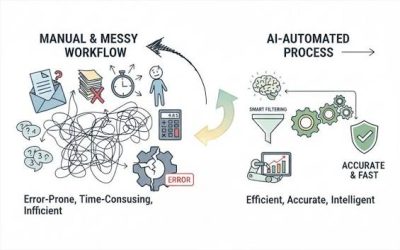
One of the biggest advantages of AI is its ability to automate repetitive tasks.
Businesses spend significant resources on activities such as:
- Data entry
- Report generation
- Customer inquiries
- Document processing
- Scheduling
- Invoice management
- Email communication
AI-powered automation reduces the amount of manual work required while maintaining consistency and accuracy.
Example:
A customer service team handling 5,000 monthly inquiries can use AI chatbots to answer common questions automatically while allowing human agents to focus on complex cases.
Business impact:
- Lower support costs
- Faster response times
- Improved customer experience
- Increased employee productivity
2. Saving Employee Time and Increasing Productivity
Time is one of the most valuable business resources.
AI helps employees complete tasks faster:
| Business Task | Traditional Time | AI-Assisted Time |
|---|---|---|
| Writing reports | 3 hours | 30 minutes |
| Market research | 5 hours | 1 hour |
| Email management | 2 hours/day | 30 minutes/day |
| Meeting summaries | 1 hour | 5 minutes |
| Data analysis | Several hours | Minutes |
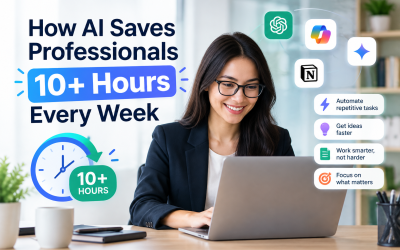
When employees save several hours every week, businesses gain additional capacity without increasing headcount.
The result:
- More projects completed
- Faster customer response
- Greater innovation
- Improved employee efficiency
3. Improving Decision-Making With AI Analytics
Modern businesses generate massive amounts of data, but many organizations struggle to convert information into useful insights.
AI helps analyze:
- Sales performance
- Customer behavior
- Marketing campaigns
- Financial trends
- Market opportunities
AI-powered analytics can identify:
- Hidden patterns
- Revenue opportunities
- Potential risks
- Customer preferences
- Performance improvements
Better decisions lead to stronger business outcomes.

4. Increasing Revenue Through Personalization
AI enables businesses to understand customers at a deeper level.
Companies use AI to:
- Recommend products
- Personalize marketing campaigns
- Predict customer needs
- Optimize pricing strategies
- Improve customer engagement
For example, e-commerce businesses can analyze customer behavior and deliver personalized product recommendations, increasing purchase probability.
AI transforms marketing from a broad approach into a more targeted and efficient process.
5. Improving Customer Experience
Customer expectations are higher than ever. Businesses must provide fast, accurate, and personalized service.
AI improves customer experience through:
- 24/7 support
- Instant responses
- Personalized recommendations
- Automated onboarding
- Faster problem resolution
Better customer experiences lead to:
- Higher satisfaction rates
- Increased loyalty
- More repeat purchases
- Stronger brand reputation
6. Reducing Human Errors
Manual processes often create mistakes, especially when handling large amounts of information.
AI improves accuracy in areas such as:
- Financial reporting
- Data processing
- Inventory management
- Document analysis
- Compliance monitoring
Fewer errors mean:
- Lower correction costs
- Better operational reliability
- Improved customer trust
AI ROI Across Different Business Departments
Marketing
AI helps companies:
- Create content faster
- Optimize SEO strategies
- Analyze customer behavior
- Improve advertising performance
ROI impact:
Lower marketing costs and higher campaign effectiveness.
Sales
AI supports:
- Lead qualification
- Customer research
- Sales forecasting
- Personalized communication
ROI impact:
More qualified leads and improved conversion rates.
Human Resources
AI improves:
- Recruitment processes
- Employee onboarding
- Internal communication
- Training programs
ROI impact:
Faster hiring and reduced administrative workload.
Finance
AI enables:
- Automated reporting
- Expense tracking
- Fraud detection
- Financial forecasting
ROI impact:
Greater accuracy and operational efficiency.
Operations
AI optimizes:
- Supply chains
- Inventory management
- Workflow automation
- Resource planning
ROI impact:
Lower costs and improved scalability.
Measuring AI Success: Key Business Metrics
Businesses should track measurable outcomes after implementing AI.
Important KPIs include:
Productivity Metrics
- Hours saved per employee
- Tasks completed per day
- Workflow completion speed
Financial Metrics
- Cost reduction
- Revenue growth
- Customer acquisition cost
- Profit margin improvement
Customer Metrics
- Response time
- Customer satisfaction score
- Retention rate
- Support resolution time
Employee Metrics
- Employee satisfaction
- Reduced repetitive workload
- Increased focus on strategic work
Challenges in Calculating AI ROI
Although AI provides significant value, businesses should consider several challenges:
Initial Investment
Costs may include:
- AI software subscriptions
- Employee training
- System integration
- Data preparation
Adoption Challenges
Employees need:
- Training
- Clear workflows
- Understanding of AI capabilities
Measuring Long-Term Value
Some AI benefits, such as innovation and improved decision-making, may take longer to measure.
Successful companies evaluate both immediate savings and long-term strategic advantages.
Best Practices for Maximizing AI ROI
To achieve the highest return from AI:
- Start with high-impact repetitive tasks.
- Identify workflows with the biggest time costs.
- Train employees to use AI effectively.
- Combine AI automation with human expertise.
- Monitor performance improvements regularly.
- Scale successful AI applications across departments.
AI adoption should not be viewed as simply buying a tool—it is a transformation of how work gets done.
The Future of AI-Driven Business Efficiency
As AI technology continues to advance, businesses will move from using individual AI tools toward integrated AI-powered ecosystems.
Future AI systems will:
- Automate complete workflows
- Predict business needs
- Support strategic planning
- Manage complex operations
- Provide real-time insights
Organizations that successfully integrate AI will gain a significant competitive advantage through faster execution, lower costs, and smarter decision-making.
Conclusion
The ROI of using AI in everyday business tasks extends far beyond automation. AI creates measurable value by saving time, reducing costs, improving accuracy, increasing revenue opportunities, and empowering employees to work more effectively.
Businesses that adopt AI strategically can transform routine operations into efficient, intelligent workflows. The question is no longer whether companies should use AI, but how quickly they can integrate it to unlock greater productivity and long-term growth.
AI is not just a technology investment—it is an investment in a smarter, faster, and more competitive future.


Write Your Review
No reviews yet. Be the first to share your experience!