
The modern workplace is undergoing a dramatic transformation. Tasks that once required hours of manual effort can now be completed in minutes with the help of artificial intelligence (AI). From writing emails and analyzing spreadsheets to managing customer support and generating reports, AI is reshaping how professionals work every day.
Rather than replacing employees, AI is automating repetitive, time-consuming processes, allowing people to focus on creativity, strategic thinking, and high-value decision-making. Businesses that embrace AI-driven workflows are seeing higher productivity, lower operational costs, and faster response times.
This article explores how AI transforms manual workflows into automated processes across common business functions and why automation has become a competitive advantage.
Why Manual Workflows No Longer Scale
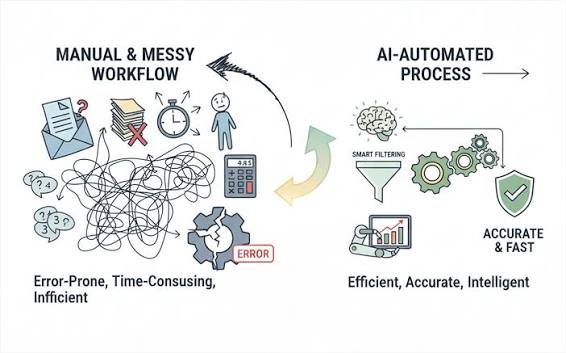
Traditional workflows often involve repetitive tasks that consume valuable time and introduce unnecessary errors. Common examples include:
- Copying data between applications
- Responding to routine emails
- Creating weekly reports
- Scheduling meetings
- Updating CRM records
- Organizing documents
- Researching market information
- Tracking project progress
As businesses grow, these tasks increase in volume. Hiring additional employees to manage repetitive work is expensive, while manual processes often lead to inconsistencies and delays.
AI addresses these challenges by handling repetitive operations quickly and accurately.
Manual vs. AI-Powered Workflows
| Process | Manual Workflow | AI-Powered Workflow |
|---|---|---|
| Email Management | Read, write, categorize manually | Drafts, summarizes, and prioritizes emails automatically |
| Document Review | Read every page | Extracts key insights and action items instantly |
| Meeting Notes | Manual note-taking | Automatic transcription and summaries |
| Customer Support | Agents answer repetitive questions | AI chatbots provide instant responses and escalate complex issues |
| Content Creation | Research, write, and edit manually | Generates first drafts, outlines, and optimized content |
| Data Analysis | Manual formulas and reports | Identifies trends, forecasts, and creates dashboards |
| Project Management | Manual task updates | Automatically tracks deadlines and progress |
| Scheduling | Back-and-forth communication | AI suggests meeting times and manages calendars |
The difference is not just speed—it is consistency, scalability, and accuracy.
How AI Automates Everyday Workflows
1. Email and Communication
Professionals spend a significant portion of their workday managing email.
AI can:
- Draft professional replies
- Rewrite messages with different tones
- Summarize lengthy conversations
- Translate multilingual communication
- Prioritize urgent messages
Instead of spending hours in an inbox, employees can focus on meaningful conversations.
2. Content Creation
Marketing teams, freelancers, and business professionals create content every day.
AI assists with:
- Blog posts
- Product descriptions
- Social media content
- Press releases
- Newsletters
- Presentation outlines
- SEO optimization
Rather than replacing human creativity, AI accelerates the first draft, allowing writers to refine and personalize the final output.
3. Research and Knowledge Discovery
Finding accurate information traditionally requires opening multiple browser tabs, comparing sources, and organizing notes.
AI simplifies research by:
- Summarizing articles
- Comparing information
- Extracting statistics
- Answering complex questions
- Organizing references
This significantly reduces the time needed for market research and competitive analysis.
4. Meeting Productivity
Meetings often generate valuable insights that are easily forgotten.
AI meeting assistants can automatically:
- Record conversations
- Produce transcripts
- Highlight decisions
- Generate action items
- Assign responsibilities
- Create follow-up summaries
Teams spend less time documenting discussions and more time executing decisions.
5. Workflow Automation
Modern businesses use many software platforms, including CRM systems, project management tools, accounting software, and communication apps.
AI-powered automation connects these systems to eliminate repetitive tasks such as:
- Creating invoices
- Sending notifications
- Updating customer records
- Moving files
- Generating reports
- Assigning tasks
- Processing approval requests
Instead of switching between applications, workflows run automatically in the background.
AI Across Different Departments
Marketing
AI helps marketers:
- Generate campaign ideas
- Optimize SEO
- Analyze advertising performance
- Personalize email campaigns
- Schedule social media posts
Result:
Higher engagement with less manual effort.
Sales
Sales professionals use AI to:
- Score leads
- Predict customer behavior
- Draft follow-up emails
- Summarize client meetings
- Forecast revenue
Result:
More selling time and stronger customer relationships.
Human Resources
HR teams automate:
- Resume screening
- Interview scheduling
- Employee onboarding
- Internal documentation
- Policy questions
Result:
Faster hiring and improved employee experiences.
Finance
Finance departments use AI for:
- Expense categorization
- Invoice processing
- Fraud detection
- Financial forecasting
- Budget analysis
Result:
Greater accuracy and reduced manual processing.
Customer Support
AI-powered assistants handle:
- Frequently asked questions
- Ticket routing
- Order tracking
- Product recommendations
- 24/7 customer assistance
Result:
Faster responses and lower support costs.
Benefits Beyond Productivity
Organizations adopting AI-powered workflows often experience:
- Reduced operational costs
- Fewer human errors
- Improved data accuracy
- Faster decision-making
- Better customer experiences
- Increased employee satisfaction
- Higher business scalability
Automation also allows employees to focus on strategic initiatives rather than repetitive administrative work.
Common Challenges
Despite its advantages, AI implementation requires careful planning.
Businesses should address:
- Data privacy and security
- Employee training
- Workflow redesign
- AI output verification
- Ethical AI usage
- Integration with existing systems
Successful automation combines AI capabilities with human oversight.
Best Practices for AI Workflow Automation
To maximize success:
- Identify repetitive tasks with the highest time cost.
- Automate simple processes before tackling complex workflows.
- Keep humans involved in critical decisions.
- Review AI-generated outputs for quality and accuracy.
- Monitor performance and refine workflows continuously.
- Train employees to work alongside AI rather than compete with it.
Organizations that follow these practices achieve higher adoption rates and stronger returns on investment.
The Future of Work
The next generation of AI will move beyond isolated tools toward fully connected digital workplaces. AI agents will coordinate calendars, manage projects, analyze business performance, and automate cross-functional workflows with minimal human intervention.
Professionals who embrace AI will spend less time on repetitive administration and more time solving complex problems, building relationships, and driving innovation.
Automation is no longer about replacing jobs—it is about enabling people to perform at their highest potential.
Conclusion
The transition from manual processes to AI-powered automation is redefining how businesses operate. Everyday workflows that once required hours of repetitive effort can now be completed in minutes with greater speed, consistency, and accuracy.
Whether it's managing emails, creating content, analyzing data, coordinating meetings, or automating business operations, AI empowers professionals to work smarter rather than harder.
As organizations continue to adopt intelligent automation, the greatest advantage will belong to those who successfully combine human expertise with AI-driven efficiency. The future of work is not manual or fully automated—it is collaborative, where people and AI work together to achieve better outcomes than either could alone.


Write Your Review
No reviews yet. Be the first to share your experience!