
Artificial Intelligence is transforming every industry.
From healthcare and finance to education, marketing, software development, manufacturing, and customer service, AI is changing how work gets done.
The question is no longer “Will AI affect my career?”
The real question is:
“How can I use AI to become more valuable in my profession?”
The future belongs to professionals who know how to collaborate with AI, automate repetitive work, make better decisions with data, and continuously learn new technologies.
In this final module, you'll learn how AI is reshaping the job market, discover the most in-demand AI skills, and build a roadmap for long-term career success.
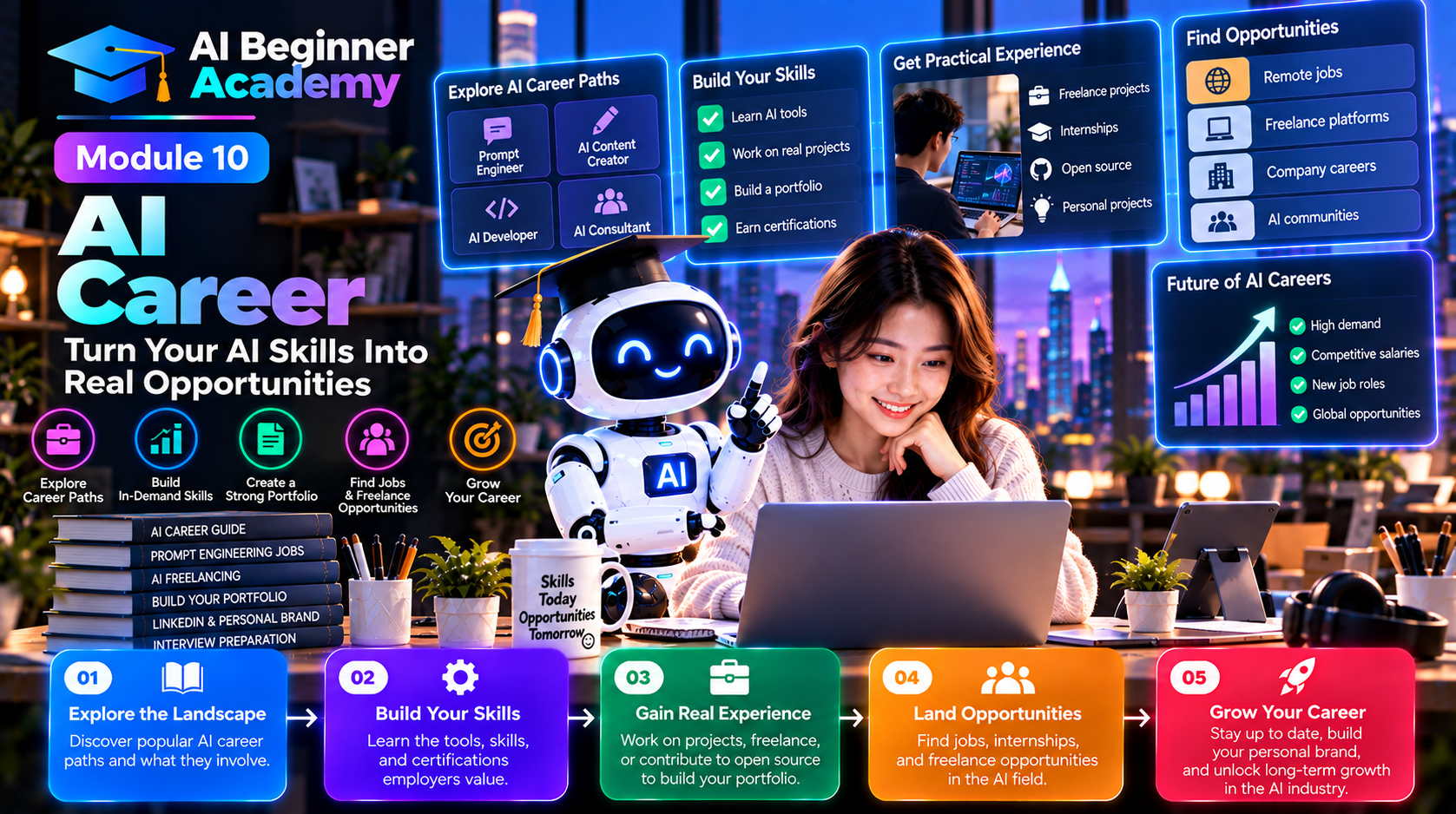
AI Will Change Jobs—Not Eliminate Human Value
Throughout history, technology has transformed the way people work.
The internet changed communication.
Cloud computing changed software delivery.
Smartphones changed how we access information.
Now AI is changing how knowledge work is performed.
Rather than replacing every job, AI is changing the nature of many roles.
Routine and repetitive tasks are increasingly automated, while human strengths such as creativity, critical thinking, empathy, leadership, and strategic decision-making become even more valuable.
Professionals who learn to work alongside AI are likely to adapt more successfully than those who ignore it.
Skills That Matter Most in the AI Era
Technical knowledge is important, but it is only part of the picture.
The most valuable professionals combine AI literacy with strong human skills.
Key capabilities include:
- AI literacy
- Prompt engineering
- Critical thinking
- Problem-solving
- Communication
- Creativity
- Data analysis
- Business understanding
- Digital collaboration
- Continuous learning
These skills apply across industries and job functions.
AI Career Paths
AI creates opportunities far beyond software engineering.
Content Creator
Use AI to produce articles, videos, podcasts, newsletters, and social media content more efficiently.
Digital Marketer
Leverage AI for SEO, advertising, email campaigns, analytics, customer segmentation, and content personalization.
Software Developer
Build AI-powered applications, integrate APIs, automate development workflows, and design intelligent systems.
Data Analyst
Use AI to clean data, identify trends, generate reports, and communicate insights more effectively.
Product Manager
Incorporate AI features into products, prioritize user needs, and collaborate with engineering teams on AI initiatives.
Customer Support Specialist
Work with AI assistants to resolve issues faster while focusing on complex customer interactions.
Sales Professional
Use AI to research prospects, personalize outreach, summarize meetings, and manage customer relationships.
Entrepreneur
Create AI-powered products, automate business operations, and identify new market opportunities.
The Future Workplace
Modern workplaces increasingly combine:
People
      +
AI Assistants
      +
Automation
      +
Business Applications
      +
Data
      =
Intelligent Organization
Employees will work alongside AI assistants that help with research, writing, planning, scheduling, coding, and decision support.
Learning how to collaborate with these systems will become a core professional skill.
Build Your Personal AI Toolkit
Different professionals need different tools, but a practical toolkit may include:
| Category | Suggested Tools |
|---|---|
| General AI Assistant | ChatGPT, Claude, Gemini |
| Research | Perplexity, NotebookLM |
| Writing | ChatGPT, Claude |
| Images | ChatGPT Image Generation, Adobe Firefly |
| Video | Google Veo, Runway |
| Productivity | Notion AI, Microsoft Copilot |
| Coding | Cursor, GitHub Copilot |
| Automation | Zapier, Make, n8n |
| Meetings | Fireflies.ai, Otter.ai |
Rather than trying every new tool, master a small set that fits your workflow.
Develop an AI Learning Habit
AI evolves rapidly.
To stay current:
- Read industry blogs and research.
- Follow product updates.
- Experiment with new tools.
- Join AI communities.
- Build small projects.
- Reflect on what works and what doesn't.
Continuous learning is more valuable than trying to memorize every feature.
Build a Portfolio
The best way to demonstrate AI skills is through practical work.
Examples include:
- AI-powered websites
- Chatbots
- Automated workflows
- AI-generated marketing campaigns
- Personal productivity systems
- Software projects
- Research assistants
- Content portfolios
A portfolio shows how you apply AI to solve real problems.
Ethical and Responsible AI
Professional success also requires responsible use of AI.
Always:
- Verify important information.
- Respect privacy and confidentiality.
- Protect sensitive data.
- Be transparent about AI-generated content when appropriate.
- Follow organizational and legal requirements.
- Keep humans involved in important decisions.
Trust is one of the most valuable assets in an AI-driven world.
Your 90-Day AI Growth Plan
Month 1 – Build Foundations
- Learn prompt engineering.
- Explore major AI tools.
- Use AI for everyday tasks.
- Practice with simple projects.
Month 2 – Apply AI to Your Work
- Automate repetitive tasks.
- Improve writing and communication.
- Analyze data with AI.
- Build your first workflow.
Month 3 – Create Real Projects
- Publish content.
- Build a portfolio.
- Learn advanced AI concepts.
- Share your work publicly.
- Reflect on lessons learned and refine your approach.
By the end of three months, you'll have practical experience rather than just theoretical knowledge.
Lifelong Learning Roadmap
AI is a journey, not a destination.
A possible progression is:
Beginner
      ↓
Confident AI User
      ↓
AI Power User
      ↓
AI Automation Builder
      ↓
AI Solution Designer
      ↓
AI Leader
Each stage builds on the previous one through consistent practice and curiosity.
Common Mistakes
Waiting for the “Perfect” Time
AI is evolving quickly. The best time to start learning is now.
Depending on AI for Every Decision
AI is a tool that supports your thinking, not a substitute for judgment or responsibility.
Learning Without Practicing
Reading articles is useful, but hands-on experience builds real capability.
Chasing Every New Tool
New AI products appear constantly. Focus on mastering core concepts that transfer across tools.
Final Advice
Technology will continue to change.
The most successful professionals will not necessarily be those who know the most programming languages or use the most AI tools.
They will be the people who:
- Learn continuously.
- Adapt quickly.
- Think critically.
- Solve meaningful problems.
- Collaborate effectively with both people and AI.
Your long-term value comes from combining technical knowledge with creativity, communication, and sound judgment.
Congratulations!
You have completed the AI Beginner Academy learning journey.
Across these ten modules, you explored:
- AI fundamentals and core concepts.
- Prompt engineering techniques.
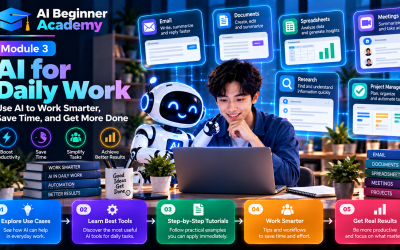
- AI for daily productivity.
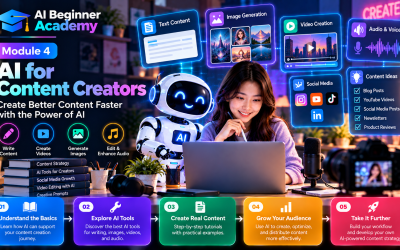
- AI-assisted content creation.
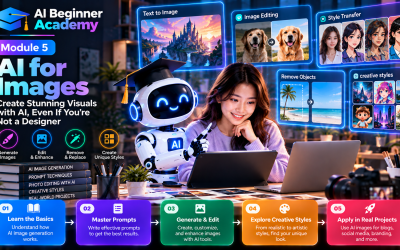
- AI image generation.
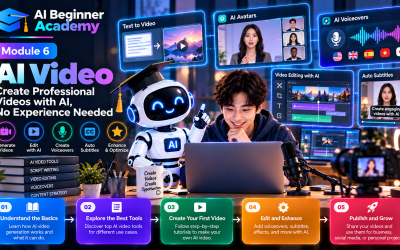
- AI video production.
- AI for software development.
- AI automation and intelligent workflows.
- Advanced AI architectures and enterprise concepts.
- Career development in the age of AI.
This knowledge provides a strong foundation, but your learning journey doesn't end here.
Keep experimenting.
Keep building.
Keep asking questions.
Most importantly, keep applying AI to solve real problems.
Final Thoughts
Artificial Intelligence is one of the most significant technological shifts of our time.
The professionals who thrive will not be those who fear change, but those who embrace it thoughtfully and continue developing skills that complement AI.
Remember:
AI doesn't replace human potential—it amplifies it.
Use AI to work smarter, learn faster, create more, and deliver greater value. By combining your expertise with intelligent tools, you'll be well prepared for the opportunities and challenges of the years ahead.
Welcome to the future of work.
Write Your Review
No reviews yet. Be the first to share your experience!