
By now, you've learned how to use AI for writing, image generation, video creation, software development, and workflow automation.
But have you ever wondered how modern AI systems actually work behind the scenes?
Why can ChatGPT answer complex questions?
How do enterprise AI assistants retrieve company knowledge?
Why do businesses use multiple AI models instead of relying on a single one?
What makes an AI agent capable of planning and completing tasks independently?
These capabilities are powered by technologies such as Retrieval-Augmented Generation (RAG), Vector Databases, AI Memory, LLM Routers, AI Gateways, Multi-Agent Systems, and AI Monitoring.
This module introduces these advanced concepts in a practical, beginner-friendly way.
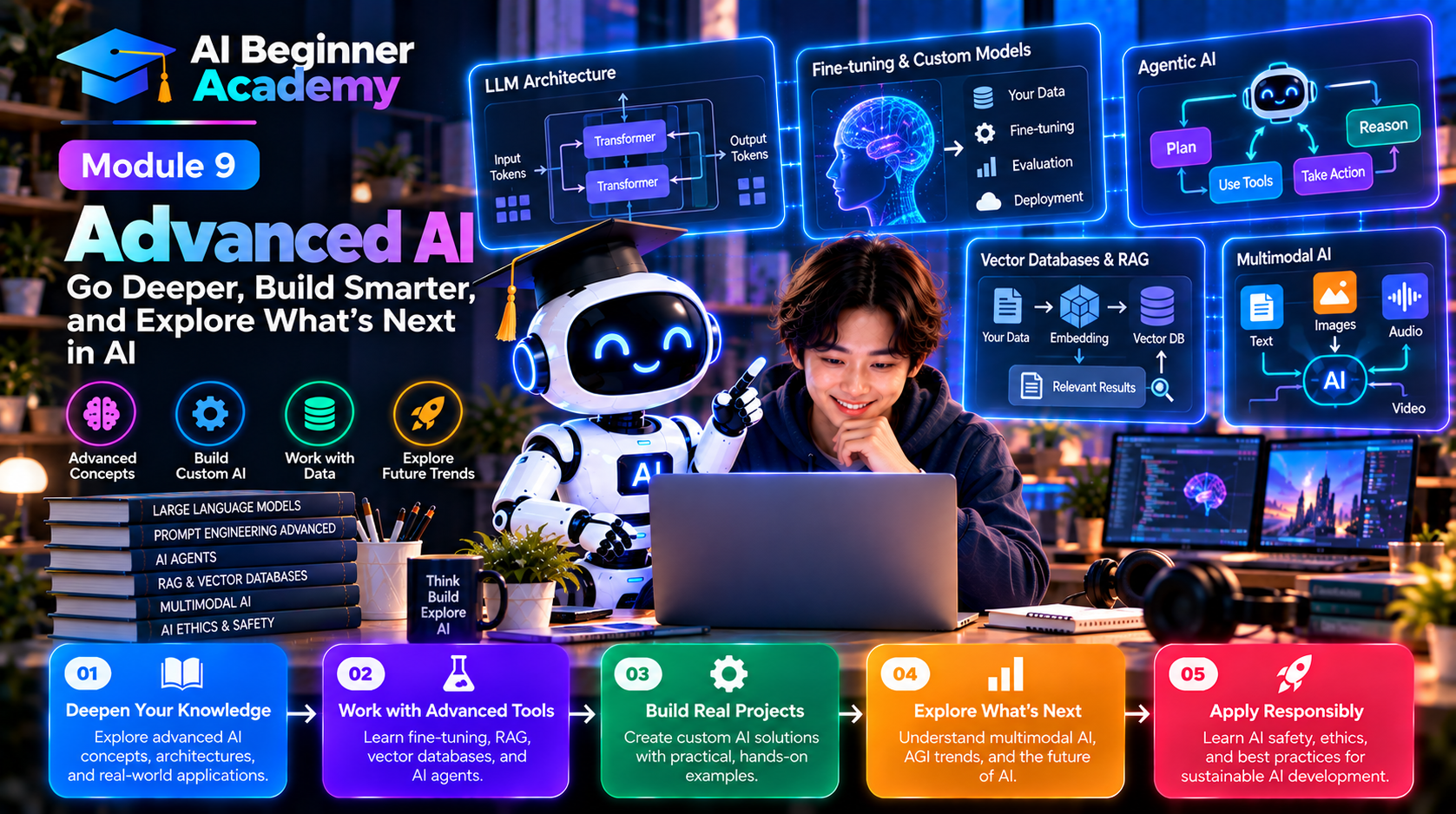
From AI Tools to AI Systems
Most people interact with AI through chat interfaces.
Enterprise organizations, however, build complete AI systems that integrate with internal data, business applications, and automated workflows.
A modern AI architecture often looks like this:
Users
   ↓
AI Application
   ↓
AI Gateway
   ↓
LLM Router
   ↓
Multiple AI Models
   ↓
Knowledge Sources
   ↓
Business Systems
Each layer has a specific role in delivering secure, scalable, and reliable AI services.
1. Retrieval-Augmented Generation (RAG)
Large Language Models have extensive general knowledge, but they do not automatically know your company's latest documents or private data.
Retrieval-Augmented Generation (RAG) solves this problem by retrieving relevant information before generating a response.
How RAG Works
User Question
      ↓
Search Knowledge Base
      ↓
Retrieve Relevant Documents
      ↓
Provide Context to AI
      ↓
Generate Accurate Response
Benefits
- Uses up-to-date information
- Reduces hallucinations
- Keeps proprietary data outside the model's training set
- Improves answer accuracy
Common use cases include customer support, internal knowledge assistants, and enterprise search.
2. Vector Databases
AI models cannot efficiently search millions of documents using traditional keyword searches alone.
Instead, they convert content into embeddings—numerical representations of meaning.
These embeddings are stored in vector databases.
Popular vector databases include:
- Pinecone
- Weaviate
- Milvus
- Qdrant
- Chroma
Vector search allows AI to find information based on semantic similarity rather than exact keywords.
3. AI Memory
Traditional chat sessions forget previous conversations once the context window is exceeded.
AI Memory enables systems to retain useful information over time.
Types of memory include:
Short-Term Memory
Stores information within the current conversation.
Long-Term Memory
Remembers user preferences, recurring tasks, and historical interactions across sessions.
Enterprise Memory
Connects AI to organizational knowledge such as:
- Documentation
- Wikis
- CRM records
- Policies
- Project data
Memory makes AI more personalized and context-aware.
4. Multi-Agent Systems
Instead of assigning every task to one large AI model, organizations increasingly use multiple specialized AI agents.
Example:
Project Manager Agent
        ↓
Research Agent
        ↓
Writer Agent
        ↓
Reviewer Agent
        ↓
Publishing Agent
Each agent focuses on a specific responsibility, improving efficiency and maintainability.
Multi-agent architectures are especially useful for complex workflows.
5. LLM Router
Not every request requires the same AI model.
An LLM Router automatically selects the most suitable model based on the task.
Examples:
- GPT for creative writing
- Claude for long-document analysis
- Gemini for Google Workspace integration
- Open-source models for cost-sensitive workloads
Benefits include:
- Lower operational costs
- Better performance
- Higher availability
- Vendor flexibility
6. AI Gateway
An AI Gateway acts as the central control plane between applications and AI models.
Its responsibilities include:
- Authentication
- Rate limiting
- Security
- Logging
- Cost tracking
- Model management
- Policy enforcement
Rather than connecting every application directly to multiple AI providers, enterprises use an AI Gateway to centralize governance and simplify operations.
7. AI Monitoring
Deploying AI is only the beginning.
Organizations must continuously monitor AI performance.
Important metrics include:
- Response quality
- Latency
- Cost per request
- Token usage
- Hallucination rate
- User satisfaction
- System availability
Monitoring ensures AI continues delivering business value over time.
8. AI Governance
As AI becomes more deeply integrated into business operations, governance becomes essential.
AI Governance focuses on:
- Responsible AI usage
- Compliance
- Security
- Privacy
- Transparency
- Human oversight
- Ethical decision-making
Effective governance reduces organizational risk while building trust in AI systems.
9. Model Context Protocol (MCP)
Modern AI assistants often need access to external tools and data.
Model Context Protocol (MCP) provides a standardized way for AI applications to communicate with external systems such as:
- Databases
- File storage
- Calendars
- CRMs
- Development platforms
- Business applications
Instead of building a custom integration for every tool, MCP offers a common interface, making AI ecosystems easier to extend and maintain.
10. Agentic AI
Traditional AI responds to prompts.
Agentic AI goes further by planning, reasoning, using tools, and executing multi-step tasks with minimal human intervention.
An AI agent can:
- Break down complex goals.
- Decide which tools to use.
- Retrieve information.
- Execute actions.
- Evaluate results.
- Adjust its strategy if needed.
Examples include research assistants, customer support agents, coding assistants, and business process automation.
Enterprise AI Architecture
A simplified enterprise AI architecture might look like this:
Users
      ↓
AI Applications
      ↓
AI Gateway
      ↓
LLM Router
      ↓
Foundation Models
      ↓
RAG Layer
      ↓
Vector Database
      ↓
Enterprise Data Sources
      ↓
Business Applications
This layered architecture improves scalability, security, and flexibility.
Best Practices
When building advanced AI systems:
- Use RAG for domain-specific knowledge.
- Monitor quality, cost, and performance continuously.
- Route requests to the most appropriate model.
- Protect sensitive information with strong security controls.
- Keep humans involved in high-impact decisions.
- Design systems to be modular and easy to evolve.
Common Misconceptions
“One AI model can solve every problem.”
Different models have different strengths. Combining them often produces better results.
“Bigger models are always better.”
Model selection should balance quality, latency, and cost.
“AI never needs monitoring.”
AI systems require ongoing evaluation to maintain accuracy and business value.
“Enterprise AI is just ChatGPT.”
Enterprise AI combines multiple technologies—including gateways, routers, retrieval systems, monitoring, and governance—to deliver reliable, production-ready solutions.
Practice Projects
To deepen your understanding, try designing:
- A RAG-powered internal knowledge assistant.
- A customer support chatbot using company documentation.
- A multi-agent content creation workflow.
- An AI Gateway architecture for a SaaS application.
- An LLM Router that selects models based on request type.
- A dashboard for monitoring AI quality and costs.
- An enterprise document search assistant.
- A secure AI workflow with governance controls.
- A meeting assistant that stores long-term memory.
- An AI-powered business operations assistant.
These projects introduce many of the architectural patterns used in real-world enterprise AI deployments.
What's Next?
You've explored the technologies behind modern AI systems.
In the final module, Module 10 – AI Career & Future Skills, you'll discover how AI is reshaping careers, which skills will become increasingly valuable, how to build an AI-ready mindset, and practical strategies for staying competitive in an AI-driven workplace.
Final Thoughts
Using AI effectively is only the first step.
Understanding the technologies behind AI—such as RAG, Vector Databases, AI Memory, Multi-Agent Systems, AI Gateways, LLM Routers, and AI Monitoring—gives you a deeper appreciation of how intelligent systems are built and deployed at scale.
You don't need to become an AI researcher to benefit from these concepts. By understanding the architecture and principles behind modern AI, you'll be better equipped to evaluate tools, design smarter workflows, and contribute to the next generation of AI-powered products and services.
The future belongs not only to those who use AI, but to those who understand how AI works and can apply it thoughtfully to solve real-world problems.
Write Your Review
No reviews yet. Be the first to share your experience!