
Choosing a Customer Relationship Management (CRM) platform is a long-term investment that can significantly impact your sales performance and business growth. Two of the most recognized names in the CRM industry are Close CRM and Salesforce. While both platforms help businesses manage leads, track opportunities, and improve customer relationships, they are designed for very different audiences.
Close CRM focuses on helping sales teams sell faster with built-in communication tools and a simple user experience. Salesforce, on the other hand, is a highly customizable enterprise platform capable of supporting large organizations with complex business processes.
In this comparison, we'll examine the strengths and weaknesses of both platforms to help you determine which CRM is the right choice for your business in 2026.
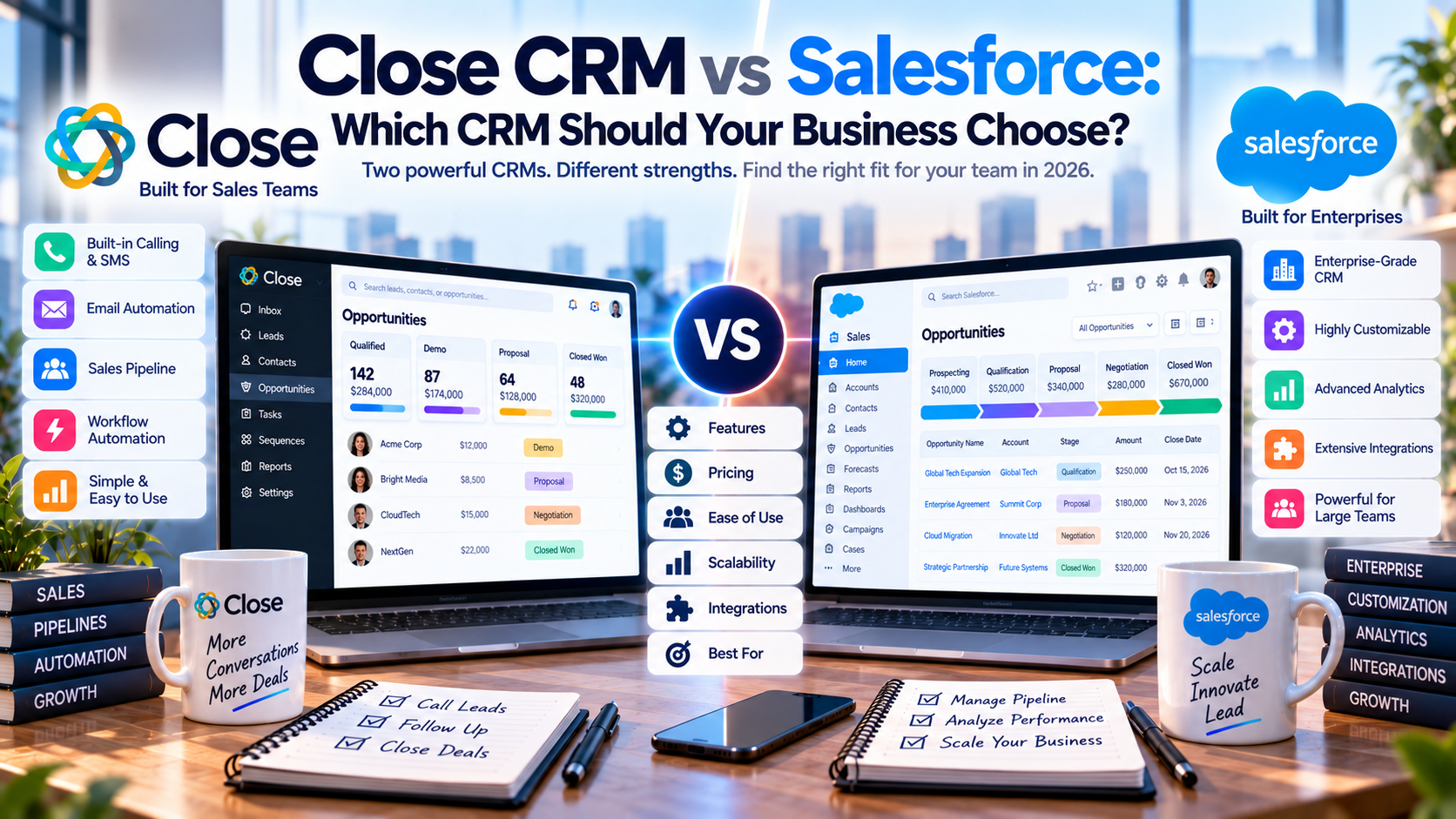
Platform Overview
Close CRM
Close CRM is a cloud-based sales CRM designed for startups, SMBs, SaaS companies, and outbound sales teams. It combines CRM functionality with built-in calling, email, SMS messaging, workflow automation, and AI-powered productivity features.
Best for:
- Startups
- SaaS businesses
- Sales agencies
- Small and medium-sized companies
- Outbound sales teams
Salesforce
Salesforce is the world's largest CRM platform, serving organizations of all sizes. It provides an extensive ecosystem of products covering sales, marketing, customer service, analytics, commerce, and application development.
Best for:
- Large enterprises
- Global organizations
- Businesses with complex workflows
- Companies requiring extensive customization
- Organizations managing multiple departments
Feature Comparison
| Feature | Close CRM | Salesforce |
|---|---|---|
| Contact Management | ✅ Excellent | ✅ Excellent |
| Built-in Calling | ✅ Native | Available through add-ons/integrations |
| Email Integration | ✅ Yes | ✅ Yes |
| SMS Messaging | ✅ Built-in | Via integrations |
| Sales Pipelines | ✅ Customizable | ✅ Highly customizable |
| Workflow Automation | ✅ Advanced | ✅ Enterprise-grade |
| AI Features | AI summaries, email assistance | Einstein AI, predictive analytics |
| Reporting | Excellent | Industry-leading |
| Customization | Moderate | Extensive |
| Third-Party Integrations | Large ecosystem | Massive AppExchange marketplace |
Salesforce offers unmatched flexibility, while Close CRM focuses on delivering a streamlined sales experience.
Ease of Use
One of the biggest differences between these platforms is usability.
Close CRM is designed to be intuitive. Sales representatives can quickly learn the interface and begin working without extensive training.
Salesforce provides incredible flexibility, but that flexibility comes with complexity. Many organizations require dedicated administrators, consultants, or implementation partners to configure and maintain the platform.
Winner: Close CRM
Built-in Communication
Communication is where Close CRM has a clear advantage.
It includes:
- Built-in cloud calling
- SMS messaging
- Email synchronization
- Call recording
- Automatic activity logging
- Power Dialer
Everything works within a single interface.
Salesforce supports similar capabilities but often requires additional products, integrations, or configuration.
Winner: Close CRM
Automation and Artificial Intelligence
Both platforms provide powerful automation capabilities.
Close CRM includes:
- Workflow automation
- Email sequences
- AI call summaries
- AI meeting notes
- AI email writing
- Lead enrichment
Salesforce offers:
- Einstein AI
- Predictive lead scoring
- Opportunity forecasting
- Automated workflows
- AI-generated insights
- Advanced analytics
Salesforce's Einstein AI is one of the most advanced enterprise AI solutions available, especially for organizations managing large datasets.
Winner: Salesforce
Customization and Scalability
Salesforce is known for its nearly unlimited customization.
Businesses can create:
- Custom objects
- Custom workflows
- Industry-specific applications
- Advanced dashboards
- Automated approval processes
Close CRM intentionally limits complexity to maintain speed and ease of use.
For businesses with straightforward sales processes, this simplicity is often an advantage.
Winner: Salesforce
Pricing
Close CRM offers transparent pricing with features included across its subscription plans.
Businesses benefit from:
- Built-in calling
- Email integration
- SMS
- Automation
- AI tools
without purchasing multiple additional products.
Salesforce pricing varies significantly depending on the edition and additional cloud products required. Implementation, customization, consulting, and training costs can also increase the total investment.
Winner: Close CRM
Pros and Cons
Close CRM
Pros
- Fast implementation
- User-friendly interface
- Built-in communication tools
- AI-powered productivity
- Excellent workflow automation
- Lower total cost of ownership
Cons
- Limited enterprise customization
- Smaller application ecosystem
- Fewer cross-department business tools
Salesforce
Pros
- Highly customizable
- Powerful AI with Einstein
- Enterprise-grade reporting
- Massive AppExchange marketplace
- Supports nearly every business function
- Excellent scalability
Cons
- Higher pricing
- Complex implementation
- Steeper learning curve
- Often requires dedicated CRM administrators
Which CRM Should You Choose?
Choose Close CRM if your business:
- Prioritizes outbound sales
- Wants built-in calling and SMS
- Needs a CRM that is easy to implement
- Has a small or growing sales team
- Prefers a lower total cost of ownership
Choose Salesforce if your business:
- Requires extensive customization
- Operates across multiple departments
- Needs advanced enterprise reporting
- Has dedicated IT or CRM administrators
- Plans to build highly customized business processes
Real-World Scenarios
Startup SaaS Company
A SaaS startup with a five-person sales team can quickly deploy Close CRM, automate follow-ups, and begin managing leads without hiring CRM specialists.
Enterprise Corporation
A multinational company with separate sales, marketing, customer service, and finance departments may benefit from Salesforce's enterprise ecosystem and deep customization capabilities.
Sales Agency
An outbound sales agency can leverage Close CRM's built-in calling, Power Dialer, and automation features to increase daily outreach and improve productivity.
Large Manufacturing Business
A global manufacturer with complex approval processes and multiple regional sales teams may prefer Salesforce for its advanced workflow customization and reporting.
Final Verdict
Close CRM and Salesforce are both outstanding CRM platforms, but they serve different types of organizations.
Close CRM is designed for businesses that value speed, simplicity, and sales productivity. Its built-in calling, email integration, SMS messaging, workflow automation, and AI-powered tools allow sales teams to work efficiently without the complexity of enterprise software. It is an excellent choice for startups, SaaS companies, sales agencies, and growing SMBs.
Salesforce remains the industry leader for enterprise CRM. Its unmatched customization, scalability, advanced reporting, and AI capabilities make it ideal for large organizations with complex operational requirements. However, these advantages come with greater implementation effort, higher costs, and a steeper learning curve.
If your goal is to empower a sales team with an intuitive, all-in-one CRM, Close CRM is the better choice. If your organization requires enterprise-level customization across multiple business functions, Salesforce remains the gold standard.


Write Your Review
No reviews yet. Be the first to share your experience!