
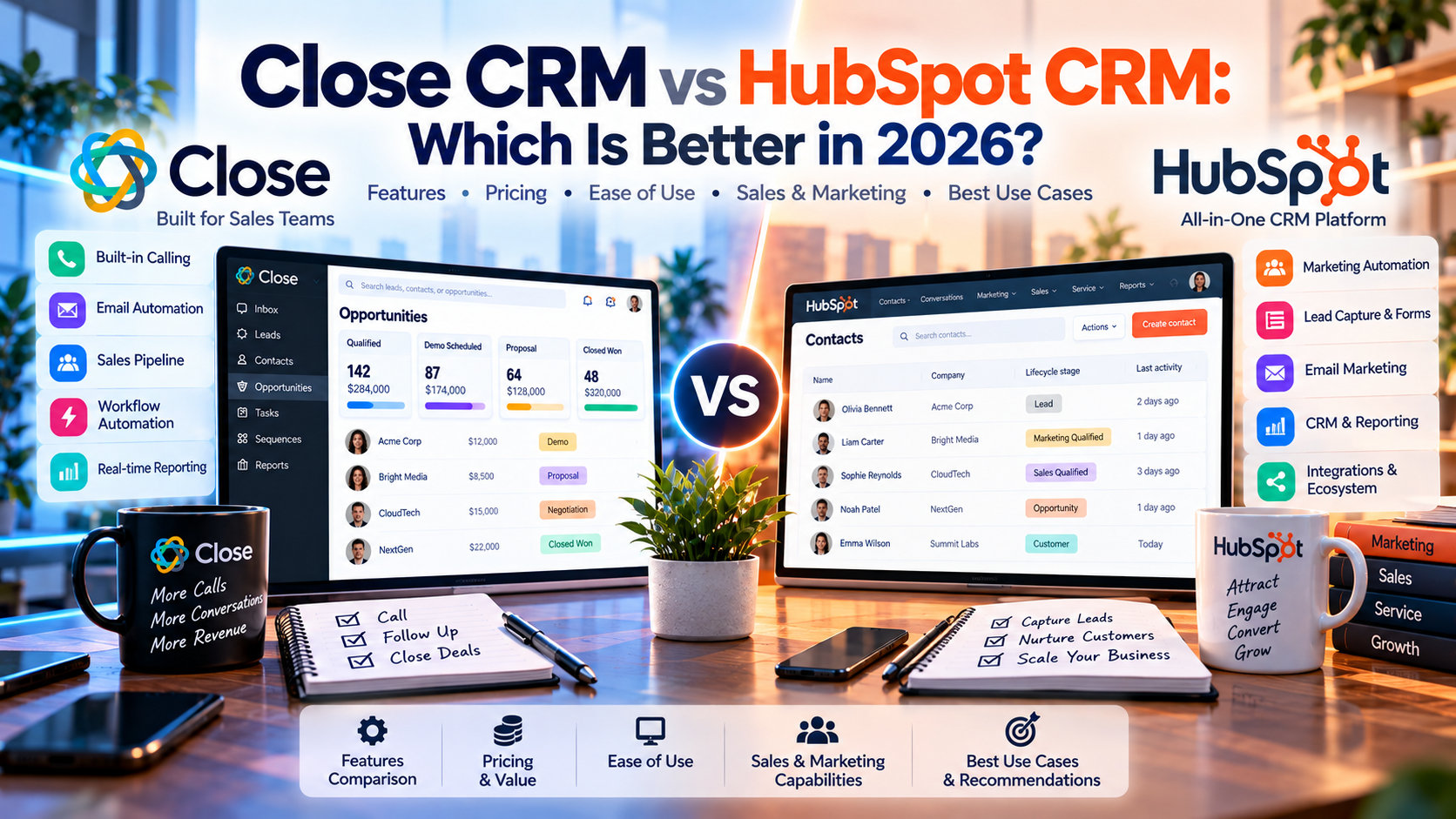
Choosing the right Customer Relationship Management (CRM) platform is one of the most important decisions for any growing business. A well-designed CRM helps sales teams manage leads, automate repetitive tasks, improve customer relationships, and increase revenue. Among the many options available, Close CRM and HubSpot CRM are two of the most popular platforms, but they serve different business needs.
Close CRM is designed primarily for sales-focused teams that rely on outbound prospecting and direct communication. HubSpot CRM, on the other hand, offers a broader ecosystem that combines sales, marketing, customer service, content management, and operations into a single platform.
This comparison examines the two CRMs across key areas—including features, pricing, ease of use, automation, AI capabilities, and scalability—to help you decide which solution is best for your business in 2026.
Overview
Close CRM
Close CRM is a cloud-based sales CRM built for startups, small businesses, and growing sales teams. It emphasizes productivity by integrating calling, email, SMS, workflow automation, and AI-powered tools into one platform.
Best for:
- Startups
- SaaS companies
- Sales agencies
- Outbound sales teams
- Small and medium-sized businesses
HubSpot CRM
HubSpot CRM is part of HubSpot's larger customer platform, which includes Marketing Hub, Sales Hub, Service Hub, CMS Hub, Commerce Hub, and Operations Hub.
It is designed for businesses that want to manage the entire customer lifecycle from lead generation to customer support.
Best for:
- Marketing teams
- Growing businesses
- Inbound sales organizations
- Customer service teams
- Medium to large businesses
Feature Comparison
| Feature | Close CRM | HubSpot CRM |
|---|---|---|
| Contact Management | ✅ Excellent | ✅ Excellent |
| Built-in Calling | ✅ Native | ✅ Available (plan dependent) |
| Email Tracking | ✅ Yes | ✅ Yes |
| SMS Messaging | ✅ Built-in | Limited via integrations |
| Sales Pipelines | ✅ Customizable | ✅ Highly customizable |
| Workflow Automation | ✅ Advanced | ✅ Advanced |
| AI Features | ✅ Call summaries, email assistance | ✅ AI assistant, content generation, forecasting |
| Marketing Tools | Basic | ⭐ Comprehensive |
| Customer Service Tools | Limited | ⭐ Extensive |
| Reporting | Excellent | Excellent |
| Third-Party Integrations | Extensive | Extensive |
Both platforms provide strong CRM functionality, but HubSpot offers a broader suite of business tools, while Close CRM focuses on maximizing sales productivity.
Ease of Use
One of Close CRM's biggest strengths is its simplicity.
The interface is clean, intuitive, and designed specifically for sales representatives. New users can typically learn the platform within a few hours.
HubSpot also offers an excellent user experience, but because it includes multiple hubs and advanced functionality, new users may face a steeper learning curve as they adopt additional tools.
Winner: Close CRM
Communication Tools
Communication is where Close CRM truly stands out.
It includes:
- Built-in cloud calling
- Email integration
- SMS messaging
- Automatic call logging
- Call recording
- Power Dialer
Everything is available directly inside the CRM.
HubSpot provides calling and email functionality, but some advanced communication capabilities depend on subscription level or additional configuration.
Winner: Close CRM
Automation and AI
Both platforms invest heavily in automation.
Close CRM offers:
- Email sequences
- Workflow automation
- AI call summaries
- AI meeting notes
- AI email assistance
- Lead enrichment
HubSpot provides:
- Workflow automation
- AI-powered content generation
- Predictive lead scoring
- Sales forecasting
- Marketing automation
- Customer service automation
Businesses focused only on sales may find Close CRM sufficient, while companies needing marketing automation and customer support will appreciate HubSpot's broader AI capabilities.
Winner: HubSpot CRM
Marketing Capabilities
This category heavily favors HubSpot.
HubSpot includes:
- Email marketing
- Landing pages
- Blog management
- SEO recommendations
- Marketing automation
- Social media scheduling
- Lead nurturing campaigns
Close CRM intentionally focuses on sales rather than digital marketing.
Winner: HubSpot CRM
Pricing
Close CRM offers straightforward pricing with plans designed around sales teams.
Businesses receive built-in communication features without purchasing multiple add-ons.
HubSpot CRM offers a free plan, making it attractive for small businesses. However, costs can increase significantly when companies add Sales Hub, Marketing Hub, Service Hub, or advanced enterprise features.
For businesses requiring multiple HubSpot products, pricing can become substantially higher.
Winner: Close CRM for sales value
Winner: HubSpot for free entry-level access
Scalability
Both platforms scale effectively.
Choose Close CRM if your business expects to grow its sales organization.
Choose HubSpot if your long-term strategy includes:
- Marketing
- Customer success
- Content management
- Service operations
HubSpot provides a complete customer platform that supports nearly every business department.
Pros and Cons
Close CRM
Pros
- Excellent built-in calling
- Integrated SMS messaging
- AI-powered sales tools
- Easy implementation
- Simple interface
- Strong automation for sales teams
Cons
- Limited marketing functionality
- No built-in CMS
- Smaller ecosystem than HubSpot
HubSpot CRM
Pros
- Free CRM available
- Comprehensive marketing tools
- Powerful automation
- Excellent reporting
- Large integration ecosystem
- Scales across multiple departments
Cons
- Advanced plans can become expensive
- More complex to configure
- Some features require premium subscriptions
Which CRM Should You Choose?
Choose Close CRM if you:
- Focus primarily on outbound sales
- Need built-in calling and SMS
- Want a simple CRM with fast implementation
- Operate a startup or SMB
- Prioritize sales productivity
Choose HubSpot CRM if you:
- Need both marketing and sales tools
- Want an all-in-one customer platform
- Produce content regularly
- Manage customer service inside the same ecosystem
- Plan to unify multiple business functions
Final Verdict
Close CRM and HubSpot CRM are both outstanding platforms, but they are built for different types of businesses.
Close CRM excels as a dedicated sales CRM. Its built-in calling, SMS messaging, workflow automation, and AI-powered productivity tools make it one of the best choices for startups, SaaS companies, sales agencies, and outbound sales teams. It delivers a streamlined experience that allows representatives to spend more time selling and less time switching between applications.
HubSpot CRM, meanwhile, is a broader business platform. It goes beyond sales by integrating marketing, customer service, content management, and operations into a single ecosystem. Organizations looking for an all-in-one solution will benefit from its extensive capabilities, although they should be prepared for higher costs as their needs expand.
Ultimately, the best choice depends on your business goals. If your primary objective is building a highly productive sales team, Close CRM is an excellent investment. If you want a complete platform to manage the entire customer journey—from attracting leads to supporting customers—HubSpot CRM remains one of the strongest options available in 2026.

Write Your Review
No reviews yet. Be the first to share your experience!