
Customer expectations have never been higher. People want their calls answered quickly, routed to the right department, and resolved without repeating their issue multiple times. Unfortunately, many traditional phone systems still rely on outdated call menus, manual transfers, and long wait times.
Poor call routing doesn't just frustrate customers—it also wastes employee time, increases operational costs, and can result in lost sales opportunities.
Quo addresses these challenges with Intelligent Call Routing, a cloud-based solution that uses automation and AI to direct every caller to the right destination. Whether your business has five employees or five hundred, Quo helps create efficient call flows that improve customer experience and team productivity.
In this guide, you'll learn how Quo Call Routing works, its key features, best practices, and how to build smarter call flows for your business.
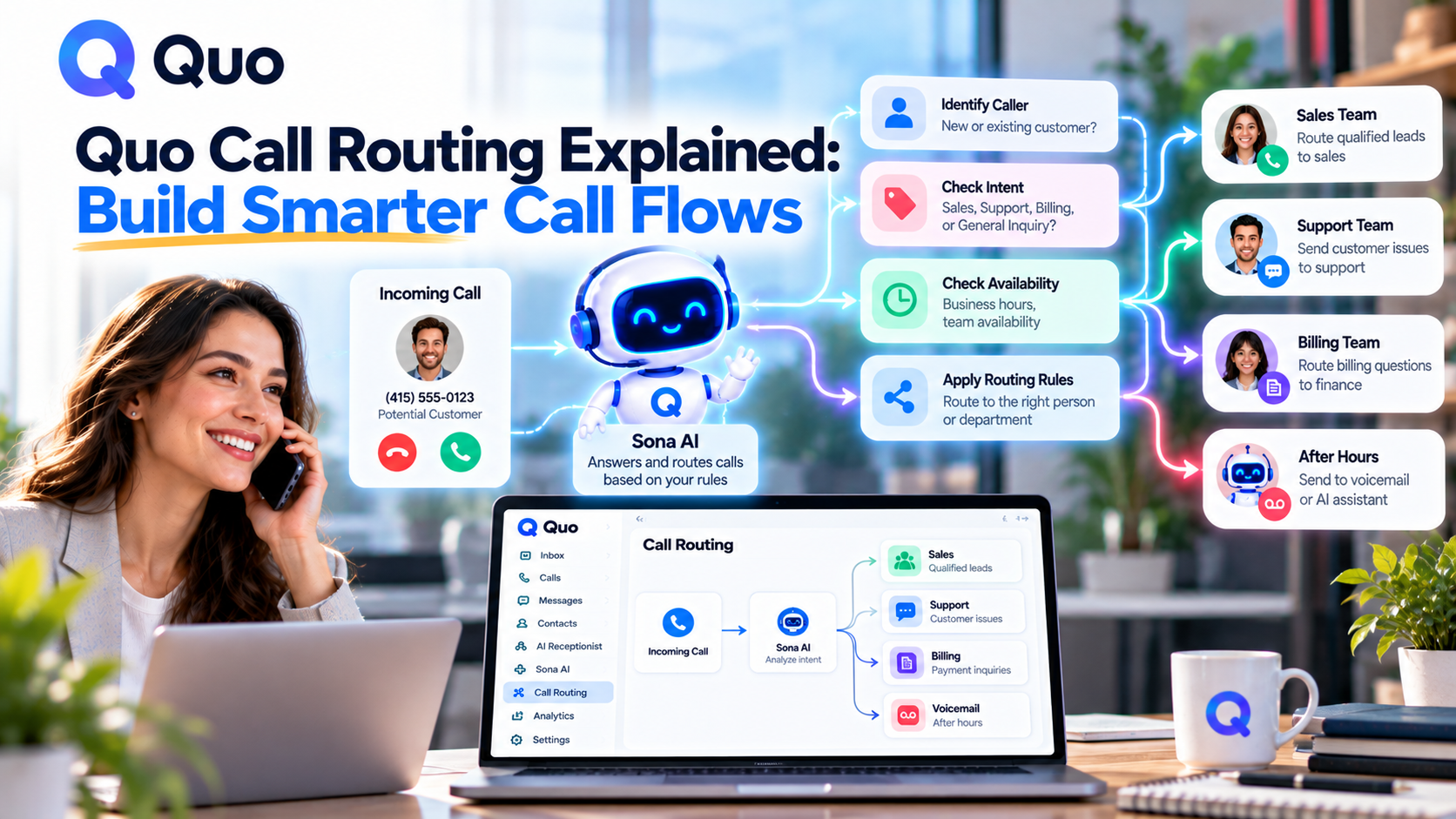
What Is Call Routing?
Call routing is the process of directing incoming phone calls to the most appropriate person, department, or destination based on predefined rules.
Instead of every call going to a single phone number, the system automatically decides where the call should go.
Common routing destinations include:
- Sales
- Customer Support
- Billing
- Technical Support
- Human Resources
- Individual employees
- Voicemail
- AI Voice Agent
Modern call routing reduces unnecessary transfers and helps customers reach the right person more quickly.
How Quo Call Routing Works
Quo combines cloud telephony with AI-powered automation to intelligently manage incoming calls.
A typical workflow looks like this:
- A customer calls your business number.
- Quo's AI Receptionist answers immediately.
- The system identifies the customer's request.
- Intelligent routing rules determine the best destination.
- The caller is connected to the appropriate employee or department.
- If no one is available, the AI collects information and schedules a callback.
This entire process takes only a few seconds while creating a smooth experience for the caller.
Key Features of Quo Call Routing
Intelligent Routing Rules
Businesses can create custom routing rules based on different conditions.
Examples include:
- Department selection
- Business hours
- Employee availability
- Customer type
- Call priority
- Geographic location
These rules ensure every caller reaches the most suitable destination.
AI Receptionist Integration
Quo's AI Receptionist works seamlessly with call routing.
Instead of forcing callers through complicated phone menus, the AI can simply ask:
“How can I help you today?”
Using natural language understanding, the AI identifies the customer's intent and routes the call accordingly.
This creates a much more conversational and user-friendly experience.
Business Hours Routing
Customer calls don't always arrive during office hours.
Quo allows businesses to configure different call flows based on schedules.
For example:
During Business Hours
- Route to Sales
- Route to Support
- Route to Reception
After Hours
- AI Receptionist answers
- Collect customer details
- Schedule callback
- Forward emergency calls if necessary
This ensures businesses remain responsive around the clock.
Ring Groups
Sometimes multiple employees should receive the same incoming call.
Quo's Ring Groups allow businesses to create teams such as:
- Sales Team
- Customer Success
- Technical Support
- Reception
- Service Dispatch
Calls ring multiple users simultaneously or in a predefined sequence, reducing wait times and improving answer rates.
Priority Routing
Not every caller has the same level of urgency.
Businesses can prioritize:
- VIP customers
- Existing clients
- Emergency requests
- High-value prospects
- Premium support customers
Priority routing ensures important calls receive immediate attention.
Voicemail and Callback Routing
If no employee is available, Quo automatically handles the situation.
The platform can:
- Record voicemail
- Collect caller information
- Generate AI summaries
- Notify employees
- Schedule callbacks
Instead of losing potential customers, businesses maintain continuity.
Benefits of Intelligent Call Routing
Faster Customer Service
Customers reach the correct department without unnecessary transfers.
Fewer Missed Calls
AI Receptionist and automated routing ensure every inquiry is handled.
Better Employee Productivity
Employees receive only the calls relevant to their responsibilities.
Improved Customer Satisfaction
Shorter wait times and fewer transfers create a more professional experience.
Higher Lead Conversion
Potential customers connect with the sales team more quickly, increasing the likelihood of conversion.
Example Call Flows
Example 1: Small Business
Incoming Call
↓
AI Receptionist
↓
Sales Inquiry → Sales Representative
↓
Support Request → Customer Support
↓
Billing Question → Office Manager
↓
After Hours → AI Callback Collection
Example 2: Law Firm
Incoming Client Call
↓
AI Receptionist
↓
New Client → Intake Team
↓
Existing Client → Assigned Attorney
↓
Billing → Accounting
↓
Emergency Legal Matter → On-Call Attorney
Example 3: Healthcare Clinic
Patient Call
↓
AI Receptionist
↓
Appointment Booking
↓
Prescription Questions
↓
Billing Department
↓
Emergency Instructions
↓
Voicemail or Callback Scheduling
Best Practices for Building Smarter Call Flows
To maximize efficiency, consider the following recommendations:
Keep Routing Simple
Avoid creating long or confusing call trees.
Use Natural Language
Allow customers to explain their needs instead of navigating complex phone menus.
Prioritize Important Calls
Identify VIP customers, urgent service requests, or high-value leads and route them appropriately.
Review Call Analytics
Monitor routing performance regularly to identify bottlenecks and improve workflows.
Combine AI and Human Support
Allow AI to handle routine conversations while employees focus on complex customer needs.
Integrate with Your CRM
Connecting Quo with platforms like HubSpot or Salesforce provides additional customer context before calls are answered.
Industries That Benefit Most
Quo Call Routing is valuable for businesses of all sizes, particularly:
- Small Businesses
- SaaS Companies
- Marketing Agencies
- Law Firms
- Healthcare Providers
- Real Estate Agencies
- Home Service Companies
- Customer Support Teams
- Sales Organizations
Any organization receiving regular customer calls can improve efficiency with intelligent routing.
Traditional Call Routing vs Quo Call Routing
| Feature | Traditional Phone System | Quo |
|---|---|---|
| AI-powered routing | ❌ | ✅ |
| Natural language understanding | ❌ | ✅ |
| Business hours automation | Limited | ✅ |
| Ring groups | Basic | ✅ |
| Priority routing | Limited | ✅ |
| AI Receptionist | ❌ | ✅ |
| Callback automation | Limited | ✅ |
| CRM integration | Limited | ✅ |
Quo replaces static call trees with intelligent, automated workflows that improve both customer and employee experiences.
Final Thoughts
Efficient call routing is no longer just about connecting callers to extensions. Today's businesses need systems that understand customer intent, automate repetitive tasks, and ensure every inquiry reaches the right person quickly.
Quo's Intelligent Call Routing combines AI Receptionist, cloud telephony, automation, and customizable workflows to create a smarter customer communication experience.
Whether you're a startup handling dozens of calls per week or an enterprise managing thousands of customer interactions, well-designed call flows can reduce wait times, improve productivity, and increase customer satisfaction.
As part of Quo's AI-powered communication platform, Intelligent Call Routing is a powerful feature that helps businesses deliver faster, more organized, and more professional service.

Write Your Review
No reviews yet. Be the first to share your experience!