
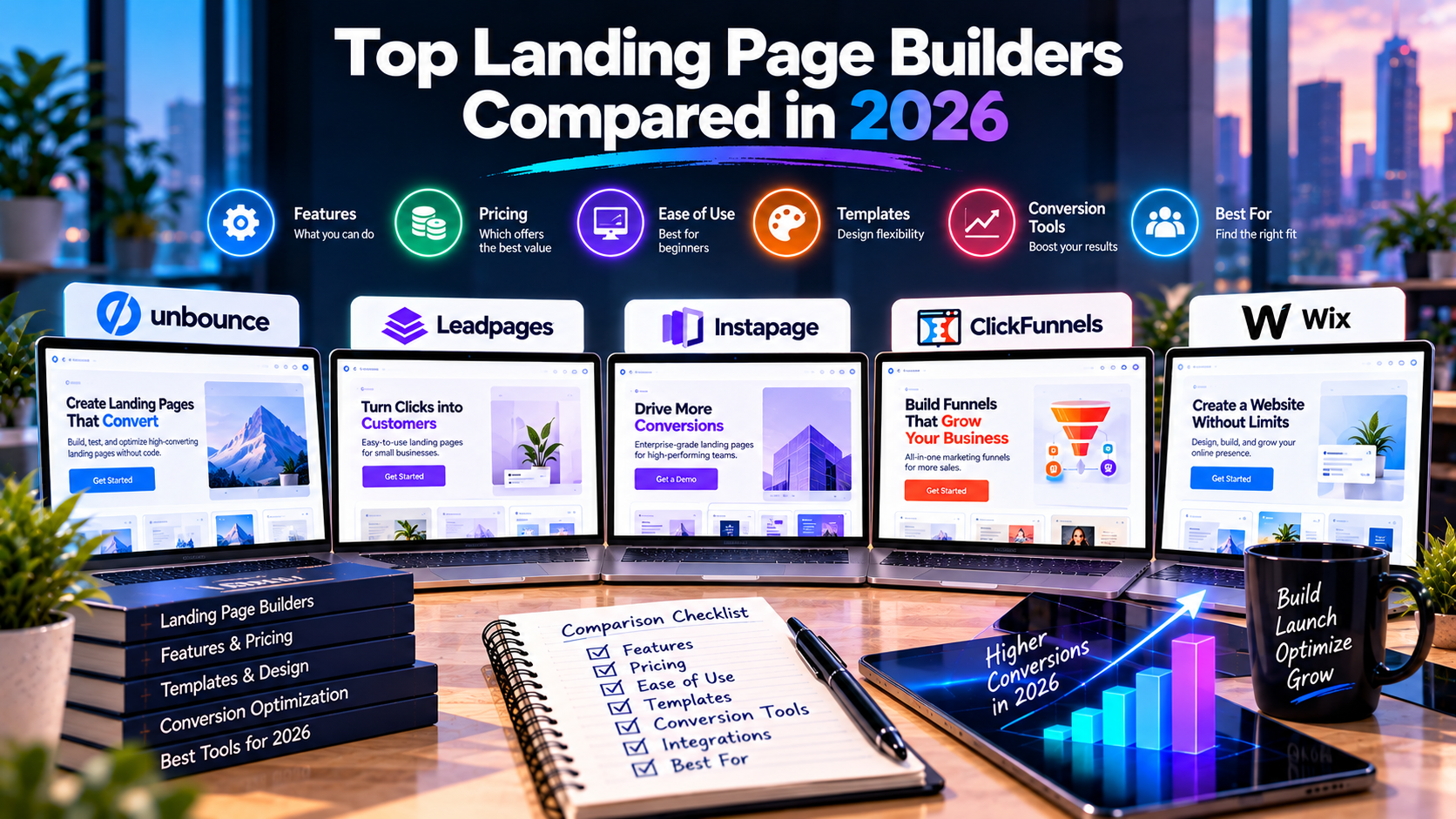
Landing pages play a crucial role in digital marketing, especially for businesses investing in paid advertising and lead generation. The right landing page builder can improve conversion rates, reduce customer acquisition costs, and maximize return on advertising spend (ROAS).
Among the leading platforms in this category, Unbounce and Instapage are frequently compared. Both platforms are designed for marketers and offer advanced landing page creation tools, but they target slightly different audiences and prioritize different capabilities.
This comparison examines their features, ease of use, AI capabilities, collaboration tools, integrations, pricing, and ideal use cases to help you determine which platform best meets your marketing needs.
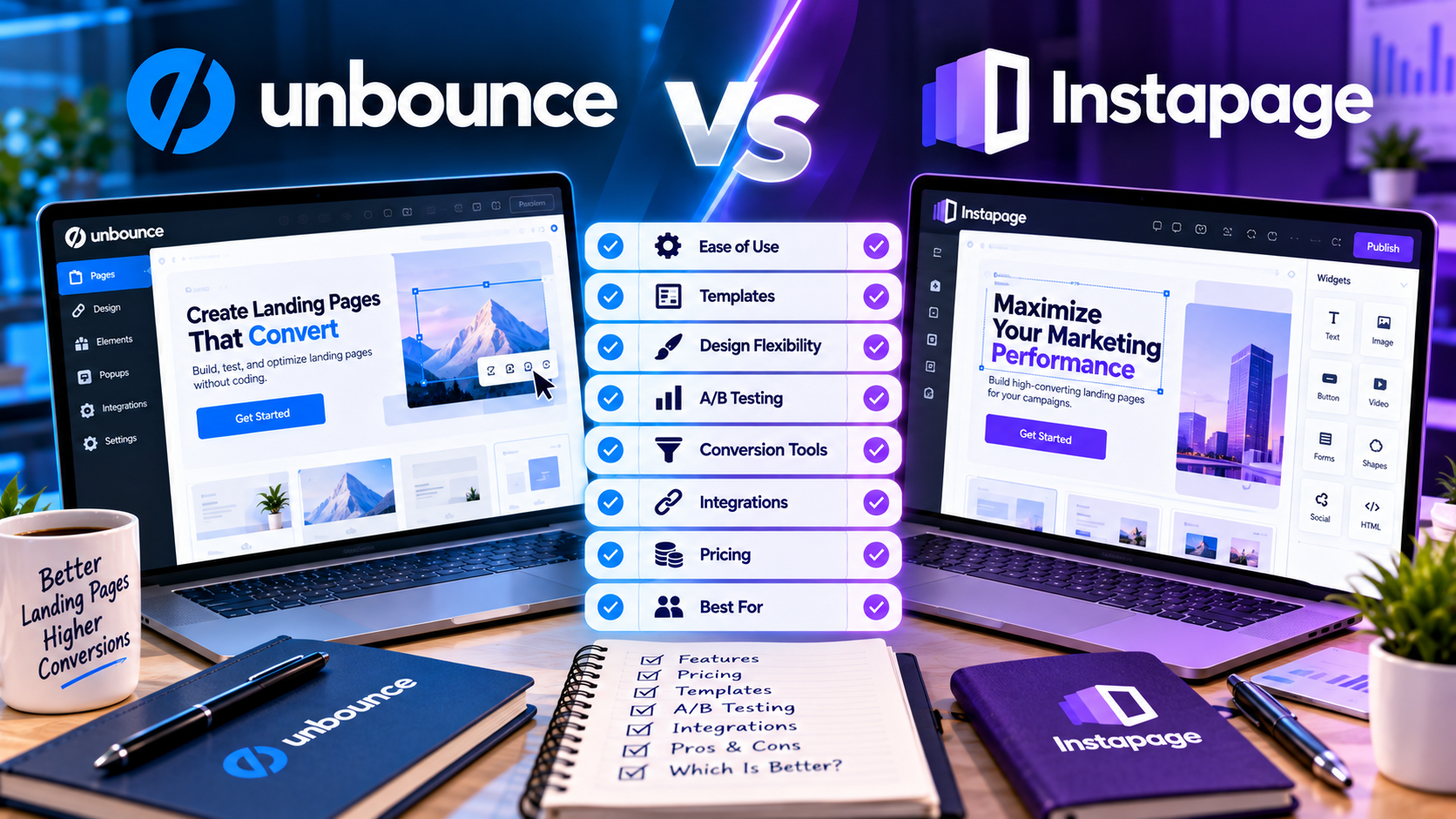
Unbounce Overview
Unbounce is a conversion optimization platform built for marketers who want to create, test, and improve landing pages without writing code.
Its core strengths include:
- Drag-and-drop landing page builder
- AI-powered Smart Traffic
- Dynamic Text Replacement
- Built-in A/B testing
- Popups and Sticky Bars
- Extensive CRM integrations
- Conversion-focused templates
Unbounce is particularly popular among SaaS companies, ecommerce brands, marketing agencies, and businesses running Google Ads campaigns.
Instapage Overview
Instapage is an enterprise-focused landing page platform designed to support large marketing teams and organizations managing high-volume advertising campaigns.
Its primary features include:
- Pixel-perfect landing page builder
- Ad-to-page personalization
- A/B testing
- Collaboration and commenting tools
- Instablocks (reusable page sections)
- Heatmaps
- Advanced analytics
- Enterprise-level integrations
Instapage is widely used by agencies and enterprise marketing teams that require collaboration, workflow management, and scalable campaign deployment.
Feature Comparison
| Feature | Unbounce | Instapage |
|---|---|---|
| Drag-and-Drop Builder | ✅ | ✅ |
| Pixel-Level Design Control | ✅ | ✅ |
| AI Smart Traffic | ✅ | ❌ |
| Dynamic Text Replacement | ✅ | Limited Personalization |
| Built-in A/B Testing | ✅ | ✅ |
| Heatmaps | ❌ | ✅ |
| Popups & Sticky Bars | ✅ | ❌ |
| Instablocks | ❌ | ✅ |
| Collaboration Tools | Basic | Advanced |
| CRM Integrations | Extensive | Extensive |
| Mobile Responsive Pages | ✅ | ✅ |
Both platforms are powerful, but they focus on different priorities.
Ease of Use
Both Unbounce and Instapage provide intuitive visual editors that eliminate the need for coding.
Unbounce
Designed for marketers who want to launch campaigns quickly while optimizing conversions.
The interface is clean and includes built-in optimization tools that simplify campaign management.
Instapage
Offers a polished editing experience with additional collaboration features designed for larger teams.
Marketing departments working across multiple stakeholders may benefit from its review and commenting system.
Winner: Tie
Landing Page Design Flexibility
Both platforms provide excellent design freedom.
Unbounce
Allows marketers to create highly customized landing pages using a drag-and-drop editor.
Users can easily adjust layouts, forms, images, videos, and CTA buttons without technical knowledge.
Instapage
Offers pixel-perfect editing with precise positioning, making it especially attractive for design-focused teams.
Its reusable Instablocks feature also speeds up page creation across multiple campaigns.
Winner: Instapage (slightly)
AI and Conversion Optimization
This category strongly favors Unbounce.
Smart Traffic
Unbounce uses artificial intelligence to automatically send visitors to the page variation most likely to convert.
Unlike traditional A/B testing, Smart Traffic continuously learns from visitor behavior and improves routing automatically.
Dynamic Text Replacement
This feature automatically updates landing page headlines based on Google Ads keywords, creating better message match and improving Quality Score.
Instapage offers personalization options but does not provide an equivalent AI-driven Smart Traffic system.
Winner: Unbounce
A/B Testing
Testing is essential for improving landing page performance.
Both platforms allow marketers to compare multiple landing page versions by testing:
- Headlines
- CTA buttons
- Images
- Forms
- Layouts
- Pricing sections
Both platforms perform well in this category.
Winner: Tie
Collaboration Features
This is one of Instapage's biggest strengths.
Marketing teams can:
- Leave comments directly on pages
- Approve designs
- Track revisions
- Collaborate with clients
- Manage enterprise workflows
These features reduce communication delays during campaign development.
Unbounce includes collaboration capabilities but focuses more on campaign optimization than team workflows.
Winner: Instapage
Analytics and Reporting
Understanding visitor behavior is critical for optimization.
Unbounce
Provides conversion tracking and integrates with:
- Google Analytics
- Google Ads
- HubSpot
- Salesforce
- Zapier
Instapage
Offers built-in heatmaps that show:
- Click behavior
- Scroll depth
- Mouse movement
Heatmaps provide valuable visual insights into user engagement.
Winner: Instapage
Integrations
Both platforms integrate with many popular marketing tools.
Supported platforms include:
- HubSpot
- Salesforce
- Mailchimp
- Marketo
- ActiveCampaign
- Zapier
- Google Analytics
Most businesses will find sufficient integration options regardless of which platform they choose.
Winner: Tie
Pricing Comparison
Pricing varies over time, but generally:
Unbounce
- Mid-to-premium pricing
- Multiple plans for growing businesses
- Excellent value for marketers focused on conversion optimization
Instapage
- Higher pricing
- Enterprise-oriented plans
- Designed for larger organizations with substantial advertising budgets
Businesses should always check the latest pricing before making a decision.
Winner: Unbounce (better overall value)
Pros and Cons
Unbounce
Pros
- AI-powered Smart Traffic
- Dynamic Text Replacement
- Built-in A/B testing
- Popups and Sticky Bars
- Strong Google Ads optimization
- Flexible page builder
- Excellent value
Cons
- No built-in heatmaps
- Collaboration tools are less advanced
- Enterprise workflow features are limited
Instapage
Pros
- Beautiful page builder
- Heatmaps
- Instablocks
- Excellent collaboration tools
- Enterprise workflow support
- Advanced personalization
Cons
- Higher pricing
- Fewer AI optimization features
- Better suited for large organizations than small businesses
Who Should Choose Unbounce?
Unbounce is ideal for:
- SaaS companies
- Marketing agencies
- Ecommerce businesses
- PPC specialists
- B2B lead generation teams
- Small and medium-sized businesses
- Companies focused on maximizing conversion rates
If your goal is improving conversions through AI-powered optimization, Unbounce is an excellent choice.
Who Should Choose Instapage?
Instapage is best suited for:
- Enterprise marketing teams
- Large advertising agencies
- Global organizations
- Design-focused teams
- Businesses managing hundreds of landing pages
- Companies requiring advanced collaboration workflows
Its enterprise features make it particularly attractive for organizations with multiple stakeholders.
Which Platform Performs Better for Google Ads?
For advertisers focused on Google Ads, Unbounce has several important advantages.
Features such as:
- Dynamic Text Replacement
- Smart Traffic
- Fast landing page creation
- Conversion-focused templates
help improve message match, user experience, and campaign performance.
Instapage also supports PPC campaigns but emphasizes collaboration and design workflows rather than AI-driven optimization.
Winner: Unbounce
Final Verdict
Both Unbounce and Instapage rank among the best landing page builders available today, but they target different types of businesses.
Instapage excels in enterprise collaboration, visual design, reusable page components, and analytics with built-in heatmaps. It is an excellent solution for large organizations managing complex advertising operations with multiple team members.
Unbounce, however, delivers exceptional value for marketers focused on improving conversion rates. Its AI-powered Smart Traffic, Dynamic Text Replacement, built-in A/B testing, Popups, Sticky Bars, and flexible landing page builder make it one of the strongest platforms for lead generation and PPC optimization.
If you're a growing business, SaaS company, ecommerce brand, or marketing agency looking to maximize conversions without paying enterprise-level prices, Unbounce is likely the better investment. If your organization requires advanced collaboration, enterprise workflows, and visual optimization tools for large-scale campaigns, Instapage may be the better fit.
Ultimately, both platforms are excellent, but the right choice depends on your marketing objectives, team size, workflow requirements, and budget.

Write Your Review
No reviews yet. Be the first to share your experience!