
Artificial intelligence has transformed the way sales teams create cold emails. Instead of spending hours writing messages from scratch, professionals can now use AI tools like lemlist AI and ChatGPT to generate persuasive, personalized emails in seconds.
However, the quality of AI-generated content depends heavily on the quality of the prompt. A vague prompt often produces generic results, while a well-structured prompt generates highly relevant, conversion-focused sales emails.
In this guide, you'll learn proven AI prompt strategies that help create high-converting sales emails, improve personalization, and increase reply rates.
Why Prompt Quality Matters
AI follows instructions. The more context and direction you provide, the better the output.
A strong prompt should tell the AI:
- Who the prospect is
- What problem they face
- What your solution offers
- The desired tone of voice
- The goal of the email
- The preferred length
Providing these details helps AI generate emails that sound natural and relevant rather than generic.
The Five-Part Prompt Framework
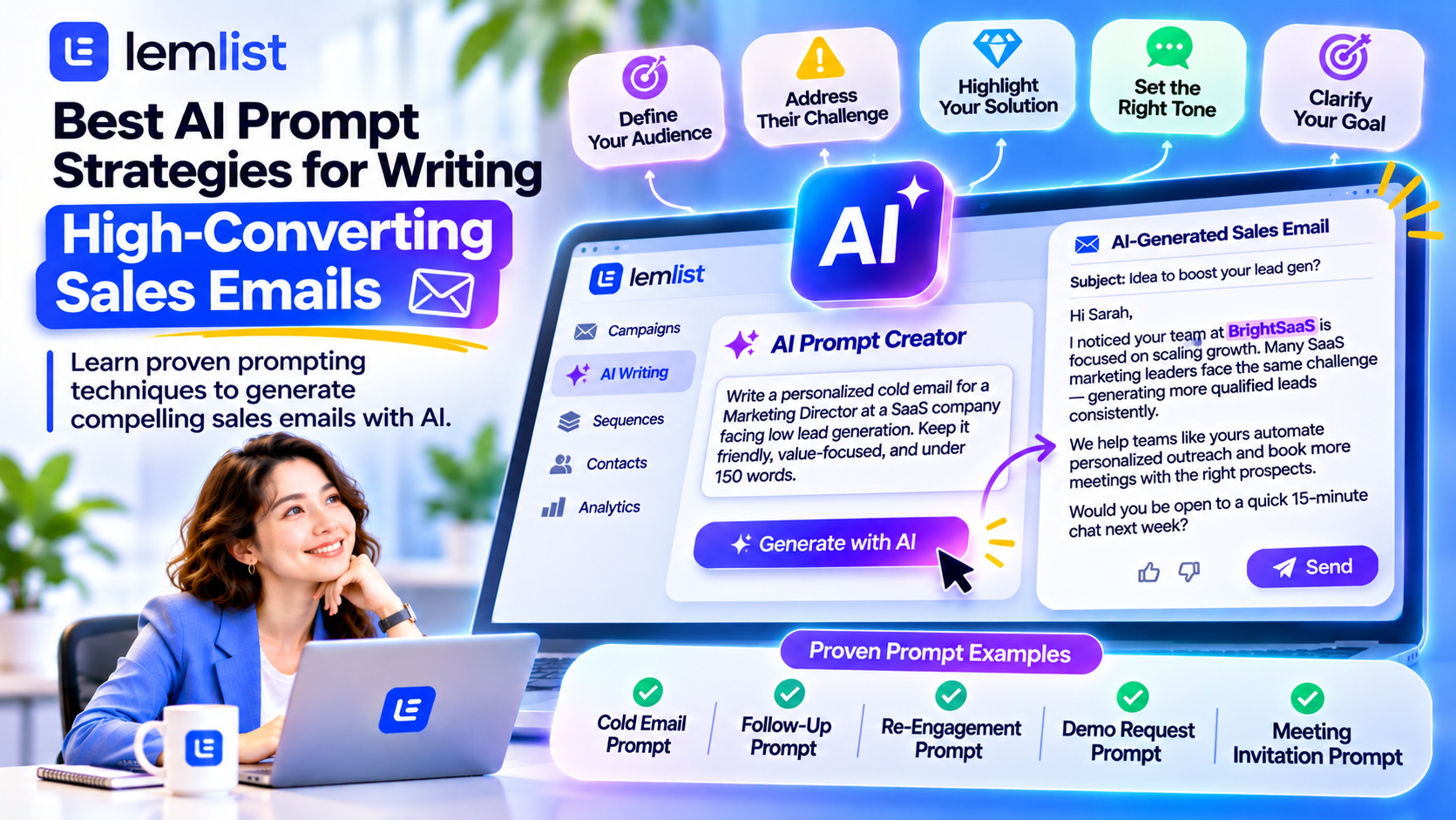
One effective structure for writing AI prompts includes five essential components.
1. Define Your Audience
Clearly describe your ideal prospect.
Example:
“Write an email for a Sales Director at a B2B SaaS company with 100–500 employees.”
Specific audience details allow AI to tailor the messaging more effectively.
2. Explain the Business Challenge
Tell the AI what problem the prospect is trying to solve.
Examples include:
- Low outbound conversion rates
- Poor email deliverability
- Manual prospecting
- Limited sales productivity
- Inconsistent lead generation
Problem-focused emails resonate more strongly than product-focused messages.
3. Describe Your Solution
Briefly explain your product or service.
For example:
“Our AI sales engagement platform helps automate personalized cold outreach, improve reply rates, and book more qualified meetings.”
This gives AI enough context to create a compelling value proposition.
4. Specify the Tone
Tell AI how the email should sound.
Examples include:
- Professional
- Friendly
- Consultative
- Conversational
- Executive-level
- Confident but not aggressive
Matching the tone to your audience improves authenticity.
5. Define the Desired Outcome
Finish your prompt by explaining the objective.
Examples:
- Book a 15-minute discovery call
- Generate a reply
- Schedule a product demo
- Introduce the company
- Reconnect with an inactive prospect
A clear goal helps AI write focused and actionable emails.
Example AI Prompt
Here's an example prompt you can adapt for your own campaigns:
Write a personalized cold email for a VP of Sales at a growing SaaS company. The company is expanding internationally and likely needs a more efficient outbound sales process. Introduce an AI-powered sales engagement platform that improves personalization and automates multichannel outreach. Use a friendly, professional tone, keep the email under 150 words, and end with a simple call-to-action asking if they're open to a brief conversation next week.
This prompt provides the AI with enough context to generate an email that feels relevant and tailored.
Best Practices for AI Prompting
To get better results:
- Provide detailed context.
- Mention your target audience.
- Focus on customer problems.
- Specify the desired tone.
- Limit the email length.
- Ask for one clear call-to-action.
- Request multiple variations for A/B testing.
The more guidance you provide, the better the AI performs.
Common Prompt Mistakes
Avoid these common errors:
- Writing prompts that are too short.
- Providing no audience information.
- Focusing only on product features.
- Asking AI to write overly long emails.
- Using multiple objectives in one email.
- Forgetting to review AI-generated content before sending.
Even the best AI benefits from thoughtful human editing.
Combining AI with Human Expertise
AI is an excellent writing assistant, but it should support—not replace—your sales expertise.
Review every email to ensure:
- The personalization is accurate.
- The tone matches your brand.
- The value proposition is clear.
- The call-to-action feels natural.
Adding your own insights can make AI-generated emails even more effective.
Final Thoughts
Writing high-converting sales emails starts with writing high-quality prompts. By giving AI clear instructions about your audience, their challenges, your solution, and the desired outcome, you can consistently generate personalized emails that engage prospects and encourage replies.
Whether you're using lemlist AI, ChatGPT, or another AI writing assistant, effective prompt engineering is a valuable skill that can improve outreach efficiency and campaign performance. As AI continues to evolve, mastering prompt strategies will become an increasingly important advantage for modern sales professionals.


Write Your Review
No reviews yet. Be the first to share your experience!